
Podcast Episode: Living by God’s Instructions: A Faith Journey

Podcast Episode: Living by God’s Instructions: A Faith Journey

Pip: There is a particular kind of morning ritual that starts with Scripture and ends with a question you cannot easily shake — and cj has been living inside one of those.

Mara: This episode follows a single extended meditation on what it actually means to live by God’s instructions — the tension between hearing and doing, between belief and action, and what Ezekiel and James have to say about where loyalty really lies.

Pip: Let’s get into the faith journey itself.

Living by God’s Instructions: A Faith Journey

Mara: The question at the center of this post is whether faith is something you hold or something you do — and whether the two can come apart without consequence.

Pip: The post opens with a daily recitation cj has built into morning Scripture reading, and the passage from Ezekiel 33 that it unlocked: “Turn! Turn from your evil ways! For why should you die, O house of Israel?”

Mara: That imperative is the hinge. Ezekiel’s point, and the post’s point, is that past righteousness does not bank credit against future sin — and past wickedness does not foreclose future restoration. The ledger resets on the direction you are currently moving.

Pip: Which is either deeply liberating or deeply unsettling, depending on which direction you thought you had locked in.

Mara: The post is careful to distinguish obedience from performance. The framing is direct: “Obedience isn’t works, it’s covenant.” Forgiveness is a promise, but it is tied to the orientation of the heart, not the accumulation of good deeds done while continuing to do as you please.

Mara: James gets quoted at length on exactly this point — the mirror illustration, where a hearer of the word walks away and forgets his own face. The post identifies the “perfect law of liberty” James names as Torah, God’s instruction in righteousness, and cites Strong’s definition of liberty as freedom from corrupt desires so that the soul acts freely in alignment with God’s will.

Pip: So liberty, in this reading, is not freedom from the law — it is freedom through it.

Mara: The post also draws on Acts 15, where the Jerusalem council’s guidance to gentile believers is framed as a beginning, not a ceiling — a first set of steps into a process of ongoing instruction read every Sabbath. Faith here is explicitly described as progressive, growing, active.

Pip: The closing question lands without softening: how are you seeking, how are you growing — because faith, the post says, is not stagnant, not passive, and not finished.


Mara: The through-line is that hearing and doing are not the same thing, and the gap between them is where the real work of faith lives.

Pip: The kind of work that apparently starts before breakfast, with a statement that challenges you before the day has a chance to.

Mara: Read the post in its entirety: Living by God’s Instructions: A Faith Journey at thewayoftherabbi.com
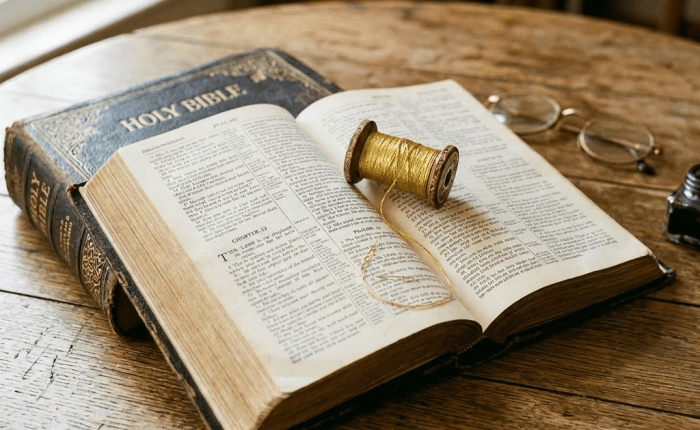

Podcast Episode: The One Story: God’s Covenant and Instructions

Podcast Episode: The One Story: God’s Covenant and Instructions

Pip: One book, not two — and apparently that page between Malachi and Matthew has a lot to answer for.

Mara: cj’s recent writing on The Way of the Rabbi goes deep into what holds scripture together as a single story, and what that means for how we live inside it. Let’s start with the covenant itself — and what the text actually says about sin, Torah, and obedience.

The One Story: God’s Covenant and Instructions

Pip: The central claim here is that the Bible was never meant to be read in two halves — and that the dividing line most readers take for granted has quietly done real damage to how people understand who they are and what they’re called to do.

Mara: The post frames the whole of scripture this way: “It should be read as if it was written to you and your family from your dad. Because, every word of it, was inspired by your Heavenly Father.”

Pip: That reframe matters practically. If it’s a letter from a father, you don’t skip chapters or treat half of it as superseded fine print. The whole thing carries weight, and you read it looking for coherence, not contradiction.

Mara: And the coherence the post argues for runs straight through the question of sin. John’s definition from 1 John 3:4 is quoted directly: “Everyone who makes a practice of sinning also practices lawlessness; sin is lawlessness.” The post is careful to note that the word translated as law is better rendered Torah — instruction.

Pip: So lawlessness isn’t just moral chaos in the abstract. It’s specifically being without God’s instruction — which reframes repentance too.

Mara: Exactly. Repentance, the post argues, has always meant returning to the Father’s ways. Not a one-time transaction, but an ongoing orientation. Romans 6 gets quoted at length on this point — the logic that dying to sin means you can no longer live in it.

Pip: There’s a pointed moment where the Pharisees come up — not as rule-obsessives, but as people who added to and subtracted from Torah while performing compliance. That’s the irony the post lands on: the accusation of legalism often comes from people who also claim you should obey God.

Mara: The post closes with a direct question to the reader — what exactly are you practicing? It’s less a rhetorical flourish and more a genuine diagnostic. The instruction, the covenant, the door — all one continuous thing.


Pip: One story, one covenant, one set of questions you actually have to answer for yourself.

Mara: The kind of reading that doesn’t let you stay comfortable at the page break. More of that territory next time.

Read the whole post here: The One Story: God’s Covenant and Instructions

Podcast Episode: Peter’s Three Little Pigs

Podcast Episode: Peter’s Three Little Pigs

Pip: Peter had a vision involving a sheet full of animals, and somehow it became the most consequential real-estate dispute between clean and unclean in all of scripture.

Mara: Today we’re looking at a piece from cj that works through Acts 10 — Peter’s rooftop vision, what it actually meant, and what Israel had quietly forgotten about its own calling to the nations.

Pip: Let’s start with the vision, the pigs, and what Peter finally understood.

Peter’s Vision and the Nations

Mara: The post opens with a question that Acts 10 has been answering for centuries: what does it mean for something — or someone — to be called unclean, and who gets to decide?

Pip: And the anchor is Peter’s own words, once the vision lands. The setup is Acts 10:28-29, where Peter explains himself to Cornelius’s household: “You yourselves know how unlawful it is for a man who is a Jew to associate with a foreigner or to visit him; and yet God has shown me that I should not call any man unholy or unclean. That is why I came without even raising any objection when I was sent for.”

Mara: So the vision was never about dietary law. The sheet full of animals was a teaching tool — the real subject was the Gentiles standing at Peter’s door.

Pip: The post takes care to show how Israel arrived at this moment. The Torah was clear about welcoming the stranger — Leviticus 19:34 says to treat the foreigner as a native and love him as yourself. Exodus 12:49 and Numbers 15:16 both establish one law for native and stranger alike.

Mara: But somewhere between Sinai and the first century, a protective instinct calcified into total separation. Contact with Gentiles became a purity issue requiring Temple sacrifice and ritual cleansing. That’s the tradition Peter is carrying when the vision hits.

Pip: Which is why the Spirit’s staging is so deliberate — three times the sheet descends, three times Peter refuses, and then three Gentile men knock on the door. The number isn’t coincidence; it’s the lesson repeating until it sticks.

Mara: The post traces the original purpose back to Exodus 19:5-6, where Israel is called “a kingdom of priests” — priests exist to mediate between God and others, not to wall themselves off. Isaiah 42:6 and 49:6 frame the Messiah as the fulfillment of that priestly, outward-facing calling.

Pip: So Yahoshua isn’t dismantling Israel’s structure — he’s restoring what Israel was always supposed to be doing.

Mara: Peter’s conclusion in Acts 10:34-35 makes it explicit: “I most certainly understand now that God is not one to show partiality, but in every nation the man who fears Him and does what is right is welcome to Him.” The apostles in Jerusalem respond: God has granted the Gentiles “the repentance that leads to life.”

Pip: A kingdom of priests that forgot it had a congregation — and needed a rooftop vision to remember.

Mara: The post is careful to note what the vision does not revise. The animals on that sheet were still unclean as food — the point was the people at the door, not the menu.

Pip: Isaiah 66:17 gets cited as a prophetic bookend: judgment still falls on those who eat swine’s flesh. The dietary instructions, the post argues, were not the thing being cleansed.

Mara: What shifts is the wall between peoples. What stays is the Torah’s instruction — and the post frames both as consistent expressions of the same God calling humanity back to His ways.


Pip: One vision, one sheet, one centurion — and the whole architecture of who belongs gets reexamined.

Mara: The thread from Sinai to Acts to Isaiah 66 is longer than it looks. There’s more to follow here.

Read the full post here: Peter’s Three Little Pigs