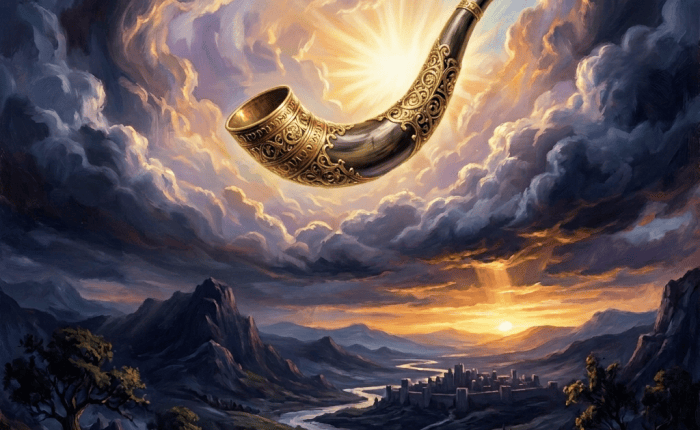
Today on the modern Jewish calendar marks, Rosh Hashanah. The Jewish new year. They have incorporated it into Yom Teruah, the Feast of Trumpets. It is the only Biblical Feast that does not have a known day or hour as it is marked by the sighting of the first sliver of the moon or the waxing crescent. Teruah, in Hebrew means to cry-out, Shout loudly, and sound the trumpet. It is a call to attention! The fall Feast days have arrived and it begins with a call to attention, and a focus on repentance until the day of atonement, Yom Kippur, now 10 days away. Modern Judaism has removed the waiting and marked a generally close proximity start to Rosh Hashanah.
Rosh Hashanah, or Head of the Year. They call it the new year even though quite clearly the Torah calls this Feast Yom Teruah, and places it in the seventh month. Pesach, or Passover, is in Nisan which is the first month of the year according to Torah. They still use it to call in a time of reflection to begin the (spiritual) new year with repentance but obedience is found in the little things. And it is easy, if one isn’t paying attention to lose sight of the little things and thereby missing the entire thing altogether.
In my daily reading of Scripture I am in 1 Samuel. In chapter eight verses six through nine the people ask for a king and Elohim responds to their request by telling Samuel, “But when they said, ‘Give us a king to judge us,’ their demand was displeasing in the sight of Samuel; so he prayed to YHWH. And YHWH said to Samuel, “Listen to the voice of the people in all that they say to you. For it is not you they have rejected, but they have rejected Me as their King. Just as they have done from the day I brought them up out of Egypt until this day, forsaking Me and serving other gods, so they are doing to you. Now listen to their voice; but you must solemnly warn them and show them the manner of the king who will reign over them.”
When I began waking up to Torah and to Faith in Yahoshua as well as obedience to the commandments of Elohim. As Revelation 14:12 says: “Here is a call for the endurance of the saints, those who keep the commandments of God and their faith in Yahoshua (Jesus).” I started by reading and reading and reading the Torah. What is the history being told. When you understand its history and the arch of faith the people of Israel were on you can better understand that the modern church is essentially on this same arch. We have brushed aside the commands of God for the traditions of men. We have demanded our own way and by so doing have rejected God, the one who has brought us out of spiritual bondage.
And even still we are unhappy. Look at the rest of the lesson found in 1 Samuel. Just a few chapters later, ten verse twenty-seven we read: “But some worthless men said, ‘How can this man save us?’ So they despised him and brought him no gifts; but Saul remained silent about it.” God gave them the king they demanded and still they were not happy. Are we not often of the same mind. We pray and pray for answers, and when the answer is given we are still unhappy with the answer.
God has told us in His Word when the Feasts are and what they are meant to accomplish. Yet, modern Judaism has changed their meanings and essentially the timing. The modern church has thrown them out entirely for man made traditions of Christmas, the celebration of Jesus’ birth and coming to dwell with us. Which is the very celebration of the Feast of Booths or Feast of Tabernacles, the last of the Fall Feasts. They have chosen Easter over Passover discarding the very meal they claim to take in remembrance of Him.
Both of these are marks of a rebellious spirit of which we are warned of in Scripture multiple times. Daniel 7:25 says; “He will speak out against the Most High and oppress the saints of the Most High, intending to change the appointed times and laws; and the saints will be given into his hand for a time, and times, and half a time.” ‘He’ who Daniel is referring to is the lawless one, the Anti-Messiah or Anti-Christ. The coming of the lawless one, as we read in 2 Thessalonians 2:9-12 is marked by, well lawlessness, which is to say without Torah.
“The coming of the lawless one will be accompanied by the working of Satan, with every kind of power, sign, and false wonder, and with every wicked deception directed against those who are perishing, because they refused the love of the truth that would have saved them. For this reason God will send them a powerful delusion so that they believe the lie, in order that judgment may come upon all who have disbelieved the truth and delighted in wickedness.” What is the TRUTH, God’s Word is Truth. John 17:17 – “Set them apart for holiness by means of the truth – Your Word is TRUTH.” These are the words Yahoshua prayed before being hung on a tree. And wickedness which they delight are the very acts committed outside of Torah.
Here is the stated instruction for the Feast of Trumpets or Yom Teruah in Leviticus 23:23-25 – “YHWH Adonai also said to Moses, “Speak to the Israelites and say, ‘On the first day of the seventh month you are to have a day of rest, a sacred assembly announced by trumpet blasts. You must not do any regular work, but you are to present a food offering to YHWH.’” Later in Numbers 29:1-6 we read:
“On the first day of the seventh month, you are to hold a sacred assembly, and you must not do any regular work. This will be a day for you to sound the trumpets. As a pleasing aroma to YHWH, you are to present a burnt offering of one young bull, one ram, and seven male lambs a year old, all unblemished, together with their grain offerings of fine flour mixed with oil—three-tenths of an ephah with the bull, two-tenths of an ephah with the ram, and a tenth of an ephah with each of the seven male lambs. Include one male goat as a sin offering to make atonement for you. These are in addition to the monthly and daily burnt offerings with their prescribed grain offerings and drink offerings. They are a pleasing aroma, a food offering to YHWH.”
There are other references throughout the Tenakh of Yom Teruah or the Feast of Trumpets as well. Ezra 3:1-6 and Nehemiah 8:1-12 and a poetic reference in Psalm 81:3. There is also a coming significance to the Feast of Trumpets. Just as Adonai fulfilled the Spring Feasts through the Death and Resurrection of our Messiah Yahoshua, so the Fall Feasts will mark His coming again. This time not as suffering servant but as Adonai and King!
1 Thessalonians 4:16-17
“For Adonai Himself will descend from heaven with a loud command, with the voice of an archangel, and with the trumpet of God, and the dead in Messiah will be the first to rise. After that, we who are alive and remain will be caught up together with them in the clouds to meet Adonai in the air. And so we will always be with Adonai.”
1 Corinthians 15:51-53
“Listen, I tell you a mystery: We will not all sleep, but we will all be changed— in an instant, in the twinkling of an eye, at the last trumpet. For the trumpet will sound, the dead will be raised imperishable, and we will be changed. For the perishable must be clothed with the imperishable, and the mortal with immortality.“
These are not Jewish Feasts, these are Biblical Feasts, they are indeed Elohim’s Feasts and they are for both the Israelite and the foreigner who dwells among them. Those who call on the name of Yahoshua are grafted into the root and that roots foundation is Elohim’s Word which taken in its entirety is not an unbearable yoke but freedom from sin and death.
Take up the Word of Truth and discover all that it has for you in keeping the Feasts of Elohim.
You are loved,
cj


 The Way of the Rabbi