Podcast Episode: The Ancient Paths: Following God’s Word in Modern Times

Podcast Episode: The Ancient Paths: Following God’s Word in Modern Times

Pip: There is a woman in a crowd who interrupts a sermon to compliment the speaker's mother, and somehow that two-thousand-year-old moment becomes the sharpest possible diagnosis of where religious attention goes wrong. That is the kind of move cj makes on The Way of the Rabbi.

Mara: This episode follows one extended argument about obedience, distraction, and what it actually means to believe — tracing from the Gospels through the Torah and back to a crossroads in Jeremiah. Let's start with the ancient paths themselves.

The Ancient Paths: Hearing, Believing, Doing

Pip: The post opens with a scene most readers would gloss over — a woman in the crowd praising the mother of Yahoshua — and uses it to ask a harder question: what pulls our attention away from the instruction itself and toward the person delivering it?

Mara: The anchor is Luke 11:28, and the post frames it as a corrective: "blessed are those who hear the word of God and keep it." That word "keep" is doing real work here, and the post unpacks exactly why.

Pip: The upshot is that hearing alone is not enough. The post argues that Yahoshua is consistently calling people back to active obedience — not passive acknowledgment — and that the distractions are everywhere, from elevated figures to misread letters.

Mara: The linguistic argument is where this gets precise. The Aramaic word for "believe" used by Yahoshua is "haymen," rooted in the Hebrew "aman" — the same root that gives us "amen." The post defines it plainly: "to support, prop up, or make firm. It is NOT passive, rather it is indeed, active."

Pip: So when Yahoshua says "believe," he is not describing a feeling. He is describing something you do with your feet.

Mara: Exactly, and the post applies that reading across several passages in John — 6:29, 6:38 through 40, and 6:47 — each time returning to the same Aramaic root to make the case consistent. The companion piece, Understanding Faith Beyond Faith and Action, develops this thread further for readers who want to stay in it.

Pip: The Jeremiah crossroads image is where it lands — stand at the ancient paths, ask which is the good way, take it. The post notes the answer given in Jeremiah is not a triumphant yes. It is "We will not take it."

Mara: And that refusal is what the post calls the real distraction: not wickedness in some dramatic sense, but simply declining to seek the instruction and walk in it.


Pip: A crowd shouts praise at the wrong thing, and the Teacher redirects to the Word. That tension has not resolved in two thousand years.

Mara: More to come from The Way of the Rabbi — same crossroads, next episode.

Reflections on Family and Faith in Daily Life

Reflections on Family and Faith in Daily Life

Quick life update before we dive into the current post. i took a vacation. A much needed visit to see two out of my three adult sons. As well, their amazing wives and my now three grandchildren, with a fourth on the way. It was an amazing week in a beautiful part of the world. The grandkids are growing like weeds. my boys continue to make me proud, as they have grown into great men, husbands, and fathers. They help each other out on projects as they live 15 minutes apart. While i was there my middle son helped by oldest put up a new stove pipe for a wood stove and my oldest son helped my middle son with some landscaping work, putting in a pad for a fifth wheel trailer with full hookups. The way they worked together, communicated, asked questions, gave advice, and sought outside input from others was so impressive and inspiring to me.

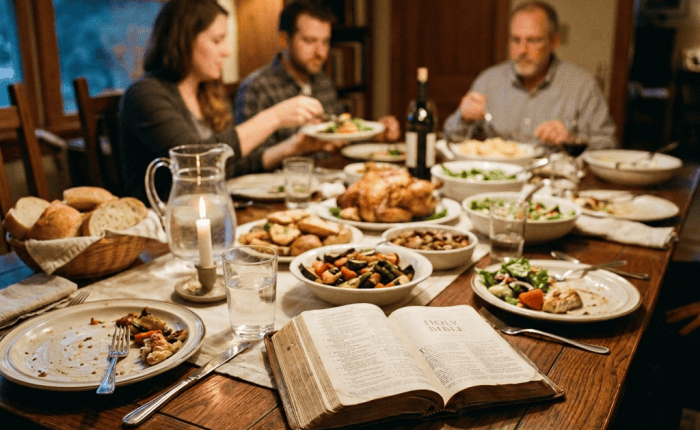
The earliest “Christians” as you may know were not call themselves Christians. Although, the term Christian means “little christ” it was used as a mocking term. An insult. Believers, were known in Judaism as the Sect of the Nazarene. “Followers of the Way”, was another name in which one would be known by within the early Church. It was a family. Sabbaths, began with a meal at sundown on Friday, known then as the “day of preparation.” These meals were in homes with like minded family, friends, and neighbors. They then would attend Synagogue on the Sabbath day, we call Saturday. This was the custom. It didn’t stop there as they were all excited for life in Messiah they met as often as they could.

We read in Acts 2 this description; “They devoted themselves to the apostles’ teaching and to the fellowship, to the breaking of bread and to prayer. A sense of awe came over everyone, and the apostles performed many wonders and signs. All the believers were together and had everything in common. Selling their possessions and goods, they shared with anyone who was in need. With one accord they continued to meet daily in the temple courts/ and to break bread from house to house, sharing their meals with gladness and sincerity of heart, praising God and enjoying the favor of all the people. And Adonai added to their number daily those who were being saved.”

This eagerness to be apart and to learn and grow in Messiah was infectious. As we read, “And Adonai added to their number daily those who were being saved.” A desire to be like Messiah was the heart of those in Berea, as we read in Act 17 (which I have shared numerous times over the past few posts) “Now the Bereans were more noble-minded than the Thessalonians, for they received the message with great eagerness and examined the Scriptures every day to see if these teachings were true.”

This is what i was reminded of this past week and a half. i watched my boys (now men), live out early Ekklesia life. Throughout history, culture, and community, there have been pockets that mirror this life. There is a glimmer of The Way. It sparks a desire within those partaking to commitment, one to one another, as a collective. While simultaneously sparking the interest of those on the outside looking in.

They say old habits die hard. It isn’t because there isn’t a desire for change, but routine is comfortable. Braking out of routine was the problem the Pharisee’s and the Religious leaders had. Their way of life was being challenged, their understanding was being challenged, their traditions were being challenged. When Yahoshua (Jesus) was talking about why His disciples didn’t fast He says this in particular to make His point: “Besides that, after drinking old wine, people don’t want new: because they say, ‘The old is better.'”

This is true with many things in life. Recently, the company that I work for as means to pay bills has been updating their computer system. With every update it will be heard, “I liked it better the old way!” I have probably said it a time or two. Yet, the more I use the new system the less I feel that way. The Pharisee’s had been doing things one way their whole lives, and in so doing adding more and more man made traditions. It is the same with the Church today, they have been doing things one way their entire lives, and following the traditions of man in the process.

my desire has always been to strip away the pomp and circumstance for simplicity. To look beyond the torn veil into the perfect instruction of God. To test what I have been taught and to seek Gods truth above all else. And to do it in community with other Followers of the Way, the sect of the Nazarene. To mirror the early Ekklesia, in fellowship and in attractiveness. So that those who see from the outside, see a group of people, loving God with all their heart, soul, mind, and strength. And likewise, loving their neighbor as themselves. Seeking to live lives pleasing to the Father by imitating the Son.

What is your desire? How do you want to be seen? And who do you want others to see in you?
For me– simplicity, just, loving, humble, a reflection of my Messiah.

You are loved,
cj

Embracing a Lifestyle Beyond Religion

Embracing a Lifestyle Beyond Religion

Religion, relationship, or lifestyle? The motto for many Christians is; “Christianity isn’t a religion, it’s a relationship.” And they get this idea from Jesus Himself. He calls His followers, friends and brothers. The “Church” is described as the “Bride of Christ.” So there is good reason to use a motto that pulls on the idea of relationship. Religion in our culture has become a byword for rigidity, ritual, rules and regulations, requiring strict adherence. So yes when you put the two side-by-side, relationship is far more appealing than religion.

The definition of religion is: a set of beliefs concerning the cause, nature, and purpose of the universe, especially when considered as the creation of a superhuman agency or agencies, usually involving devotional and ritual observances, and often containing a moral code governing the conduct of human affairs; the practice of religious beliefs; ritual observance of faith; strict faithfulness; devotion.

The definition of relationship is: a connection, association, or involvement; connection between persons by blood or marriage; an emotional or other connection between people.

When one reads John 15:15; “I no longer call you servants, because a servant does not know his master’s business. Instead, I have called you friends, for everything that I learned from my Father I have made known to you.” It is easy to see the idea of relationship. Also, the idea of relationship makes it feel like a partnership. In a partnership there are two-sides, generally equal and therefore autonomous, moving freely, within the relationship.

Two friends are having a conversation, “What are you doing tonight?” friend one asks friend two. “I don’t have any plans, just gonna go home and watch TV, maybe get takeout on my way.” Friend two reply’s. “You want to grab a bite together and then hit up downtown, there’s a block party tonight?” He asks, adding, “And I don’t want to go alone.” Friend two hesitates, “Come on, it will be fun.” Friend one pushes. Finally, friend two relents, “Ok, I’ll go.” Regardless of how this conversation ends up it is two individuals, making individual decisions.

Religion is as defined a rigid devotion to the rules. If the religious leader says, do this, a good devout religious person, will do it. Wash your hands this way, before eating. In order to join our order you must do this or that in this order, no exception. You must follow these rules precisely or you will need to ritually cleanse yourself. It is focused and it is one-way. One is simply an observer in a collective observance of said religious practices. A participant in the pre-ordained ritualistic rites. No conversation, no friendship, just instruction.

But what does Scripture teach us about the dynamics of this faith that we have? In the beginning, we read that there was a relationship so close-knit that Adam recognized the footsteps of God in the garden. We see the Angel of the God having a meal with Abraham. Even disclosing what was about to take place, the judgement of Sodom and Gomorrah. We see a burning bush and Moses, then later a pillar of fire by night and cloud by day. We see a covenant established between God and the people of Israel. A set of instructions given that if they obeyed them they would be blessed. But, if they did not obey them they would be cursed.

Israel was to be the Nation to the nations, a city set on a hill that drew all nations to God. A priestly nation, each with a particular part based on the tribe they were from. Yet, even it what appears to be the establishment of Religion we see that it was still wrapped in a fundamental desire to have a relationship. David, who is said, “a man after God’s own heart,” writes in Psalm 4 a plea.

O God, my vindicator! Answer me when I call! When I was distressed, you set me free; now have mercy on me, and hear my prayer.” This is not the cry of religion this is the cry of a relationship. He continues, “Men of rank, how long will you shame my honor, love what is vain, case after lies? Understand that Adonai sets apart the godly person for Himself; Adonai will hear when I call to Him. You can be angry, but do not sin! Think about this as you lie in bed, and calm down. Offer sacrifices rightly, and put your trust in Adonai.”

This reminds me of what the Prophet Micah wrote; “With what can I come before Adonai to bow down before God on high? Should I come before Him with burnt offerings? with calves in their first year? Would Adonai take delight in thousand of rams with ten thousand rivers of olive oil? Could I give my firstborn to pay for my sin, the fruit of my body for the sin of my soul? O man, you have already been told what is good, what Adonai requires of you – no more than to act justly, love mercy, and walk humbly with your God.

David finishes Psalm 4 with this: “Many ask, ‘Who can show us some good?’ Adonai, lift the light of Your face over us! You have filled my heart with more joy than all their grain and new wine. I will lie down and sleep in peace; for, Adonai, you alone make me live securely.

Adonai Elohim, has always desired relationship with His creation. He does however do so with a purpose. There is order, there is righteousness, there is Holiness. He being loving, made away for Israel and later to all the world through Messiah Yahoshua. So this beings us back to the religion or relationship? And to that I say, yes! We began with John 15:15 “I no longer call you servants, because a servant does not know his master’s business. Instead, I have called you friends, for everything that I learned from my Father I have made known to you.” However, just before this He says, “You are my friends if you do what I command.

If we take religion and relationship we get a lifestyle. The definition of lifestyle is: the habits, attitudes, tastes, moral standards, economic level, etc., that together constitute the mode of living of an individual or group.

This is why I have chosen “a lifestyle not a religion” over the common catchphrase, “not religion but a relationship.” Some would say this is simply semantics, and they wouldn’t be entirely wrong. However, like the conversation between two individual friends, there is autonomy. However, when we enter into covenant with the Father we are agreeing to live by a set standard. We are taking on the lifestyle of Yahoshua, “fixing our eyes on the Initiator and Completer of that Faith, Yahoshua – who, in exchange for obtaining the joy set before Him, endured death on a tree as a criminal, scorning the shame, and has sat down at the right hand of the throne of Elohim.”

It is His lifestyle that we are to carry. We are called to be Ambassadors of the Kingdom. Living in the world but not of the world. We are to be the shining city on a hill, that beacon of light that draws the nations back to Elohim. We are His chosen people, a royal priesthood, ministering to the poor and needy, the nobles and the kings. Living set apart lives as Adonai instructed in His Word. That same Word taught by the Apostles. One continuous letter to humanity, from the Creator of all things. His call for us to return to His Way. Dying to ourselves we put on the new self, the lifestyle of our King Yahoshua, that is marked by obedience.

John 15:9-14 –
“As the Father has loved Me, so have I loved you. Now remain in My love. If you keep My commands, you will remain in My love, just as I have kept My Father’s commands and remain in His love. I have told you this so that My joy may be in you and that your joy may be complete. My command is this: Love each other as I have loved you. Greater love has no one than this: to lay down one’s life for one’s friends. You are my friends if you do what I command.”

The way of the Rabbi, a lifestyle not a religion, for a lifestyle outlives every label.

You are loved,
cj

Podcast Episode: The One Story: God’s Covenant and Instructions

Podcast Episode: The One Story: God’s Covenant and Instructions

Pip: One book, not two — and apparently that page between Malachi and Matthew has a lot to answer for.

Mara: cj’s recent writing on The Way of the Rabbi goes deep into what holds scripture together as a single story, and what that means for how we live inside it. Let’s start with the covenant itself — and what the text actually says about sin, Torah, and obedience.

The One Story: God’s Covenant and Instructions

Pip: The central claim here is that the Bible was never meant to be read in two halves — and that the dividing line most readers take for granted has quietly done real damage to how people understand who they are and what they’re called to do.

Mara: The post frames the whole of scripture this way: “It should be read as if it was written to you and your family from your dad. Because, every word of it, was inspired by your Heavenly Father.”

Pip: That reframe matters practically. If it’s a letter from a father, you don’t skip chapters or treat half of it as superseded fine print. The whole thing carries weight, and you read it looking for coherence, not contradiction.

Mara: And the coherence the post argues for runs straight through the question of sin. John’s definition from 1 John 3:4 is quoted directly: “Everyone who makes a practice of sinning also practices lawlessness; sin is lawlessness.” The post is careful to note that the word translated as law is better rendered Torah — instruction.

Pip: So lawlessness isn’t just moral chaos in the abstract. It’s specifically being without God’s instruction — which reframes repentance too.

Mara: Exactly. Repentance, the post argues, has always meant returning to the Father’s ways. Not a one-time transaction, but an ongoing orientation. Romans 6 gets quoted at length on this point — the logic that dying to sin means you can no longer live in it.

Pip: There’s a pointed moment where the Pharisees come up — not as rule-obsessives, but as people who added to and subtracted from Torah while performing compliance. That’s the irony the post lands on: the accusation of legalism often comes from people who also claim you should obey God.

Mara: The post closes with a direct question to the reader — what exactly are you practicing? It’s less a rhetorical flourish and more a genuine diagnostic. The instruction, the covenant, the door — all one continuous thing.


Pip: One story, one covenant, one set of questions you actually have to answer for yourself.

Mara: The kind of reading that doesn’t let you stay comfortable at the page break. More of that territory next time.

Read the whole post here: The One Story: God’s Covenant and Instructions

Podcast Episode: Light vs Darkness: The True Meaning of God’s Instruction

Podcast Episode: Light vs Darkness: The True Meaning of God’s Instruction

Pip: If you’ve ever wondered whether “let your light shine” was secretly a Torah study prompt, cj at The Way of the Rabbi has thoughts — and citations.

Mara: This episode works through one sustained argument: that light and darkness in Scripture are symbolic language for Torah and the absence of it, and that the stakes of misreading that language are higher than most churches acknowledge.

Pip: Let’s get into what Isaiah 5:20 is actually saying — and who it might be aimed at.

Light vs Darkness: Torah as the True Instruction

Mara: The post opens with a familiar cultural reference — Isaiah 5:20 and the idea that good is called evil and evil good — then immediately pivots: the argument is that the church has been reading this verse too narrowly, missing that it describes the rejection of Torah itself.

Pip: And the verse lands hard in context. The setup is “Woe to those who call evil good and good evil,” and the post defines evil through 1 John 3:4: “Everyone who practices sin also practices lawlessness; and sin is lawlessness” — where lawlessness means outside the Torah.

Mara: That definition does real work here. If sin is lawlessness and lawlessness means outside God’s instruction, then calling Torah obsolete isn’t a minor theological quibble — it’s the very inversion Isaiah is warning against.

Pip: The post goes further and names the problem directly inside the church. It argues that mainstream Christianity rejects Torah while claiming Paul as the authority for doing so — and then quotes Peter pushing back on exactly that reading.

Mara: The quote is pointed: “the untaught and unstable distort, as they do also the rest of the Scriptures, to their own destruction.” That’s 2 Peter 3:16, and the post uses it to argue that Paul has been systematically misread, that he upheld Torah, taught it, and instructed Timothy to hold fast to it.

Pip: So the light-darkness imagery isn’t decoration — it’s load-bearing. The post walks through passages from John, Ephesians, and 1 Peter and asks the reader to substitute “Torah” for “light” in each one.

Mara: The substitution exercise is the heart of the argument. “He that follows me shall not walk in darkness” becomes “he that follows me shall not walk outside of instruction.” The post’s claim is that Yahoshua as the Word made flesh makes this reading not just poetic but literal.

Pip: And the bitter-to-sweet axis from Isaiah 5:20 gets the same treatment — Psalm 119:103, Hebrews 6:5, the honey imagery — all pointing to Torah as something to be tasted, not discarded.

Mara: The post closes with a direct challenge: “Did God change so we wouldn’t have to?” It cites Isaiah 29:13 and Matthew 15:7-9 on lips-versus-heart worship, and ends with a single question — are you following the instruction of the Father, or the commandments of men?

Pip: That question doesn’t resolve neatly, which is probably the point.


Mara: The through-line here is that language carries theology — and that reading light as instruction rather than sentiment changes what obedience actually looks like.

Pip: Next time, we’ll see what else that thread pulls on.

Read the Post: Light vs Darkness, here.

Podcast Episode: Prepare for Deception: Strengthening Faith in Troubling Times

Podcast Episode: Prepare for Deception: Strengthening Faith in Troubling Times

Pip: If you have ever wanted someone to tell you that the aliens are actually demons, that your family might turn on you, and that Psalm 3 has something useful to say about all of it — cj has your episode.

Mara: This one goes deep into spiritual preparedness: what deception looks like in the current moment, where Scripture points when faith is under pressure, and how an ancient psalm becomes a framework for holding on.

Pip: Let's start with the deception itself.

Prepare for Deception: Strengthening Faith in Troubling Times

Pip: The post opens with a provocation — we are not just in another rough patch of history. The argument is that the sheer convergence of events, from geopolitical chaos to the mainstream normalization of UFO disclosure, marks something qualitatively different, and that the primary threat is not physical but spiritual.

Mara: The post draws on a reframing of Matthew 28:19-20 to make the preparedness case concrete: "Go therefore and make disciples of all the nations, immersing them in the Father and the Son and the Holy Spirit; Teaching them to observe all that I have commanded you."

Pip: The move there is to take the word "baptize" back to its root meaning — to saturate — and apply it inward. Preparation is not stockpiling information about UFOs; it is becoming so thoroughly grounded in Scripture that a competing narrative cannot displace it.

Mara: And the warning is specific. Matthew 24:4 is cited directly: "See to it that no one deceives you." The post frames the coming pressure as something that will reach into personal relationships — family, friends, even church community — not just the broader culture.

Pip: That is where Psalm 3 enters, and it earns its place. David writes it while his son Absalom is actively trying to seize his kingdom — betrayal at the closest possible range. The post reads "Selah" not as a footnote but as a deliberate pause, a moment of sorrowful reflection before the turn.

Mara: The turn being: "But You, Yahweh, are a shield about me. My glory, and the One who lifts my head." The post uses David's arc — distress, pause, declaration — as the emotional template for anyone whose faith is being tested from the inside out.

Pip: Colossians 2:8 gets woven in as the doctrinal anchor alongside it — the warning against being taken captive by philosophy and tradition rather than Messiah. The structural argument is that Scripture, read whole and taken seriously, is the only preparation that holds.

Mara: The post closes on Psalm 3:5-8, which lands the practical note: "Salvation belongs to Yahweh; Your blessing be upon Your people." Rest, steadiness, and the refusal to stay in defeat are presented not as temperament but as theological conviction.

Pip: Which is a harder sell than it sounds, and the post does not pretend otherwise.


Mara: The thread running through all of this is really about where you anchor when the ground shifts — whether that is geopolitical noise, personal betrayal, or something stranger.

Pip: Selah, as they say. More from The Way of the Rabbi next time.

Understanding False Teachings in Today’s Church

Understanding False Teachings in Today’s Church

Jeremiah 5:31
The prophets prophesy falsely, and the priests rule by their own power; And My people love to have it that way. But what will you do in the end?”

Have you ever wondered about the state of the church? There are many self proclaimed prophets out there and many pastors operating in their own authority. Yet, they have hundreds of thousands of followers, books for sale, conventions and schools. They lead a people, that although have access to the Word, fail to read it. They are not like the Berean’s, searching the Scriptures daily to see if what they are being taught lines up, or even adds up. No, they swallow it whole and regurgitate the falsehoods. Where are the Jeremiah’s, the Isaiah’s, the Ezekiel’s, the Enoch’s? Where are the Peter’s, Paul’s, and John’s?

Instead we have TikTok prophets, unschooled and unlearned babblers in pulpits. The blind leading the blind. They read a book from a false prophet and are now spewing the same falsehoods in ignorance. But what does the Word say? They don’t care, they will take one verse out of context and shout you down with it. They are weak willed individuals with no discernment. How can i be so harsh? Who am i to say such things? What gives me the right? i am not the one saying it, Jeremiah is: “The prophets prophesy falsely, and the priest rule by their own power; And My (Elohim’s) people love to have it that way. But what will you do in the end?”

Behold, you are trusting in deceptive words to no avail. Will you steal, murder, and commit adultery and swear falsely, and offer sacrifices to Baal and walk after other gods that you have known, then come and stand before Me in this house, which is called by My name, and say, ‘We are delivered!’ – that you may do all these abominations? Has this house, which is called by My name, become a den of robbers in your sight”? Behold, I, even I, have seen it,” declares Yahweh.” Jeremiah 7:8-11

What is a false prophet? What is considered false teachings? Yahoshua (Jesus) tells us through Matthew’s writing: “Beware of the false prophets, who come to you in sheep’s clothing, but inwardly are ravenous wolves. you will know them by their fruits. Grapes are not gathered from thorn bushes nor figs form thistles, are they? So every good tree bears good fruit, but the bad tree bears bad fruit. A good tree cannot produce bad fruit, nor can a bad tree produce good fruit. Every tree that does not bear good fruit is cut down and thrown into the fire. So then, you will know them by their fruits. Not everyone who says to Me, ‘Adonai, Adonai,’ will enter the kingdom of heaven, but he who does the will of My Father who is in heaven will enter. Many will say to Me on that day, ‘Adonai, Adonai, did we not prophesy in Your name, and in Your name cast out demons, and in Your name perform many miracles?’ And then I will declare to them, ‘I never knew you; Depart from Me, You who PRACTICE LAWLESSNESS (TORAHLESSNESS).'” Matthew 7:15-23

When Yahoshua is teaching on false prophets He was drawing on the Word, the Torah. Where it teaches about false prophets. He also throughout His ministry challenged those teaching the commandments of men rather than the Commandments of the Father. Let’s look at Deuteronomy 13:1-4.

“If a prophet or a dreamer of dreams arises among you and gives you a sign of a wonder, and the sign or the wonder comes true, concerning which he spoke to you, saying, ‘Let us go after other gods (whom you have not known) and let us serve them,’ you shall not listen to the words of that prophet or that dreamer of dreams; for Yahweh your Elohim is testing you to find out if you love Yahweh your Elohim with all your hear and with all your soul. You shall follow Yahweh your Elohim and fear Him; and you shall KEEP HIS COMMANDMENTS, LISTEN TO HIS VOICE, SERVE HIM, and CLING TO HIM.”

Anytime that we do mans commandments over Elohim’s commandments we are essentially following other gods. If a prophet teaches us to obey other commands than he is a false prophet, and that would include the Greco-Roman Jesus. But Yahoshua never taught a different way, in fact He said, “I am the Way, the Truth, and the Life.” He was the very unchanging Word of Elohim made flesh. To do away with the commandments of God would have been to do away with Himself.

No, He said, “Do not think that I came to abolish the Law or the Prophets; I did not come to abolish but to fulfill (Bring fullness or clarity to). For truly I say to you, until heaven and earth pass away, not the smallest letter or stroke shall pass from the Law (Torah) until all is accomplished. (Note, heaven and earth have yet to pass away. See Revelation 21) Whoever then annuls one of the least of these commandments, and teaches others to do the same, shall be called least in the kingdom of heaven; but whoever keeps and teaches them, he shall be called great in the kingdom of heaven. For I say to you that unless your righteousness surpasses that of the scribes and the Pharisees, you will not enter the kingdom of heaven.” Matthew 7:17-20.

Many will say that we cannot be more righteous than the Scribe or the Pharisees and therefore Jesus meant we actually didn’t have to. However, that isn’t at all what Yahoshua was getting at! For time and time again He challenged the Pharisees that they were teaching the commandments of men rather than the commandments of God. And by definition righteousness is “the things commanded by God to be obeyed by man.” Therefore righteousness is obedience to God’s Torah. It is that simple. The Torah is not a burden, mans tradition is the burden. God is not a yoke that we cannot bear and to say so means you lack understanding.

Time is drawing short. Even if you live to be 90 before Yahoshua returns. Why? Because, deception is growing. Hearts are growing cold, sound doctrine is drying up, the wheat and the tares are being separated. What pile do you want to find yourself in? As Jeremiah said, “But, what will you do in the end?”

You are loved,
cj

The Rabbi’s Way: Embracing God’s Promises

The Rabbi’s Way: Embracing God’s Promises

The Way of the Rabbi. It begins with a promise and a declaration: “I can do all things through Messiah who strengthens me.” (Philippians 4:13) Do you believe it? Does it inspire your life, what you do, think and say?

Deuteronomy 6:4-9 . . .
“Hear, Israel! Yahweh is our God, Yahweh is one! And you shall love Yahweh your God with all your heart and with all your soul and with all your strength. These words, which I am commanding you today, shall be on your heart. And you shall repeat them diligently to your sons and speak of them when you sit in your house, when you walk on the road, when you lie down, and when you get up. You shall also tie them as a sign to your hand, and they shall be as frontlets on your forehead. You shall also write them on the doorposts of your house and on your gates.”

Are you operating under the promise as a living declaration? As an Ambassador of God’s Kingdom, representing, “Your Kingdom come, Your will be done”? Do you know who brings this promise? It is the Holy Spirit, the Helper that Yahoshua promised. Yahoshua is the fulfillment of the promises of Yahweh.

Unfortunately, humanity has a way of complicating things. Nothing can ever be easy. Yet, throughout Scripture we find a simplicity. Difficult yes, but why? It is a made difficult by humans. By man made traditions and processes and instruction, and influence, and choice. It is what the writer of Ecclesiastes was getting at when he penned these words in the 29 verse of chapter 7. “Behold I have found only this, that God made men upright, but they have sought out many devices.” Device, also schemes, adding to or taking away from those things commanded by God to be observed by men, The very definition of righteousness. So what did Elohim intend from the beginning?

Genesis 1:26-31 . . .
26 Then Elohim said, “Let us make man in our image, after our likeness. And let them have dominion over the fish of the sea and over the birds of the heavens and over the livestock and over all the earth and over every creeping thing that creeps on the earth.” 

27 So Elohim created man in His own image,
    in the image of Elohim He created him;
    male and female He created them.

28 And Elohim blessed them. And Elohim said to them, “Be fruitful and multiply and fill the earth and subdue it, and have dominion over the fish of the sea and over the birds of the heavens and over every living thing that moves on the earth.” 29 And Elohim said, “Behold, I have given you every plant yielding seed that is on the face of all the earth, and every tree with seed in its fruit. You shall have them for food. 30 And to every beast of the earth and to every bird of the heavens and to everything that creeps on the earth, everything that has the breath of life, I have given every green plant for food.” And it was so. 31 And Elohim saw everything that He had made, and behold, it was very good. And there was evening and there was morning, the sixth day.

What are the takeaways?
– Made in the image of God, after His likeness
– To have dominion
– To be fruitful
– To subdue creation
– To tend to creation, caretakers, gardeners
– To walk with Him
He saw all this and it was very good! And what did humans do?

Genesis 3:1-13 . . .
Now the serpent was more crafty than any other beast of the field that Adonai Elohim had made. He said to the woman, “Did Elohim actually say, ‘You shall not eat of any tree in the garden’?” And the woman said to the serpent, “We may eat of the fruit of the trees in the garden, but Elohim said, ‘You shall not eat of the fruit of the tree that is in the midst of the garden, neither shall you touch it, lest you die.’” But the serpent said to the woman, “You will not surely die. For Elohim knows that when you eat of it your eyes will be opened, and you will be like Elohim, knowing good and evil.” So when the woman saw that the tree was good for food, and that it was a delight to the eyes, and that the tree was to be desired to make one wise, she took of its fruit and ate, and she also gave some to her husband who was with her, and he ate. Then the eyes of both were opened, and they knew that they were naked. And they sewed fig leaves together and made themselves loincloths. And they heard the sound of Adonai Elohim walking in the garden in the cool of the day, and the man and his wife hid themselves from the presence of Yahweh among the trees of the garden. But Yahweh called to the man and said to him, “Where are you?” 10 And he said, “I heard the sound of you in the garden, and I was afraid, because I was naked, and I hid myself.” 11 He said, “Who told you that you were naked? Have you eaten of the tree of which I commanded you not to eat?” 12 The man said, “The woman whom you gave to be with me, she gave me fruit of the tree, and I ate.” 13 Then Yahweh said to the woman, “What is this that you have done?” The woman said, “The serpent deceived me, and I ate.”

What are the takeaways?
– Gave attention to satan
– Questioned God
– Wanted more, coveted
– Hid from God
– Tried to cover their shame
– Blamed others for their poor choice
He saw this and was grieved. From this point He sets in motion the story of redemption.

Fast forward to the present day and you have modern Pharisee’s, the church. They say and do a lot of good but they deny Torah. They believe in a lawless Jesus, a Greek infused Jesus. A Jesus who has done away with obedience to God and called it legalism and replaced it with hyper-grace. They have give up, “It is too difficult, no one can keep the commandments that is why Jesus had to come!” Yet, they will say, “I can do all things through Christ who strengthens me.” This is why I use the name Yahoshua. What is the #1 curse-word, slur, slogan . . . exclamation point? Isaiah and Ezekiel write about God protecting His name and I believe that is also the name of the Son. I don’t want any part of the Greco-Roman lawless (Torahless) Jesus. So what do we know?

Ecclesiastes 12:13-14 . . .
13 Here is the final conclusion, now that you have heard everything: fear Yahweh, and keep His commandments; this is what being human is all about. 14 For Yahweh will bring to judgment everything we do, including every secret, whether good or bad.
Here is the final conclusion, now that you have heard everything: fear Yahweh, and keep His commandments; this is what being human is all about.

What are the takeaways?
– Narrow is the way to life and few find it (Matthew 7:13-14)
– Imitate Messiah (1 Corinthians 11:1)
– Yahoshua is the Way, the Truth, the Life (John 14:6)
– Yahoshua is the Word made Flesh (John 1:14)
The Word became flesh and dwelt among us, full of grace and truth. What is Truth? God’s Word is Truth. The interconnectedness of all of this is beyond coincidence. So what did Yahoshua say?

Matthew 5:17-20 . . .
17 “Do not think that I have come to abolish the Law or the Prophets; I have not come to abolish them but to fulfill them. 18 For truly, I say to you, until heaven and earth pass away, not an iota, not a dot, will pass from the Law until all is accomplished. 19 Therefore whoever relaxes one of the least of these commandments and teaches others to do the same will be called least in the kingdom of heaven, but whoever does them and teaches them will be called great in the kingdom of heaven. 20 For I tell you, unless your righteousness exceeds that of the scribes and Pharisees, you will never enter the kingdom of heaven.”

What are the takeaways?
– Obey me (Jeremiah 7:23; John 14:23)
– Keep My commandments (John 14:15) “If you love Me, you WILL keep My commandments.”
– Tell others everything He has taught you (Matthew 28:18-20)
18 And Jesus came and said to them, “All authority in heaven and on earth has been given to me. 19 Go therefore and make disciples of all nations, baptizing them in the name of the Father and of the Son and of the Holy Spirit, 20 teaching them to observe all that I have commanded you. And behold, I am with you always, to the end of the age.” We are to do this until He returns. So what will it be like in the end?

Micah 4:1-4 . . .
But in the end-of-days it will come about that the mountain of Adonai’s house will be established as the most important mountain. It will be regarded more highly than the other hills, and peoples will stream there. Many Gentiles will go and say, “Come, let’s go up to the mountain of Adonai, to the house of the God of Israel! He will teach us about His ways, and we will walk in His paths.” For out of Zion will go forth Torah, the word of Adonai from Jerusalem. 3 He will judge between many peoples and arbitrate for many nations far away. Then they will hammer their swords into plow-blades and their spears into pruning-knives; nations will not raise swords at each other, and they will no longer learn war. 4 Instead, each person will sit under his vine and fig tree, with no one to upset him, for the mouth of Adonai Elohim has spoken.”

What are the takeaways?
– Sheep and the goats (Matthew 25:31-46) Funny today being called a goat is good and a sheep is bad. Yet in the end you will want to be numbered with the sheep and not the goats.
– Your Kingdom come Your will be done (Matthew 6:10) It is Adonai’s prayer, we are to pray for His Kingdom here and now. We are to live under and in its authority, while living as strangers and aliens in our current age.
– Feast Days (Zechariah 14:17-19) In the Millennium if we don’t keep the Feast of Tabernacles we will be cursed. Also, there is coming an event that Yahweh says will be so great we will forget the first Passover. This tells me until that happens we should be honoring the Passover we know today.
– New Heavens and Earth (Revelation 21:11) Since we haven’t seen the New Heavens and the New Earth, if we are to take Yahoshua at His word, “not an iota, not a dot, will pass from the Torah“.

How can a wretch like me possibly make it?
“I can do all things through Messiah who strengthens me!” (Philippians 4:13)

This is the end of the matter as John writes in Revelation 14:12 “Here is a call for the endurance of the saints, those who keep the commandments of Elohim AND their faith in Yahoshua.”

You are loved,
cj

The Power of Endurance in Faith

The Power of Endurance in Faith

Endure.
1. to hold out against; sustain without impairment or yielding; undergo.
to endure great financial pressures with equanimity.
2. to bear without resistance or with patience; tolerate.
I cannot endure your insults any longer.
3. to admit of; allow; bear.
His poetry is such that it will not endure a superficial reading.

Those who have ears, let them hear what the Spirit is saying to the Messianic communities. To him who endures, I will give the right to eat from the Tree of Life. Which is in God’s Paradise -‘Eden.’” Revelation 2:7

Those who have ears, let them hear what the Spirit is saying to the Messianic communities. He who endures will not be hurt at all by the second death.” Revelation 2:11

Those who have ears, let them hear what the Spirit is saying to the Messianic communities. To him who endures I will give some of the hidden manna. I will also give him a white stone, on which is written a new name. A name that nobody knows except the one receiving it.” Revelation 2:17

(“Those who have ears, let them hear what the Spirit is saying to the Messianic communities.”) “. . . only hold fast to what you have until I come. To him who endures and does what I want until the goal is reached.” Revelation 2:25-26 (29)

(“Those who have ears, let them hear what the Spirit is saying to the Messianic communities.“) “He who endures will, like them, be dressed in white clothing. I will not blot his name out of the Book of Life. In fact, I will acknowledge him individually before My Father and before His angels.” Revelation 3:5 (6)

(“Those who have ears, let them hear what the Spirit is saying to the Messianic communities.”) “I will make him who endures a pillar in the Temple of My God, and he will never leave it. Also I will write on him the name of My God. As well, the name of My God’s city, the new Jerusalem. Which is coming down out of heaven from My God, and My own new name.” Revelation 3:12 (13)

(“Those who have ears, let them hear what the Spirit is saying to the Messianic communities.”) “I will let him who endures sit with Me on my throne. Just as I myself endured and sat down with my Father on his throne.” Revelation 3:21 (22)

Do you not know that in a race all the runners run, but only one receives the prize? Run in such a way as to take the prize. Everyone who competes in the games trains with strict discipline. They do it for a crown that is perishable, but we do it for a crown that is imperishable.” 1 Corinthians 9:24-25

Endurance, is an important part of the Way of the Rabbi. He taught us by His actions. Not just His life, but even more so in His death, enduring death, beaten, pierced and hung on a tree. Paul, continues the passage above by saying, “Therefore, I do not run aimlessly.” No he ran with a purpose. He said, imitate me as I imitate Messiah Yahoshua (Jesus). We are not to live aimlessly, lawlessly, or without purpose. No we have been given instruction for our purpose and charged with an enduring mission.

Then Yahoshua (Jesus) came to them and said, “All authority in heaven and on earth has been given to Me. Therefore, go and make disciples of all nations. Baptizing them in the name of the Father and of the Son and of the Holy Spirit. And teaching them to obey all that I have commanded you. And surely I am with you always, even to the end of the age.” Matthew 28:18-20

What is it that Yahoshua instructed? He exemplified the Torah, bringing it to fullness, revealing its purpose. The Torah is the instruction manual on how to live set apart lives from the nations. It reveals to us how to live obediently, holy, sanctified lives. Without it we are lawless making us no different than the nations. To keep the Torah is not to do away with Faith in Messiah. It is done because of our faith in Messiah. Revelation 14:12 says, “Here is a call for the endurance of the saints. Who keep the commandments of God and the faith of Yahoshua (Jesus).”

In Yahoshua’s charge to His disciples in Matthew 28 quoted above He says, “. . . all that I have commanded you.” At no point did Yahoshua instruct His disciples to do away with the Torah. No not once but to do away with man’s tradition. He challenged the religious leaders on their interpretation and their added rules. He clarified, and lived out the Torah perfectly. It is by His grace through faith that we are saved but we are called to live set apart.

Many will read this and say it is impossible to keep all the commandments of God. Yet in their next breath quote Philippians 4:13. “I can do all things through Messiah who strengthens me.” All but keep the commandments of God, that I cannot do. Oh you of little faith, hypocrites and weak willed fools. Paul’ s words are true and align with the instruction of Messiah perfectly.

Is it difficult in a fallen world to live set apart lives under the instruction of God? YES! A hundred times yes. But that doesn’t mean we are free to practice lawlessness (Torahlessness) and say we are under grace. By no means! We are to endure and in that endurance we will be blessed, protected, and welcomed into the Kingdom. This is the Way of the Rabbi.

You are loved,
cj

Choosing to Listen: Embracing God’s Word Daily

Choosing to Listen: Embracing God’s Word Daily

How serious are you, when you attend your church gathering, in hearing the Word of God? What preparation goes into it? Do you pray before asking God to reveal your heart? This is my practice. When I enter the Synagogue I pray, “Adonai, reveal my heart, You know me better than i know myself. Help me to not only hear You but to listen and obey Your instruction.” After this prayer I write out my initial thoughts. This past Sabbath as I prayed this prayer this is the thought given me through that prayer.

“i am not in a right frame of mind. i am not sure what i need to do since it is ultimately a heart issue. i am growing increasingly critical of myself, but lack the strength to change the thought patterns.”

But you are a chosen race, a royal priesthood, a holy nation. A people for God’s own possession. So that you may proclaim the excellencies of Him who has called you out of darkness into His marvelous light. For you once were not a people, but now you are the people of God. You had not received mercy, but now you have received mercy.” 1 Peter 2:9-10

From this point I begin to prepare my heart and my mind to receive what Adonai has for me. The question was asked, “What is the truth of your calling?” From that question I wrote down the first things that came to mind.
Concert Tour – if you read back in my blog several years. I shared how my family would travel and sing in churches. It was during this time that I believe I received my first calling into ministry.
Visions while Driving – It would become increasingly clear that this calling was sure. You see while friends were talking about their future plans or lack of I was having visions of my calling. It was a mixture of singing and preaching. This would later be the case as in some churches I had to both lead worship and preach.
Jr. High Camp – It was at an evening Chapel service at Jr. High Camp that my calling into ministry would be cemented. It would also face one of its greatest challenges. As the speaker presented the message, it became clear that I was to do this. “This is what I am calling you to do, this is the purpose I have set out for you. To preach My Word.” I could feel the burning inside my heart as I went to the alter that night. I spoke of my calling at our cabin time later.
Prayer Chapel – Years had past and I had forgotten the root of my calling. It was always there but I lacked a seriousness. I would find myself at a crossroads, homeless and jobless, I sought shelter one night in a prayer chapel. It was positioned on a cliff overlooking Puget Sound in Northwest Washington State. It was unlocked and I had prayed here many times before. On this night, although I was physically alone, I was not Spiritually alone. Through the guidance of the Holy Spirit I was reminded of my call. I rededicated my life to the purposes of God that night. The very next day I was blessed with both a house and a job.

Everything in life is a choice. You have to choose one way or another, moment by moment. These choices are often inconsequential. However, there are choices that can be earth shaking. Therefore, every decision made should be made thoughtfully and in some instances with the guidance of others. Perplexing it is that often we find these things out after wrong choices are made. Everything in life is a choice, even allowing yourself to be chosen.

1 Corinthians 6:19-20 . . .
Do you not know that your body is a temple of the Holy Spirit who is in you, whom you have received from God? You are not your own; you were bought at a price. Therefore glorify God with your body.”

How many times have I defiled the temple? How many times have I brought uncleanness, by choice, into the temple of my body? Proverbs offers wisdom in short, impactful pieces. This is perfect for a generation that cannot focus for more than 30 seconds before scrolling to the next TikTok video. “The foolishness of man ruins his way, and his heart rages against Adonai.” “Also it is not good for a person to be without knowledge, and he who hurries his footsteps errs.” “Many plans are in a man’s heart, but the counsel of Adonai will stand.” “Cease listening, my son, to discipline, and you will stray from the words of knowledge.” (Each of these are found in Proverbs 19).

They are relevant to choice. We can all relate in one way or another in making hasty decisions that ended up being wrong. Some of us carry the burden of those decisions long after the dust has settled. It is an unfortunate truth however, there is still room for choice. Will you wallow in the mud or will you step boldly forward in the Grace of God?

1 John 2:3-6
By this we know that we have come to know Him, if we keep His commandments. The one who says, “I have come to know Him.” Yet he does not keep His commandments, is a liar, and the truth is not in him. Here is truth, whoever keeps His word, in him the love of God has truly been perfected. By this we know that we are in Him . . . the one who says he abides in Him ought walk in the same manner as He walked.”

John 14:15
If you love Me, you will keep My commandments.”

IF is the conditional term. If we choose to allow ourselves to be chosen. We then must choose to walk in the manner worthy of that calling. In what manner? What are his ways? Do our ways conflict with what He has instructed? Are following the traditions of man over the instruction of God? Tradition, does not make disobedience to His word less disobedient. There is no such thing as acceptable sin. What is sin as defined by the Apostle John in 1 John 3:4? “Everyone who practices sin also practices lawlessness; and sin is lawlessness.” Lawlessness is defined as being without Torah. Likewise, being without Torah is known as being in darkness. Therefore, being in Torah is then being in the light.

But you are a chosen race, a royal priesthood, a holy nation. A people for God’s own possession. So that you may proclaim the excellencies of Him who has called you out of darkness into His marvelous light. For you once were not a people, but now you are the people of God. You had not received mercy, but now you have received mercy.” 1 Peter 2:9-10

Sin, or as many like to say, to lessen the blow, missing the mark. Whether in ignorance or intentional, when found out, repentance is required. A turning away from that sin is a choice and a matter of the heart. When you break relationship, dishonoring someone, that guilt is conviction. That conviction is dealt with by repentance. That repentance is a choice, as much as sin was a choice. “IF My people, who bear My name, will humble themselves, pray, seek My face and turn from their evil ways, I will hear from heaven, forgive their sin and heal their land.”

Trust in Adonai with all your heart;
do not rely on your own understanding.
In all your ways acknowledge him;
then he will level your paths
.
Proverbs 3:5-6

Here is where we are in the cycle of life. We are in a famine. The famine is severe, so severe that it has become normal. So normal in fact that most people don’t even know what they are missing and they don’t care to know. Even some who sense there is something deeper, a calling, a choice to be made, they too are starved. They don’t choose, whether out of fear of making a wrong choice or seeing it as inconsequential either way. The famine shouldn’t surprise anyone. It was foretold by the Prophet Amos.

The time is coming,” says Adonai Elohim,
“when I will send famine over the land,
not a famine of bread or a thirst for water,
but of hearing the words of Adonai.
People will stagger from sea to sea
and from north to east, running back and forth,
seeking the word of Adonai;
but they will not find it
.”
Amos 8:11-12

However, those who are in Messiah Yahoshua, we are at an advantage. We have the Word made flesh. He promises the new covenant will be written on our minds. It will also be inscribed on our hearts. So that we can be the Temple, that we can be the city on a hill. So that we can stand out separate from the world, sanctified by the Word of Truth. As Yahoshua prayed for us to be.

I have given them your word, and the world hated them, because they do not belong to the world — just as I myself do not belong to the world. I don’t ask you to take them out of the world, but to protect them from the Evil One. They do not belong to the world, just as I do not belong to the world. Set them apart for holiness by means of the truth — your word is truth. Just as you sent me into the world, I have sent them into the world. On their behalf I am setting myself apart for holiness, so that they too may be set apart for holiness by means of the truth.” John 17:14-19

Sometimes I have to write to remind myself of whose I am. That I am no longer my own but have been bought at a price. It is no longer I who live but Messiah who lives in me and through me. I don’t always make the right choice, I am thankful for Grace. But one thing I do, forgetting that which is behind me. I strain for what is ahead of me in Messiah Yahoshua.

It is not that I have already obtained it or already reached the goal — no, I keep pursuing it in the hope of taking hold of that for which the Messiah Yahoshua took hold of me. Brothers, I, for my part, do not think of myself as having yet gotten hold of it; but one thing I do: forgetting what is behind me and straining forward toward what lies ahead, I keep pursuing the goal in order to win the prize offered by God’s upward calling in the Messiah Yahoshua. Therefore, as many of us as are mature, let us keep paying attention to this; and if you are differently minded about anything, God will also reveal this to you. Only let our conduct fit the level we have already reached.” Philippians 3:12-16

You see it is a constant choice, moment by moment, decision by decision, we choose. What will you choose?

This is the way of the Rabbi,
You are loved,
cj