
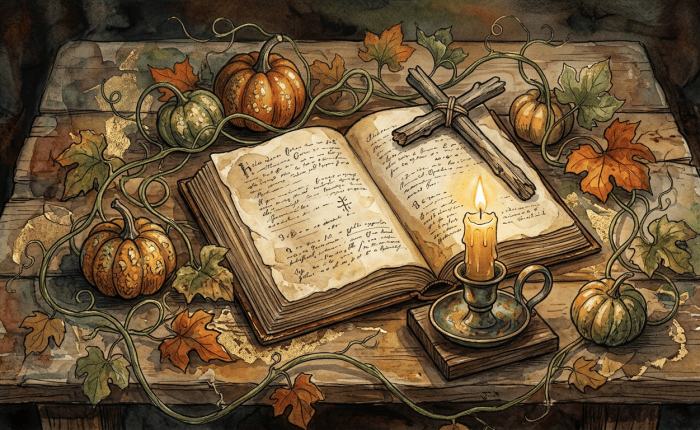
Pip: There is a moment every October when a carved pumpkin sitting on a pastor’s doorstep becomes a theological crisis — and cj found that moment.
Mara: This episode follows one post from The Way of the Rabbi, walking through the history of the Jack-O-Lantern, what an African missionary saw in it, and what the call to be set apart actually demands of a believer.
Pip: Let’s start with the gourd.
Halloween, Jack-O-Lanterns, and the Christian Call to Be Set Apart
Mara: The post opens with a story: an African missionary visiting American homes in October, seeing Halloween decorations at house after house, saying nothing — until he saw a carved pumpkin on the host pastor’s own doorstep.
Pip: That’s the frame. A man who recognized something that the pastor had stopped seeing — or maybe never looked at closely enough.
Mara: The missionary’s words, quoted directly in the post: “I cannot believe that Christians in America, would light the gourd.”
Pip: And the pastor’s response was essentially: relax, it’s just a cultural tradition. Which is exactly the kind of answer that sounds reasonable until you ask what the tradition actually is.
Mara: The post traces two separate histories. The first is the Jack-O-Lantern itself — rooted in Irish folklore about Stingy Jack, a trickster who tricked the Devil, was refused entry to both heaven and hell, and was condemned to roam the earth with a burning coal inside a hollowed turnip. Irish immigrants brought the custom to America in the 1840s and switched to pumpkins because they were easier to carve.
Pip: So the symbol is literally a man wandering in darkness, shut out of both destinations. That’s the decoration.
Mara: The second history is the one the missionary carried with him. The post explains that in parts of West Africa — likely the Congo region — lit gourds placed at a compound’s entrance served as a visible receipt: proof that a household had paid tribute to a witchdoctor and was under that practitioner’s protection.
Pip: Which means the missionary wasn’t reacting to a quaint autumn custom. He was looking at something he had seen used as a mark of occult allegiance, now sitting on a Christian pastor’s front step.
Mara: The post anchors all of this in Psalm 1 — “Blessed is the man who does not walk in the counsel of the wicked, or set foot on the path of sinners, or sit in the seat of mockers” — and in the Matthew 7 warning: “I never knew you; depart from Me, you workers of lawlessness.”
Pip: The argument isn’t that every person carving a pumpkin is making a conscious spiritual declaration. It’s that appearances carry weight, that compromise accumulates, and that loving your neighbor poorly includes modeling a life that blurs those lines.
Mara: The post puts it plainly: living in compromise does not show compassion to the lost. The call is to return to the feasts of God and turn from the traditions of man — including the ones that feel harmless because they have always been there.
Pip: The missionary’s grief was the signal. The question the post leaves open is whether the western church has the ears to hear it.
Mara: What stays with me is the image of the lit gourd — the same object, two continents, two completely different frames of reference.
Pip: Context is everything. And sometimes it takes someone from the outside to hand it back to you.
Mara: More from The Way of the Rabbi next time.
Read the entire post here: Podcast Episode: Halloween, Jack-O-Lanterns, and the Christian Call to Be Set Apart

