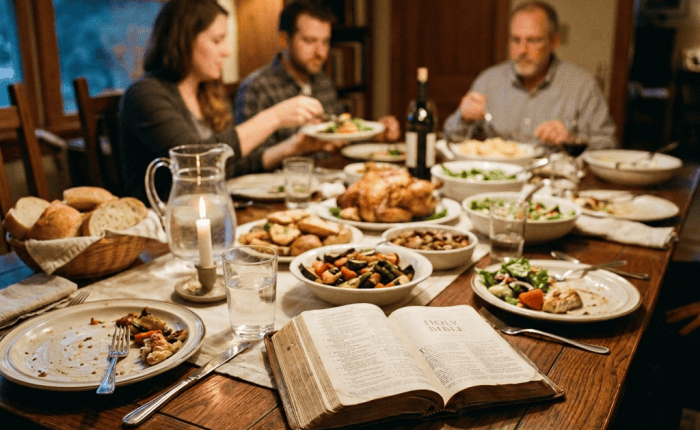
Podcast Episode: Gluttons of Grace: The Spiritual Dangers of Gluttony

Podcast Episode: Gluttons of Grace: The Spiritual Dangers of Gluttony

Pip: There’s a spiritual danger hiding in plain sight — and it’s not the one the church usually wants to talk about at the potluck.

Mara: cj’s latest post on The Way of the Rabbi takes on gluttony — not just the physical kind, but what the piece calls “gluttony of grace,” the habit of treating God’s patience as a license to keep sinning. Let’s start with what that actually means and why it matters.

Gluttons of Grace: The Spiritual Dangers of Gluttony

Pip: The post opens with a disarmingly ordinary scene — a fast food order, a one-dollar add-on, and a question: is that gluttony? But that small moment is a doorway into something much larger, the idea that we overindulge spiritually the same way we overindulge at the counter.

Mara: The post grounds the argument in Ephesians 2:10, setting up the kind of life we’re actually called to: “For we are God’s workmanship, created in Messiah Yahoshua to do good works, which God prepared in advance as our way of life.”

Pip: So the stakes here aren’t just dietary. The argument is that grace was never meant to be a standing permission slip — it was meant to launch us into something, a life shaped by the Father’s instruction, the Torah.

Mara: Right, and the post is careful to separate that from works-based salvation. The point isn’t that obedience earns anything. It’s that continuing deliberately in sin while claiming grace is its own kind of excess — the “gluttony of grace” the title names.

Pip: The church’s reluctance to preach on gluttony gets a dry observation here — that it hits too close to home and is harder to hide than most sins. Which is a fair point. Gluttony is the one vice you can’t keep in a private browser tab.

Mara: The post invokes Ezekiel 36:26-27 to answer the objection that Torah-keeping is simply impossible: “I will put My Spirit within you and cause you to walk in My statutes, and you will keep My judgments and do them.” The Spirit, not willpower, is the mechanism.

Pip: And then Paul — the one, as the post puts it, “in whom so many twist to justify their sinful natures” — gets quoted directly against that very use. Shall we continue in sin so grace may increase? Certainly not.

Mara: The post closes on Matthew 7, the sobering passage where Yahoshua tells those who performed miracles in his name: “I never knew you; depart from Me, you workers of lawlessness.” That’s the endpoint of gluttony of grace taken to its conclusion.

Pip: And the landing is Proverbs 23 — a father’s plea to a son to guide his heart on the right course. The frame shifts from warning to invitation.

Mara: Which is really the post’s whole posture. Not condemnation, but a call to search out truth and walk in it — a heart of flesh instead of stone.


Pip: Grace as a floor rather than a ceiling — that reframe does a lot of quiet work.

Mara: It does. The question underneath all of it is what we’re actually being saved toward, not just saved from. Worth sitting with until next time.

Read the full post: Gluttons of Grace: The Spiritual Dangers of Gluttony

Gluttons of Grace: The Spiritual Dangers of Gluttony

Gluttons of Grace: The Spiritual Dangers of Gluttony

The other night I ate out. It was fast food so nothing fancy and I brought it home so is that actually eating out, technically? The place I chose had a special menu option of a one dollar item. So I added it to my order. However, I didn’t take anything away from what I was already ordering. Therefore, in the end I over ate. Is this the definition of gluttony?

What is the definition of gluttony? The definition is quite simple, gluttony is “excessive eating and drinking.” It is also numbered among the often spoken of, seven deadly sins. Side note here the seven deadly sins although can be found separately within Scripture they do not appear as a list. It is believed that the seven deadly sins was coined by Pope Gregory I. Now gluttony in Hebrew can also be translated as, to be vile, to be worthless, to be insignificant. Based on these definitions, being glutinous, doesn’t sound so appealing.

The church doesn’t like to talk much about gluttony. If you ask me it is because this one hits way too close to home and is far harder to hide. Everyone has their struggles so I am not trying to be insensitive just pointing out an observation. There is plenty that I have had to overcome and others I am still battling, to that I say fight the good fight.

One issue I see abounding in the church today is, gluttony of grace. Taking advantage of Elohim’s patience. Without a doubt I have fallen into this trap as well. However, once one begins to realize that Yahoshua (Jesus) kept and taught the Torah and that He used it to teach, it cannot be denied or swept away.

In John eight Yahoshua makes a statement that many ignore or give it a cursory glance. In being brought the woman caught in adultery at the end of the encounter He says to the woman; “Neither do I condemn you: go, and sin no more.” Rather than take this verse as a statement of fact, many treat it as an invitation to change. Although they are partly correct they are missing the bigger picture. We are called to abound in good works.

Not a works based salvation but good works because we are saved. Abounding in the good works prepared for us before the foundation of the world. “For we are God’s workmanship, created in Messiah Yahoshua to do good works, which God prepared in advance as our way of life.” (Ephesians 2:10 Berean Study Bible). What are these good works? Some would say they are the fruit of the Spirit found in Galatians five. “But the fruit of the Spirit is love, joy, peace, longsuffering, kindness, goodness, faithfulness, gentleness, self-control. Against such there is no law. And those who are in Messiah have crucified the flesh with its passions and desires. If we live in the Spirit, let us also walk in the Spirit.

Again this isn’t a wrong belief it is simply incomplete. The good works involve keeping that which the Father established for His people. His instruction, the Torah, as we walk in the light of His Truth. The problem is that we see a list of rules and say it is impossible. Rather than holding to the promise that the Holy Spirit brings in fulfillment of Ezekiels prophecy. Ezekiel 36:26-27 says, “I will give you a new heart and put a new spirit within you; I will take the heart of stone out of your flesh and give you a heart of flesh. I will put My Spirit within you and cause you to walk in My statutes, and you will keep My judgments and do them.

Paul himself, the one in whom so many twist to justify their sinful natures, said, “What then shall we say? Shall we continue in sin so that grace may increase? Certainly not! How can we who died to sin live in it any longer? Or aren’t you aware that all of us who were baptized into Messiah Yahoshua were baptized into His death? We were therefore buried with Him through baptism into death, in order that, just as Messiah was raised from the dead through the glory of the Father, we too may walk in newness of life.”

Newness of life is not to continue to sin. Essentially becoming gluttons of grace. Then in the end finding out the one we claim to know, never knew us. Yahoshua said, “Not everyone who says to Me, ‘Adonai, Adonai,’ will enter the kingdom of heaven, but only he who does the will of My Father in heaven. Many will say to Me on that day, ‘Adonai, Adonai, did we not prophesy in Your name, and in Your name drive out demons and perform many miracles?’ Then I will tell them plainly, ‘I never knew you; depart from Me, you workers of lawlessness! Matthew 7:21-23.

Imagine finding out that we are vile, worthless, or insignificant. Because, instead of putting on the newness of life we walked as gluttons. Continuing in the traditions of man rather than searching out truth and living according to the Fathers instruction. Proverbs 23:15-19 is a good place to wrap things up. “My son, if your heart is wise, My own heart will indeed rejoice. My inmost being will rejoice  when your lips speak what is right. Do not let your heart envy sinners, but always continue in the fear of the YHWH. For surely there is a future, and your hope will not be cut off. Listen, my son, and be wise, and guide your heart on the right course.”

May we all seek for a heart of flesh from the Father. This is the Way of the Rabbi.

You are loved,
cj

Breaking Free from Legalism: Embracing Messiah’s Love

Breaking Free from Legalism: Embracing Messiah’s Love

When taking your relationship with Messiah from a religion to a relationship, one by necessity strips off the man made traditions. This is an important first step. One then begins to learn to walk in relationship with Messiah. However, in our humanity we still make this about ourselves, our comforts, our desires, our feelings, me, me me, I and me again. We look at all that Yahoshua (Jesus) did for us, how he suffered the most horrific torturous death imaginable. Then we say to ourselves, “He did this so that I don’t have to keep the law.” Say that out-loud and tell me it doesn’t sound like you are in an abusive relationship. Now look deeper into it and tell me who is the abuser?

I do not reject God’s gracious gift; for if the way in which one attains righteousness is through legalism, then the Messiah’s death was pointless.

You stupid Galatians! Who has put you under a spell? Before your very eyes Yahoshua the Messiah was clearly portrayed as having been put to death as a criminal! I want to know from you just this one thing: did you receive the Spirit by legalistic observance of Torah commands or by trusting in what you heard and being faithful to it? Are you that stupid? Having begun with the Spirit’s power, do you think you can reach the goal under your own power?  Have you suffered so much for nothing? If that’s the way you think, your suffering certainly will have been for nothing!  What about God, who supplies you with the Spirit and works miracles among you — does he do it because of your legalistic observance of Torah commands or because you trust in what you heard and are faithful to it?

It was the same with Abraham: “He trusted in God and was faithful to him, and that was credited to his account as righteousness.”  Be assured, then, that it is those who live by trusting and being faithful who are really children of Abraham. (Galatians 2:21-3:7)

When talking about following the commands of God, especially after coming out of religion, many will cry, ‘legalism!’ And they will use Galatians as a point of reference. Followed by something along the lines of, “See, it is about a relationship, not legalistic religion.” And they would be half right. Abraham trusted that what God said, He would do. And based on that trust, that faith, Abraham was obedient to all that God commanded. Paul in his letter to the Galatians goes so far as to call them stupid. Why? Because they began to focus on the observance of Torah outside of trusting in what they had heard and then being faithful to it. You see they were making it about something, rather than someone, and separating the two.

How do I know this? Paul himself tells the Romans this in 6:1-2. “What then shall we say? Shall we continue in sin so that grace may increase? Certainly not! How can we who died to sin live in it any longer?” What is sin? As we have looked at time and time again 1 John 3:4 tells us exactly what sin is: “Everyone who practices sin practices lawlessness as well. Indeed, sin is lawlessness.” That is to say that sin is being outside of Torah. There is no way around it.

So what is it then that saves us? It is the blood of Messiah, His death has taken away the sin of those who put their faith in Him. His righteousness is given to us and undeservedly so. However, sin is still sin and Abraham shows us that trusting in God is shown through obedience to Him, and that is counted to him as righteousness. So the message Paul is writing to the Galatians and also to the Romans is the same. Now that we have put our faith and trust in Messiah, we should no longer walk in the former sins that we knew. For there is a more excellent way! It is the Way of the Rabbi. It is taking on His lifestyle. Going from religion to relationship to a lifestyle that mirrors that of Messiah.

Who was obedient to the Father even to death. Yahoshua set the example of Faith in the promise of His resurrection that we who believe will also be raised up with Him in newness of life. That we no longer walk according to the ways of man, but that like Messiah we do as the Father has instructed. We build on the relationship with His Son Yahoshua, our groom to be at the marriage supper of the Lamb. “So Yahoshua replied, “Truly, truly, I tell you, the Son can do nothing by Himself, unless He sees the Father doing it. For whatever the Father does, the Son also does.“” John 5:19. We should be so like minded. What pleases the Father? Psalm 51 reveals, “The sacrifices of God are a broken spirit; a broken and a contrite heart, O God, You will not despise.”

If you ask those who have been married for a long time what is their secret you will hear a common theme. That is that each one sought to do for the other more than themselves. In a two-sided relationship where both participants are seeking to honor the other more than themselves you find not only longevity but happiness, peace, joy, love, and satisfaction. It is a lifestyle that becomes the focal point in a relationship, a choice to love the other as they receive love. That is how our Messiah loved and loves us and that is how we ought to love Him in return. And when we love Him we are loving the Father.

Create in me a clean heart, O God, and renew a right spirit within me. Cast me not away from Your presence; take not Your Holy Spirit from me. Restore to me the joy of Your salvation, and sustain me with a willing spirit. Then I will teach transgressors Your ways, and sinners will return to You. Deliver me from bloodguilt, O God, the God of my salvation, and my tongue will sing of Your righteousness. O Adonai, open my lips, and my mouth will declare Your praise.” Psalm 51:10-1

Finally, here in Psalm 51 David writes, “I will teach transgressors Your ways, and sinners will return to You.” This has always been the point of coming to Messiah. Learning the ways of the Father and doing them. Taking on the heavenly lifestyle and leaving the lawless lifestyle of humanity behind. For the ruler of this world is lawless, he is without Torah, without instruction. And the lawless one is coming to deceive many into a lifestyle of lawlessness, of sin. Are you walking in the light of the Fathers instruction by faith in Messiah? For in the end both are required, Revelation 14:12 says: “Here is a call for the perseverance of the saints, who keep the commandments of God and the faith of Yahoshua.

Choose this day whom you will serve, the lawless one parading around as the gods of this world or the maker of Heaven and Earth? As for me, i will serve my Father YHWH, in faith of Messiah Yahoshua, by the power of the Holy Spirit.

You are loved,
cj

Podcast Episode: Living Life His Way: A Perspective on Faith

Podcast Episode: Living Life His Way: A Perspective on Faith

Pip: There is a Frank Sinatra song that has apparently been haunting cj for some time, and honestly, as spiritual provocations go, “My Way” is not the worst place to start.

Mara: cj’s latest post at The Way of the Rabbi pulls that song apart and rebuilds it around a single question: whose way are we actually living by? Let’s start with faith, tradition, and the tension between God’s instruction and doing things on our own terms.

Living by Whose Instructions?

Mara: The post opens with a direct challenge to personal autonomy as a spiritual default — the idea that pride, comfort, and cultural tradition have quietly displaced what Scripture actually asks of us.

Pip: The verse from Acts 5 is where it lands: “But if it is of God, you cannot overthrow it — lest you be found to fight against God.”

Mara: That’s the hinge the whole piece turns on. If something is genuinely of God, resistance to it isn’t preference or tradition — it’s opposition. The stakes shift from lifestyle choice to something considerably heavier.

Pip: And the post is careful about where that resistance comes from. It’s not just secular culture pulling against God’s instruction — it’s church tradition, family tradition, human additions layered onto Scripture until the original is barely visible. The Pharisees get named directly: taking Torah and lacing it with tradition until the yoke became unbearable.

Mara: John’s first epistle gets quoted at length to sharpen the point. “For this is the love of God, that we keep His commandments. And His commandments are not burdensome. For everyone who has been born of God overcomes the world — and this is the victory that has overcome the world — our faith.”

Pip: So the commandments aren’t a burden; the flesh is the burden. That’s a reframe worth sitting with.

Mara: Paul reinforces it from two directions — Romans and Galatians both get cited, arguing that walking by the Spirit is the practical mechanism for not gratifying the flesh. And John defines sin plainly as lawlessness, living outside of Torah, which the post notes sits uncomfortably against the modern Christian tendency to treat the commands as optional or already fulfilled away.

Pip: There is a certain irony in a Sinatra song becoming the clearest argument for obedience. But the rewritten lyrics at the close earn it — “The record shows HE took my blows, and I did it HIS way” is a genuinely different song.

Mara: The post closes on a Proverb: “Whoever turns his ear away from hearing the Torah, even his prayer is detestable.” Torah as guardrail, not cage — that’s the frame the whole piece is building toward.


Pip: The question underneath all of this is simple and not simple at all: when the final curtain closes, whose way will it have been?

Mara: That’s the thread worth carrying into whatever comes next — how instruction and faith and daily habit actually connect. More from The Way of the Rabbi next time.

Glowing anatomical heart entwined with compass surrounded by stars
A vibrant cosmic heart intertwined with a glowing compass, symbolizing guidance and emotion.

Living Life His Way: A Perspective on Faith

Living Life His Way: A Perspective on Faith

In the end, when the time has come, for the final curtain, will it be said, “I did it, His way?” Unfortunately, for many and even myself, on more occasions than I would like, like many we do things “our way.” Like the famous song sung by many and introduced by Frank Sinatra, “I did it myyyyyyyy wayyyyyyyy.” The more I learn and grow and discern truth in Scripture, it becomes glaringly more clear, His Way is constantly under attack.

There is a certain amount of pride that comes with the idea that we do things our way. Success feels good, as does rebellion in certain areas, power and control, is captivating. They say no one likes being told what to do. And there is some truth to that. Neither does anyone like to be under constant pressure to perform. So when you couple the idea that the Law is some sort of checklist that one must keep, it becomes less appealing. Especially, when it is put up next to a philosophy of do whatever you want.

However, most will agree that having certain parameters is necessary for a cohesive community. Now the debate begins, how far should those parameters reach? Who should get to dictate those boundaries? In today’s world regardless of where you live in it, you are living within the parameters of society. Those parameters are being established by governing bodies. The country you live in has laws that you must live under. This trickles down, State laws, city ordinances, even communities have bylaws dictated by HOA’s, work has codes of conduct even. In fact the home you live in with your family has unspoken rules as well as established understandings. Without the rule of law, there is chaos. Imagine six billion people all doing things their own way?

In the days Yahoshua (Jesus) walked to streets of Jerusalem He confronted a religious order. He did so on the premise of calling them out on their hypocrisy. Placing on the people a yoke none could bear. Taking the instruction of God and lacing it with human tradition and placing that tradition above the very Scriptures they taught. In the end causing the people undo hardship increasing the taxes levied, sacrifices required, offerings given, lining the pockets of the priests and religious counsels. Not much different than we see today in a lot of ways.

This verse in Acts 5 got me thinking: 39 “But if it is of God, you cannot overthrow it–lest you be found to fight against God.” Humanity will fight hard to keep their traditions. They will make excuses for it. Warp Scripture for it. Say it doesn’t matter in order to justify it. Rather than ask the question, “Is it of God?” If the answer is yes, then we better be found doing it, if the answer is no, we better weigh its consequences carefully. God left us with a pretty clear set of instructions, we better seek to understand them rather than make up our own.

The world is pulling for our attention in every–which–way possible. Human tradition, cultural tradition, family tradition, church tradition, individual tradition, are often at odds with God’s instruction. If we aligned ourselves with His ways we would find a set of traditions unparalleled in society. Leading to a genuine relationship with the Father based on Truth, His Word is Truth. John writes in the fifth chapter of his first epistle the following concerning Gods instructions.

By this we know that we love the children of God, when we love God and obey His commandments. For this is the love of God, that we keep His commandments. And His commandments are not burdensome. For everyone who has been born of God overcomes the world. And this is the victory that has overcome the world—our faith.

What does it mean to overcome the world? It is the same as overcoming the flesh. We are not to count ourselves as citizens of the world any longer, once we come to faith in Messiah. We are a new creation and therefore become representatives of that Kingdom. Paul to the Romans writes: 6:11: “So you also must consider yourselves dead to sin and alive to God in Messiah Yahoshua.” Later Paul writes: Romans 8:13: “For if you live according to the flesh, you will die; but if by the Spirit you put to death the misdeeds of the body, you will live.”

John defines sin this way in the third chapter of his first epistle, “Everyone who practices sin practices lawlessness (Torahlessness) as well. Indeed, sin is lawlessness” (living outside of Torah, or Gods instruction). John continues to drive home a point that Paul was trying to make to the Romans. “But you know that Messiah appeared to take away sins, and in Him there is no sin. No one who remains in Him keeps on sinning. No one who continues to sin has seen Him or known Him.” These all seem quite inline and incredibly opposed to how modern christians live today. For many say that the commands of God have been done away with, or worse, they ignore the commands of God outright.

To the Galatians Paul writes: Galatians 5:16: “But I say, walk by the Spirit, and you will not gratify the desires of the flesh.” Paul goes on to contrast the flesh vs. the spirit and caps his thought with this: Galatians 5:24: “And those who belong to Messiah Yahoshua have crucified the flesh with its passions and desires.” Man has been fighting God’s instruction from the beginning in an effort to do things on mans terms. It is the same lie whispered in the garden by the serpent, the devil himself. If Satan can get you to question God’s word then he has you right where he wants you.

Proverbs is a wisdom book. You probably have heard the expression “Ancient Chinese Proverbs”. Well, the same can be said of the book of Proverbs in the Tanakh. Hear now an Ancient Hebraic Proverb, “Whoever turns his ear away from hearing the Torah, even his prayer is detestable.” This wisdom and truth. Do not fall to the temptation to dismiss God’s instruction. His Torah is the guardrails that keep you on the path of life, to keep one in the Way. Yahoshua said to Pilate, “So then,” Pilate said to Him, “You are a king, after all.” Yahoshua answered, “You say I am a king. The reason I have been born, the reason I have come into the world, is to bear witness to the truth. Every one who belongs to the truth listens to me.” Shortly before this interaction, Yahoshua is praying in the garden, “Sanctify them by the truth; Your word is truth.”

As much as I like music and even some of the classics sung by Frank Sinatra, the one song that makes me cringe every time is the song, “My Way.” Because when my final curtain closes and this part of my life is over, I want others to see in my and to say of me, “he did it, HIS way!” That in spite of all his flaws, he was always growing, always learning, and always trying to walk the Way of the Rabbi. Here is a remastered version I could probably sing along to.

And now the end is near
So I face the final curtain
My friend, I’ll say it clear
I’ll state my case of which I’m certain

I’ve lived a life that’s full
I’ve traveled each and every highway
And more, much more than this
I did it HIS way

Regrets, I’ve had a few
But then again, too few to mention
I did what I had to do
And saw it through without exception

I studied each charted course
Each careful step along the byway
And more, much more than this
I did it HIS way

Yes, there were times, I’m sure you know
That I bit off more than I could chew
But through it all when there was doubt
Faith ate it up and spit it out
I faced it all and I stood tall
And did it HIS way

I’ve loved, I’ve laughed and cried
I’ve had my fill, my share of losing
And now as tears subside
I find it all so amusing
To think I did all that
And may I say, not in a shy way
Oh, no, no not me
I did it HIS way

For what is a man, what has he got
If not Gods Instruction, then he has not
To say the words he truly feels
And the words of one who kneels
The record shows HE took my blows
And I did it HIS way

You are loved,
cj

Understanding Repentance and Return in Faith

Understanding Repentance and Return in Faith

“Therefore repent and return, so that your sins may be wiped away, in order that times of refreshing may come from the presence of Adonai.” Acts 3:19

Repent: repentance is not only seeking forgiveness but also turning around. It is a 180 degree life course correction, from a life of sin. Peter in his second sermon found in Acts also states return, return to what? It is a return to righteousness, it is the opposite direction of sin. If sin is the transgression of the law, one can have confidence that to return means to return to the instruction of God. A return not to law as we define it today but to what the word law means, Torah, Instruction, the things commanded by God to be obeyed by man. Perhaps this point could be debated if we only read this verse however, Peter continues.

“And that He may send Yahoshua (Jesus), the Messiah appointed for you, whom heaven must receive until the period of restoration of all things about which God spoke by the mouth of His holy prophets from ancient time.” Acts 3:20-21

Peter is giving continued validity to the Tanakh and its teachings on repentance. From the pages of Torah to the writings of the prophets, the message is “IF”, if you will turn from your wicked ways and follow Yahweh’s commandments, He will bless you and the land. As Peter says, “that times of refreshing may come from the presence of Adonai.” You see Peter is referring to the time between Yahoshua’s coming, his death, resurrection, and His ascension into the heavens, until He returns in the clouds to rule and reign from Jerusalem as King.

What did Yahoshua declare to Pilate? “You say correctly that I am a king. For this I have been born, and for this I have come into the world, to testify to the truth. Everyone who is of the truth hears My voice.” (John 18:37). What is truth? His Word is Truth! And therefore if we are of His Word then we hear His voice, and if you hear His voice do not harden your heart but repent of your sin. What is sin? John writes in 1 John 3:4 – “Everyone who practices sin also practices lawlessness; and sin is lawlessness.” Lawless, without or outside of Torah, the instruction, the things commanded by God to be obeyed by man.

For the entirety of my ministry I preached repentance, and to believe in the Name of Jesus for salvation. Although, now I use His Hebraic name Yahoshua, the message is still the same. However, with one major change, ‘IF’. For roughly three and a half years Yahoshua taught repentance and walking in humility with the Father. What does it mean to walk in humility? It is to set aside yourself and live for Him, by His instruction. Yahoshua came to present the Torah as a living, breathing, instruction manual of how to live righteously, set apart for the kingdom. One must ask the question, “What is one to repent of?” The answer of course is sin. That begs the question, “What is sin?” If sin is Torahlessness which John states than repentance is by its very definition observance of Torah.

In Luke 13 Yahoshua tells this parable: “A man had a fig tree which had been planted in his vineyard; and he came looking for fruit on it and did not find any. And he said to the vineyard-keeper, ‘Behold, for three years I have come looking for fruit on this fig tree without finding any. Cut it down! Why does it even use up the ground?’ And he answered and said to him, ‘let it alone, sir, for this year too, until I dig around it and put in fertilizer; and if it bears fruit next year, fine; but if not, cut it down.'” Luke 13:6-9

If we compare this parable and the scene Mark tells in 11:12-14 we will see something striking. “On the next day, when they had left Bethany, He became hungry. Seeing at a distance a fig tree in leaf, He went to see if perhaps He would find anything on it; and when He came to it, He found nothing but leaves, for it was not the season for figs. He said to it, “May no one ever eat fruit from you again!” And His disciples were listening.” This scene takes place at the end of Yahoshua’s earthly ministry just after His Triumphal entry into Jerusalem. He went straight to the Temple looked around and departed.

What is the significance you ask? There was no fruit in the lives of the Pharisees or other ‘Religious’ leaders. They had replaced much of Torah with their own traditions of man. It is the same thing the western church has done today. The Word calls us back to Himself throughout its pages from Genesis to Revelation. Yet, most will separate the ‘Old’ from the ‘New’ and miss the whole point of the story. The Torah was not found in the people. They were void of righteousness i.e. the righteous acts of the saints, which is obedience to the Ways of God. “The beginning of wisdom is: Acquire wisdom; And with all your acquiring, get understanding.” Proverbs 4:7 – The whole passage is on gaining and keeping wisdom, about faith and the heart. It is and always has been a heart issue!

The heart is more deceitful than all else and is desperately sick; Who can understand it? I, Yahweh, search the heart, I test the mind, Even to give to each man according to his ways, according to the fruit of his doing.” Jeremiah 17:9-10

Create in me a clean heart, O God, and renew a steadfast spirit within me. Do not cast me away from Your presence and do not take Your Holy Spirit from me. Restore to me the joy of Your salvation and sustain me with a willing spirit.” Psalm 51:10-12

Search me, O God, and know my heart; Try me and know my anxious thoughts; And see if there be any hurtful way in me, and lead me in the everlasting way.” Psalm 139:23-24

We have a promise in all of this spiritual battling that rages for our very souls. “And we know that God causes all things to work together for good to those who love God, to those who are called according to His purpose.” Romans 8:28

We read in Act 5:32 – “And we are witnesses of these things; and so is the Holy Spirit, whom Elohim has given to those who obey Him.” To whom is the Holy Spirit given? To those who obey Him. Are you obeying God or man? Are you seeking His ways or are you trapped in a man made religion that is on the wrong side of the spiritual battle?

“If you love Me, you will obey My commandments.” John 14:15

So you shall keep My commandments, and do them; I am Yahweh. You shall not profane My Holy Name, but I will be sanctified among the sons of Israel; I am Yahweh who sanctifies you.” Leviticus 22:31-32

So then, brethren, we are under obligation, not to the flesh, to live according to the flesh– for if you are living according to the flesh, you must die; but if by the Spirit you are putting to death the deeds of the body, you will live. For all who are being led by the Spirit of God, these are sons of God.” Romans 8:12-14

We who are under grace are not devoid of Torah, by no means! We are to put on Messiah who is the Word made flesh. The one who sanctifies us and puts us on the good path. As the Proverb states: “He who turns away his ear from listening to the Torah, Even his prayer is an abomination.” Proverbs 28:9 – Psalm 119:53 states, “Righteous indignation has seized me because of the wicked, who forsake Your Torah.” Those who know God’s commands but choose not to obey them, that is the one being described here. As a reminder again 1 John 3:4 tells us what is sin. “Everyone who practices sin also practices lawlessness; and sin is Torahlessness.

My hope is that you will be challenged in heart and mind to search out the Scriptures. To seek what the good way is and to walk in it. That you will desire good works that have been prepared for you to do and that you will do them. Deuteronomy 6:17 “You should diligently keep the commandments of Yahweh your Elohim, and His testimonies and His statutes which He has commanded you.” To put to death the old self and put on the new self, this is repentance, turning from sin (outside of Torah) to righteousness (in Torah).

All who sin apart from the Torah will also perish apart from the Torah, and all who sin under the Torah will be judged by the Torah. For it is not the hearers of the Torah who are righteous before God, but it is the doers of the Torah who will be declared righteous. Indeed, when Gentiles, who do not have the Torah, do by nature what the Torah requires, they are a Torah to themselves, even though they do not have the Torah. So they show that the work of the Torah is written on their hearts, their consciences also bearing witness, and their thoughts either accusing or defending them on the day when God will judge men’s secrets through Messiah Yahoshua, as proclaimed by my gospel.” Romans 2:12-16

“I charge you in the presence of God, who gives life to all things, and of Messiah Yahoshua, who testified the good confession before Pontius Pilate, that you keep the commandment without stain or reproach until the appearing of our Adon Yahoshua Messiah.” 1 Timothy 6:13-14

For this is the love of God, that we keep His commandments; and His commandments are not burdensome.” 1 John 5:3

The lawless one, the deceiver of nations, the prince of this world, is a lier and a thief. Yahoshua came to present Himself the living Word and as He declared to Pilate, “and for this I have come into the world, to testify to the Truth.” Yahoshua already told us what Truth is; “Your Word is Truth.” (John 17:17; 18:37) – Yahoshua said, “I am door; if anyone enters through Me, he will be saved, and will go in and out and find pasture. The thief comes only to steal and kill and destroy; I came that they may have life, and have it abundantly.

IF My people who are called by My name humble themselves and pray and seek My face and turn from their wicked ways, then I will hear from heaven, will forgive their sin and will heal their land.” 2 Chronicles 7:14 – Wickedness is being outside of Torah, sin is Torahlessness, the repentant heart will humble itself and pray and seek the Face of God through Yahoshua, turning from wickedness and sin (rebellion to the Torah for those with Torah and for the Gentile born outside of Torah but by nature turning and doing the work of Torah as it is written on the heart through faith) to righteousness in Messiah by faith that He who began a good work in you will see it through to completion.

Humbly return to His Ways, this is the Way of the Rabbi.

You are loved,
cj

The One Story: God’s Covenant and Instructions

The One Story: God’s Covenant and Instructions

It’s one book, not two or sixty-six, it is a three act play in which the beginning is also the end. It’s one continuous story of redemption, of hope, pointing to a time to come that goes beyond anything we could ever imagine. It’s a love story, it’s an adventure novel, it’s a history book, it’s a prophetic look into the future. It is a collection of writing by many authors but inspired by the same Spirit. It should be read as if it was written to you and your family from your dad. Because, every word of it, was inspired by your Heavenly Father. It is profitable for teaching, for reproof, for correction, and for training in righteousness. It is intended to equip you so that you can be competent in all that the Father has for you.

That page that is found between Malachi and Matthew that says, “New Testament”, rip it out. It has done more harm to the body of Messiah than any other page in your Bible. Not because there isn’t a new or renewed covenant. Because of the separation it has caused the church from Elohim’s people and the covenant. It has put up a dividing line on both sides. There is one God, one story, and one people, one covenant and one way to enter in.

The law of sin and death, death for sin, has been done away with for those who are in Messiah. It is not a license to sin but rather the removal of a sacrifice for sin. Since by one mans death and resurrection the debt of sin has been paid. Repentance, however, has always been and still is a returning to God’s ways. A return to the Fathers instruction. The door remains the same Yahoshua, the Word made flesh is that door. Obedience to the Word, obedience to Yahoshua, is obedience to the Father.

What shall we say then? Are we to continue in sin that grace may abound? By no means! How can we who died to sin still live in it? Do you not know that all of us who have been baptized into Messiah Yahoshua were baptized into his death? We were buried therefore with him by baptism into death, in order that, just as Messiah was raised from the dead by the glory of the Father, we too might walk in newness of life.” Romans 6:1-4

What is sin? Sin as defined by the Apostle John is violation of the Torah. We read in 1 John 3:4 exactly what sin is: “Everyone who makes a practice of sinning also practices lawlessness; sin is lawlessness.” Again as we have discussed in previous posts the word law is better translated Torah or instruction. Thus lawlessness is being without Torah or without the instruction of God. If this wasn’t enough what does John go on to say in this passage?

“Everyone who makes a practice of sinning also practices lawlessness; sin is lawlessness. You know that he appeared in order to take away sins, and in him there is no sin. No one who abides in him keeps on sinning; no one who keeps on sinning has either seen him or known him. Little children, let no one deceive you. Whoever practices righteousness is righteous, as he is righteous. Whoever makes a practice of sinning is of the devil, for the devil has been sinning from the beginning. The reason the Son of God appeared was to destroy the works of the devil. No one born of God makes a practice of sinning, for God’s seed abides in him; and he cannot keep on sinning, because he has been born of God. By this it is evident who are the children of God, and who are the children of the devil: whoever does not practice righteousness is not of God, nor is the one who does not love his brother.

The word righteousness means; ‘The things commanded by God to be obeyed by man.’ Whoever practices obedience then is righteous and those who do not are without instruction. They are practicing lawlessness. The very thing Yahoshua accused the Pharisees of doing when He said, “you are of your father the devil.” Why? Because they had added to and taken away from the instructions of God. They were putting on the appearance of walking in Torah but it was a show as they were more concerned with their own ways than that of God’s. Indeed they were practicing lawlessness and therefore were of the devil.

So one must ask themselves, “what exactly am I practicing?” If repentance is turning from sin and sin is the breaking of Torah. Then one turns from breaking Torah to following it. This is repentance. It is not legalism to be obedient, to seek out those things God delights in and do them. That label is given by hypocrites who in the same breath will say one should obey God. In the end when Yahoshua is separating His people from those that are not he will say to many, “Depart from Me, I never knew you. You who practice lawlessness.”

What are you practicing? How are you reading? Who are you following? Who are you listening to? These are important questions that only you can answer. And you need to answer them because if you call yourself a believer but are following the traditions of man over the instruction of God . . . things will not end well. Are you walking the Way of the Rabbi?

You are loved,
cj

Grace, Law, and the Timing of God’s Instruction

Grace, Law, and the Timing of God’s Instruction

Timing is everything. Some decisions are worth waiting on to make, some need immediate attention. Wait too long and you may miss your opportunity, rush in and even if it was the right decision the timing might be wrong. Failure is inevitable. Not all failure is bad, yet there is a failure that is so great one can never recover. “Depart from Me, I never knew you, you who practice lawlessness.” It is the failure to recognize, lawlessness.

The verse that I am referencing should cause one to pause. Yet, many read over it, stop just above it, or ignore it outright. It is found in Matthew 7. Perhaps the most frightening verse in all of Scripture when read in context. Therefore, it is easier to ignore it than to grapple with it. First, let us define the word lawlessness. In modern speech according to Dictionary.com it means: the quality or condition of being without regard for the law; behavior that is contrary to or shows indifference to the law.

Many look at it as if it were simply being a law abiding citizen. They wouldn’t be wrong, however, they wouldn’t be right either. The word when broken down means, without law. The question then becomes what law? The word here is Torah, to reference the Mosaic Law: Genesis, Exodus, Leviticus, Numbers, and Deuteronomy. Torah by definition is simply instruction, or God’s instruction. So when Yahoshua says, “. . . you who practice lawlessness.” He is literally saying, you who are without Torah. I am not making this up it is right there in the text.

I have coached several sports teams. With each of them I always made them practice at game level. The reason, “you will play as you practice, so always practice to play.” It is what Paul was writing when he said, “run to win.” He emphases the idea of competing to win not just to participate. If you are reading this it isn’t too late to start training to win. Timing is everything and now is the time. This decision needs immediate attention. Especially given world events.

Some will say that we are saved by grace! They aren’t wrong. None of us are worthy of forgiveness, salvation, even a thought. Yet, here we are. Some will say if we try to keep the instruction of God we dishonor “Jesus”. Now say that out loud to yourself and tell me it doesn’t sound dumb. Yahoshua said, “Why do you call Me Adonai, Adonai, and not do as I command?” What does He command, well a lot but one thing to highlight would be Matthew 5:19. “Whoever, then, breaks one of the least of these commands and techs men so, shall be called least in the Kingdom. He who does and teaches them, he shall be called great in the Kingdom.” This isn’t about earning salvation, it is about honoring the King.

Some will say that mans traditions are now acceptable over God’s instruction. Yet, they will call out the Pharisees, as Yahoshua did, for placing their laws and traditions over God’s instruction. Make that make sense. Hypocrisy at its finest. The same God who said He is the same yesterday, today, and forever, who said He never changes, never changes. Some will say its impossible, but then will quote Philippians 4:13. “I can do all things through Messiah, who strengthens me.” Either that verse is true or it’s not, the way you choose to live will determine what you believe.

The followers of the Way are called to be separated. To be a city on a hill for all to see. For others to see the way we live and love, move and breathe. And through our witness, in both, word and deed, come to know Messiah. This is the way of the Rabbi. It is what Paul teaches, “imitate me as I imitate Messiah.” Grace is not a free pass. The preceding verses in Matthew show not a man trying to justify himself by his works but a man trying to justify his lawlessness. If it weren’t so Yahoshua would have said something along the lines of “depart from Me, you who are trying to pay your way into the Kingdom.”

“Many will say to Me on that day, ‘Adonai, Adonai, did we not prophesy in Your name, and in Your name drive out demons and perform many miracles?” Yahoshua’s response points out that they were living two lives, they were saying the right things but they were practicing lawlessness, living without Torah, without God’s instruction. Do we need grace? Yes. Are we going to fall short at times? Probably. Did Israel fall short? Yes. It was expected that they would or there wouldn’t have been given them the instruction of how to make atonement for their sin. The same is true today only Yahoshua is our atonement. Even better, he exchanged himself for us, taking on our punishment. Still this doesn’t excuse sin.

John writes in his first letter a defining way to understand life and sin. “No one who remains in Him keeps on sinning. No one who continues to sin has seen Him or known Him. Little children, let no one deceive you: The one who practices righteousness is righteous, just as Messiah is righteous. The one who practices sin is of the devil, because the devil has been sinning from the very start. This is why the Son of God was revealed, to destroy the works of the devil.”

To bring this home let’s define sin. Again let’s look to the Word of God to define it for us. 1 John 3:4 says, “Everyone who sins also commits lawlessness, for sin is lawlessness.” To bring it home let’s write this the way it is defined. Everyone who sins, lives outside of God’s instruction, for sin is rebellion against God’s Torah. These are not my words they are the words written in the book, Christians say they believe in. “Why do you call Me Adonai, Adonai, and not do as I command.” Yahoshua (Jesus), is the WORD made flesh.

Timing is everything! Now is the time to decide for time is growing short.

You are loved,
cj

Return to Your First Love: Rediscovering Faith

Return to Your First Love: Rediscovering Faith

Greetings in the Name of Yahoshua ha’Mashiah. i hope that this letter finds you well and flourishing in your spiritual journey. That you are daily seeking ways to act justly, be merciful, and walk humbly with Elohim. The reason i write to you is of no little importance but one of grave concern. As in the Revelation of John and his note to the Ekklesia in Ephesus. The church today has left its first love.

You have been lulled to sleep by lazy preaching and you have become lazy yourself. No longer do you test the prophets, and teachers. But with itching ears you seek out those who will not convict you with the word. You would rather sit in filth and be told you are clean than to wash yourself in the word. You have become more concerned on how the church makes you feel. Rather than living in a way that is pleasing to Elohim. This is not intended to be mean but to stir up in you a desire to look at yourself.

i was in an uncomfortable place too. Instead of receiving a letter to encourage me, i had to hit the wall. Oh how i wish someone would have come to me and said, “Wake up oh sleeper! Return to the love you had at first!” But like those in Ephesus i was reminded that God does know me. “I know your works, and your labor, and your endurance. That you are not able to bear evil ones. You even tested those who say they are prophets and are not, finding them false. You have endurance, and have labored for My Name’s sake. Even still you are not weary.”

In the note to the gathering in Ephesus Yahoshua says, “So remember from where you have fallen! Repent and do the first works. Or else, i shall come to you speedily and remove your lamp stand from its place, unless you repent.” When i first came to know Adonai for myself and not through others i was hungry. i could not eat enough of the Word. i could not get enough of fellowship with like minded people. i could not out do the grace given me in doing for others.

Somewhere, i lost that, somewhere, i grew selfish and lazy. i checked the necessary boxes each week but my heart was not in it. i was more concerned for life in the world than seeking the Kingdom. We are told in the Word, “Seek first the Kingdom . . . and all these things will be added to you.” But we seek the world and what is in the world. Then we complain and wonder why we don’t see the Kingdom. We are then fooled into thinking our ways are better than God’s ways. That our traditions are better than His. We then selfishly declare, He will like the way we worship Him for His ways are dead.

Return! Return! Awaken and return to the Ways of Yahweh! For His ways are better than our ways. His ways are a declaration we make that we are His. The Sabbath day is a wedding ring. Eating clean (kosher) is obedience. Honoring the Feast Days are so much more enriching than any man made tradition or holiday. His Days are HOLY, our days are disobedient. He said, “Do not learn the ways of the people around you and worship Me in that way.” Yet that is precisely what the church has done. They say His ways are dead and they have invented ways not found in Scripture to Worship Him. Stolen ideas of pagan practices, and call it redeeming. He says, “tear them down.”

This is not legalism, this is obedience. This isn’t a burdensome yoke, this is freedom from the world and the wrath to come. Soon, i might add. His ways are better than mans. In the end many will stand before Yahoshua (Jesus) and hear these words. They will hear, “depart from Me, I never knew you, you who practice lawlessness.” What law are they not practicing? You will see that they were not practicing the Torah. It doesn’t save us. We are saved by grace but what flows from that grace is a desire. A desire to live a life of obedience. “Observing all that I have commanded You and teaching others to do the same.”

Yahoshua said, “I only do what I see the Father doing.” He only spoke the Words written. He lived it, taught it, and calls His people, called by His Name to walk in it. The Word is Truth. What Word? The Tanakh, the Torah and the Prophets. It is the very Word that Paul instruct Timothy to remember and study and use. For it is good for teaching, reproof, correction, in all righteousness. Righteousness here is defined, “Things commanded by God to be obeyed by man.” If this is true, and surely it is, how can it then be done away with? It simply cannot be.

But some will say, “it is impossible to keep all the law that’s why Jesus came.” Yahoshua came to do the will of the Father. He then says, in every instance of rebuke and correction, “It is written.” What is written? The instructions on how to live, honor, and worship God. This is the Way of the Rabbi. This is how He lived, and this is what He instructs us to live. “If you love Me you will keep My commandments.” For what is sin? “Everyone who practices sin practices lawlessness as well. Indeed, sin is lawlessness (being without Torah). But you know that Messiah appeared to take away sins, and in Him there is no sin. No one who remains in Him keeps on sinning. No one who continues to sin has seen Him or known Him.”

So remember from where you have fallen. Repent and do the first works. Or else I shall come to you speedily and remove your lamp stand from its place, unless you repent.” And His return draws ever closer!

This is the Way of the Rabbi,
You are loved,
cj

Insights on Prophetic Authority and Scripture

Insights on Prophetic Authority and Scripture

An on going email conversation with two Mormon Missionaries. Part 3.

Hello friends,

i fear we are spreading out into too many topics to truly focus in on understanding. i will do my best to address each one of these topics with fairness of attention. With that said, i also want to let you know that i appreciate our email conversation. It feels good to talk about what i love most.

Let me begin with the topic of Prophets. Since that was the main topic of my last email in response to your question. i would agree with you on the definition of a prophet for the most part. Our differences are mostly inconsequential to address. However, on the point, “determine scripture.” i would have to disagree on this point. As Scripture clearly determines scripture. Man as we see with Rabbinic tradition and the modern Church, has deviated from Scripture. This was identified by Yahoshua during His ministry. In fact, when Yahoshua said, “If you believed Moses then you would believe Me for Moses wrote of Me.” Yahoshua, testified of Himself through the Word. Do prophets have insight, yes. Do they determine, absolutely not. For interpretation, and testimony have always been established by two or three witnesses. One witness is Scripture and that Scripture is the Torah and the Tanakh. If it isn’t there . . . it isn’t worth the time of day. Is there good writings worth study? Sure, i would hope that even my writing leads others to study Scripture for themselves. 

Yahoshua said, “Do not be called Rabbi, for you have one Rabbi.” The idea he was presenting is Scripture is our teacher. The Holy Spirit, leads us into all truth. i know you believe this as you hold to the idea of the “burning in your bosom.” i want to stress again the test of a Prophets authority. That is do they adhere to what has already been written. We are told not to add to or take away from His Word. If that is truth than there is no room for extra books of Scripture. Devotionals, study guides, thoughts, etc? Sure, of course again this clearly is acceptable as i expressed in my last response. Although, i would point out that perhaps John believed what he was writing was indeed going to be canon. The evidence of this would be his final statement in Revelation. “If anyone adds to the prophecy of this book, Elohim will add to him the plaques written herein. Likewise if anyone takes away from the prophecy written in this book, Elohim will take from him their part of the tree of life.” (Revelation 22:18) A pretty scary warning if you ask me. 

This warning written by John isn’t a stand alone passage. He is simply repeating from the Torah and the portion for the Tanakh called the wisdom books. Deuteronomy 4:2 and 12:32 Here Moses instructs the Israelites not to add to or take from the commands of Elohim. Proverbs 30:5-6 tell us, “Every Word of Elohim is pure and flawless, acting as a shield to anyone who takes refuge in it and trust in Him. Do not add to His Word lest He rebuke you and you be found a liar.” Jeremiah writes in 6:16 – “Ask for the ancient paths: ‘where is the good way?’ Then walk in it, and you will find rest for your souls. But they say, ‘we will not walk in it!’” Later in 8:8 he writes, “How can you say, ‘we are wise, and the Torah of YHWH is with us,’ when in fact the lying pen of the scribes has produced a deception?’” 

The entirety of Jeremiah’s writings are to call back the people of Elohim to the ways instructed. This was Messiah’s message as well. The sermon on the mount is a call to Torah. He begins with the call to walking in it wholly and holy as intended since it was given. Messiah walked in Torah. He did so without error or His walk would not have been blameless and therefore His sacrifice insufficient, worthless even. Paul tells us, “imitate me as I imitate Messiah.” 

Matthew 5:17-20 – “Do not think that I have come to abolish the Torah or the Prophets; I have not come to abolish it but to bring its fullness. For truly, I say to you, until heaven and earth pass away, not an iota, not a dot , will pass from the Torah until all is accomplished. Therefore whoever relaxes one of the least of these commandments and teaches others to do the same will be called least in the Kingdom of heaven, but whoever does them and teaches them will be called great in the Kingdom of heaven. For I tell you, unless your righteousness exceeds that of the scribes and the Pharisees, you will never enter the Kingdom of heaven.”

Has heaven and earth passed away? Has Revelation 21 already been fulfilled? If the answer to that is yes, than everything i have said and am about to say is wrong. If the answer is no, which i believe to be the right answer. Everything i have said, and will say, should at the very least, be considered. There is not one thing within the sermon on the mount that cannot be found within the Torah. The difference is it is given in practice. This is how you walk it out. Not in man made traditions and extra laws which the Scribes and Pharisees were guilty of. This is the point of our righteousness exceeding theirs. It was because they honored Elohim with their mouths but their hearts were far from Him. They read from the Torah but they taught from oral traditions. 

Jeremiah puts it this way – “For from the least to the greatest of them, everyone is greedy for unjust gain; and from the prophet to priest, everyone deals falsely. They have healed the wound of my people lightly, saying, ‘Peace, peace,’ when there is not peace. Were they ashamed when they committed abominations? No, they were not at all ashamed; they did not know how to blush. Therefore they shall fall among those who fall; at the time that I punish them, they shall be overthrown,’ says YHWH.” Jeremiah 6:13-15

Yahoshua later in Matthew says this: “The scribes and the Pharisees sit on Moses’ seat, so do and observe whatever they tell you, but not the works they do. For they preach, but do not practice. They tie up heavy burdens, hard to bear, and lay them on people’s shoulders, but they themselves are not willing to move them with their finger. They do all their deeds to be seen by others.” Matthew 23:2-5

The seat of Moses is where the Torah was read from in the Synagogue. This is why they were instructed to do whatever they tell you, as they were instructing them in Torah. It was their practices and their self-righteousness that was being rebuked by Yahoshua. The fruit of their lives was success. They were sitting in the seats of authority, a counsel to the emperor of Rome even, to a certain extent. One could say the fruit of their lives were good on the outside. Which again is what Yahoshua was pointing out if we had continued to read Matthew 23. However, we understand the fruit we are to be judged by is that of the spirit – for we will be judged by the acts of the flesh. These two stand in contrast to one another. So those who walk in the Way will exhibit the fruit of the Spirit. Of which we will be able to tell who is and who isn’t walking in the Torah.

We know that Yahoshua was not talking about the Torah being a heavy burden because we read, “For this is the love of Elohim, that we keep His commandments. And His commandments are not burdensome.” 1 John 5:3. Also in Deuteronomy 30:11 we read, “For this commandment that I command you today is not too hard for you, neither is it far off.” This was written after Moses wrote the covenant renewal in Moab in the previous Chapters. We also read throughout Scripture that the Torah is perfect. Psalm 19:7 “The Torah of YHWH is perfect, reviving the soul; the testimony of YHWH is sure, making wise the simple…” Romans 7:12 says, ‘So the Torah is holy, and the commandment is holy and righteous and good.”

Paul draws the comparison for us in Galatians of which he also expounds on in his letter to the Ephesians. That the flesh and the spirit are at war within us. The flesh is deceptive, the spirit is longing. As all of creation longs to be redeemed. So how will we know what are the signs or the fruit of the Spirit? “But the fruit of the Spirit is love, joy peace, patience, kindness, goodness, faithfulness, gentleness, self-control; against such things there is no law. And those who belong to Messiah Yahoshua have crucified the flesh with its passions and desires.” Galatians 5:23-24. 

The Gospel message that Yahoshua has brought is the braking of the yoke of the Rabbinic tradition. As well the need for atoning sacrifice, and the temple role of the Levitical Priesthood. Although that role will one day be reinstated for the sacrifice of offering. When one understands the fullness and reason for the sacrificial system and the role of the priest. It becomes clear that it has a designated purpose. Of which for the time being is not necessary or even able to occur. Knowing this before hand, is a major reason for Yahoshua’s death and subsequent resurrection. He became the Atonement the exchange in order that our sins may be forgiven. Paul’s major focus and that of the disciples was spreading the good news. What good news? The once and for all atoning sacrifice of the Messiah. (Another topic all together).

Moving on. i have not yet read all of 3 Nephi. However, i do find it interesting. a good portion of what i have read thus far is simply a reiteration. And that of what we already have written in Scripture. Making it interesting but more historical, this is what was taught to them from the Scriptures themselves. For example 3 Nephi 14:21-23 says: “Not every one that saith unto me, Lord, Lord, shall enter into the Kingdom of heaven; but he that doth the will of the Father who is in heaven. Many will say to me in that day; Lord, Lord, have we not prophesied in thy name, and in thy name have cast out devils, and in thy name done many wonderful works? And then will I profess unto them: I never knew you; depart from me, ye that work iniquity.”

What is the will of the Father? Did He not instruct us to follow His Torah? And interestingly the word here being translated “iniquity” is also rendered “lawlessness”. We would both agree that the reference is sin. However, the word being translated is better defined “being outside of Torah.” Essentially Yahoshua is saying, “. . . ye that work Torahlessness” John writes about what sin is and how to define it. 1 John 3:4 – “Everyone who makes a practice of sinning also practices lawlessness; sin is lawlessness.” Again the word here for lawlessness is Torahlessness, sin is Torahlessness. The Torah is defined also as being in the light and out side of Torah as darkness. Understanding this Hebraic idiom we can see that “You once were in darkness, but now are of the light.” Is best understood, “you were once outside of Torah and now have come into Torah.” 

This seems a good stopping point. i wish you both a blessed week as we study and grow in maturity together. 

Keep Reading – Part Four, 4th Email Response

cj