Podcast Episode: Paganism In The Church

Podcast Episode: Paganism In The Church

Pip: If you have ever wondered whether your Christmas tree has a complicated past, cj has been doing the research, and the answer is yes, very.

Mara: This episode follows a four-part series on paganism and the church — how ancient worship practices found their way into Christian tradition, what Scripture says about that, and what it means for how believers worship today.

Pip: Let’s start with how deep those roots actually go.

Church Traditions And Pagan Roots

Mara: The central question running through this series is whether the church has absorbed pagan worship practices so thoroughly that most believers no longer notice — and what the stakes are if that is true.

Pip: The fourth and final installment puts it plainly. After hundreds of years of this mixing, the post reads: “So much so that the majority in the church are so blind to it that when you even point in its direction, they become defensive and irritable. Precisely the devil’s plan.”

Mara: So the argument is not just historical contamination — it is active spiritual vulnerability. If the deception is embedded in familiar tradition, the people most attached to that tradition are least equipped to see it.

Pip: And the series does not start with Christmas. Part one lays the theological foundation first — tracing Satan’s two-front strategy of religion and materialism, and mapping a striking pattern across ancient cultures.

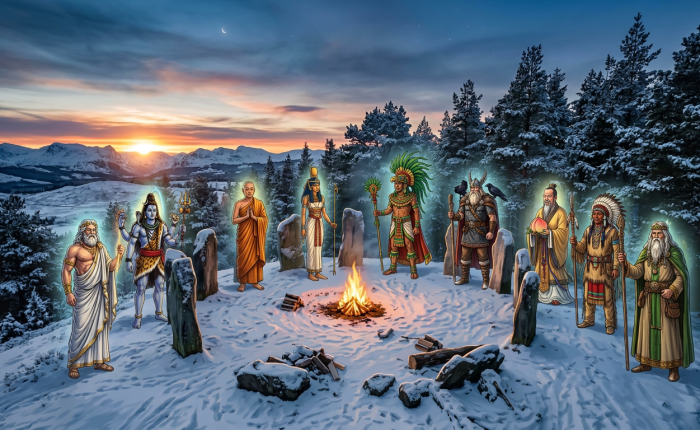
Mara: Right. The opening post lines up mother-and-son deity pairs across Babel, Assyria, Egypt, Greece, and Rome — Semiramis and Tammuz, Isis and Horus, Venus and Cupid — and argues that each mirrors the Christian nativity story, with each son dying and being resurrected. The claim is that Satan has been running a counterfeit since Genesis.

Pip: That is a lot of mythology to carry into a December shopping mall.

Mara: Part two is where Christmas specifically comes under examination. It traces December 25th not to Scripture but to Constantine, who set the date in pursuit of unity between Christians and pagans, and to Emperor Aurelian’s earlier “Natalis Solis Invicti” — the festival of the birth of the invincible sun. Saturnalia, Yule, and Egyptian sun-god worship all feed into what became Christmas tradition.

Pip: Part three follows the same thread to Santa Claus — tracing the figure through Saint Nicholas, Sinterklaas, Father Christmas, and Odin. The post is candid that the author once dressed as Santa and staged annual nerf-gun battles, and still does not call that pagan worship. But knowing the lineage changed the calculus.

Mara: The series closes by invoking King Hezekiah from 2 Kings 18, who tore down the high places and even destroyed the bronze serpent Moses had made, because Israel had begun worshiping it. The application is direct: worship that is tainted by pagan cultural influences needs to be torn down, not accommodated.

Pip: The warning is not aimed at people who celebrate Christmas. It is aimed at anyone who has never asked why they celebrate it the way they do.

Mara: And that concern about unexamined worship — about what we carry into our practice without scrutiny — is exactly where this series leaves us.


Pip: The through-line here is accountability — not condemnation, but the idea that one day we answer for how we worshiped, not just that we did.

Mara: Which makes the question less about tradition and more about attention. Whether we are actually looking at what we are doing and why.

Read Each Post at the links:

Paganism and the Church Part One

Paganism and the Church Part Two
Paganism and the Church Part Three

Paganism and the Church Part Four

Paganism and the Church (part three)

Paganism and the Church (part three)

There is a character who happens to be a wizard named Gandalf the Grey, later becoming Gandalf the White, who appears in the series of writings by J.R.R Tolkien, The Hobbit, and The Lord of the Rings series.  Gandalf is described to be a long-bearded fellow dressed in grey, later white, and carrying a staff. i was looking at photos today of Odin the Germanic pagan god, and thought, “wow, now there are some similarities here!” Could we begin to draw similarities between everything and in so doing, make everything sacred or everything unholy depending on our take?

Yes, we could, and yes, we have, in many instances, on many topics. This is the main reason that i want to be very careful as we tred into custom, tradition, holiday’s, and paganism. i don’t want to lead anyone into confusion or misunderstanding, but in everything, cause you, the reader, to think critically and examine Scripture thoroughly.

Last week we talked about the history and timing of Christmas as it relates to pagan traditions, Saturnalia, Yule, and Egyptian sun god worship. There is a figure that each of these traditions has that have surprising similarities. In fact, build upon each other within the ongoing mixing of many of these celebrations.

Most notably or recognizable in our current culture, we know him as Santa Clause. No need to dive into who he is or the tradition surrounding him. However, our present Santa is an evolutionary being, drawn from the mixing of cultures throughout time. Chiefly, Saint Nicholas, Sinterklaas, Father Christmas, Kris Kringle, and Odin.

Is Santa just a fun cultural icon who is only one of many characters within the secularization of the Christmas holiday? Or, is he a well placed pagan influence, put there purposefully by the prince and ruler of this world? Well, i will be the first to admit that i had always looked at Santa as just a fun cultural icon of the secular side of Christmas. i even had a costume, dressing up as Santa, i placed gifts under the tree.

You could say it has been a tradition also as the kids have gotten older. They certainly knew that it is me, they even knew what they are getting, nerf guns. It was the same every year, and everyone opened them at the same time, and then, traditionally, an epic battle ensued. Is this a pagan tradition? Are we worshiping Odin? i can unequivocally say, no, we are not. Yet, were we opening doors that should have remained shut?

However, with that being said, once i knew how this cultural icon has evolved, could i continue with a clear conscience? Could i continue to celebrate the birth of Yahoshua (Jesus) along the same lines as an ever-evolving holiday tradition we know as “Christmas?”

The answer to that is also, no, i cannot. If i want to celebrate within culture a holiday tradition i certainly am free to do so. Even still once i cross the line or blur the line of worshiping Yahoshua (Jesus), Adonai, my Savior, and use elements that are known by me and everyone else to have pagan history and influence, i am compelled by what i read in Scripture to stop.

“And he did what was right in the eyes of the Lord, according to all that David his father had done. He removed the high places and broke the pillars and cut down the Asherah. And he broke in pieces the bronze serpent that Moses had made, for until those days the people of Israel had made offerings to it (it was called Nehushtan). He trusted in the Lord, the God of Israel, so that there was none like him among all the kings of Judah after him, nor among those who were before him. For he held fast to the Lord. He did not depart from following him, but kept the commandments that the Lord commanded Moses. And the Lord was with him; wherever he went out he prospered. He rebelled against the king of Assyria and would not serve him.” 2 Kings 18:3-7

Notice here that King Hezekiah, to honor God, destroyed all the high places. The “high places” is another term for “holy” sights or places of pagan worship. He broke down the Asherah, again pagan symbols of worship and even the serpent that Moses was instructed by God to make when the children of Israel were being tormented by the serpents in the desert.

You see, the Israelites took something God used for good and began to worship it as a god. We can and have done the same thing within the Christian culture. We have taken things God created for our good and have worshiped them instead of God. We need to be as bold as King Hezekiah and begin to tear down those things that we have elevated or given special honor over YHWH in our worship, through worship that is tainted by pagan cultural influences.

Do you have high places that you have built up? Have you set up Asherah poles or other forms of pagan worship within your worship of God? If so, tear them down! And do it now, and do it quickly! God does not want your pagan influenced religion. He wants you to seek Him with your whole heart, soul, mind, and strength. He desires to be worshiped in spirit and in truth, untainted by the world.

Continue Reading Paganism and the Church Part Four

You are loved,

cj

Paganism and the Church (part two)

Paganism and the Church (part two)

So comes our descent into the grand tradition of Christmas. The “holy” days or holidays as we know them. Full of culture, family, celebration, gifts, decorations, food, food, and more food. It’s a merry time, had by many. It brings out goodwill in the masses, a charity of heart to our neighbors. What could possibly be vile or evil in such a time as this? Indeed, many Christians will point out that: Christmas is the celebration of the birth of Jesus, the Messiah. Who came that we might have life and that to the full. (John 10:10)

What traditions within our celebration of Christmas were first observed within pagan festivals? Specifically, Saturnalia, Yule, and Egyptian beliefs. As well as similarity in the dates of the observance of the celebrations. Although, in the case of the Egyptian festivals, dates are not easily acquired because their calendar is, well, a wreck. Therefore, in this instance, we will take the similarities of the festival and relate it the best we can. i do find it interesting that Satan is talked about as disguising himself as an angel of light, and each of these pagan traditions involves a sun god.

“For such men are false apostles, deceitful workmen, disguising themselves as apostles of Christ. And no wonder, for even Satan disguises himself as an angel of light. So it is no surprise if his servants, also, disguise themselves as servants of righteousness. Their end will correspond to their deeds.” 1 Corinthians 11:13-15

In Ezekiel, we read a depiction of  Satan and his desire to rise to the place of God. He wanted to be above all the angels. Yes, we can see that Satan is an egomaniac, and any worship of him that he can generate, even indirectly, is to him a win. It is probably one of the many reason’s, not that any are needed, for God’s decree that we are not to worship YHWH our Creator like the nations worship their pagan false gods. We are not to intermix worship practices but are told to eliminate them from our lives completely.

So this week, let’s look at some of the history of these festivals and our observance of Christmas, and you can decide which is right and how best to honor God. After all, it is you that will have to stand before Him one day and give an account, ignorance will not be an excuse, at least not anymore.

For instance, although the early church did not have a specific day to honor the birth of Christ, we have a general understanding that it was still significant in the history and telling of Yahoshua (Jesus) as we read in the Gospels of Mathew, Luke, and referenced in John.

At some point in the first century around the time of Telesphorus. He is believed to be the second Bishop of Rome. It is Telesphorus, who began a set-aside time to honor “Jesus'” birth called, “The Nativity of our Lord and Saviour.” It’s worth noting that at this time, the Nativity, was recognized in September along with the Feast of Trumpets.

In fact, for 300 years the Nativity was celebrated on many days depending on where one was in the world. The recognition of December 25, as Jesus’ birthday, was a move by the Roman Emperor and self-proclaimed Bishop of Rome Constantine. His desire was unity among the Christians and the pagans, as well as perhaps making Christianity more palatable for the pagans to convert.

Saturnalia was a celebration of the sun god. It was celebrated from December 17th through the 24th. Part of the celebration included lighting bonfires in honor of the sun and with the idea of helping it defeat the darkness. When the days would begin to get longer generally recognizable around the 23rd. Although this date could be as late as the 26th.

Later in 274 A.D. under the Roman Emporer, Aurelian proclaimed the date as “Natalis Solis Invicti,” the festival of the birth of the invincible sun and set the date as December 25th. In 320 A.D., Pope Julius I specified the 25th of December as the official date of the birth of Jesus Christ.

Yule dates back to as early as the 4th century A.D. It would later become known as Christmastide. Yule was a 12-day festival that landed between mid-November and early January. Interesting to note that January 7th, which often ended Yule is for many the day they observe the Nativity or Christmas day to this day (a few exceptions observe the 6th). Coptic Orthodox located in Eygpt and the Middle East as well as Central and Eastern Europe.

Although, there are many reasons it is notable to say that during this time, two calendar systems were in use, the Julian calendar that pre-dates the Gregorian calendar, which is commonly observed today. What is Yule, well they were original celebrations of the Wild Hunt, the god Odin, and the pagan Anglo-Saxon Mōdraniht.

Again the Egyptians worshipped many gods, including a sun god. However, their calendar was so confusing they didn’t even know how it worked resetting it often. So i will only state here that as we look at the traditions of these festivals more in-depth and begin to recognize how the church co-opted many of the pagan practices in their Christmas celebrations we will see Egyptian influence.

Let me close this entry with this, i am not in any way discouraging the celebration of the birth of Yahoshua (Jesus). It is clear that the early church remembered the Nativity. However, it is my goal to get us to think critically and honestly as we walk this narrow road together worshiping the One True God, as He desires, and not as the pagans do.

“. . . take care that you be not ensnared to follow them after they have been destroyed before you and that you do not inquire about their gods, saying, ‘How did these nations serve their gods?–that I also may do the same.’ You shall not worship the Lord your God in that way, for every abominable thing that the Lord hates they have done for their gods . . .” Deuteronomy 12:30-31 (in part)

i would state this for the record, I do not think Christians should participate in Christmas. If we are to honor the day of our Messiah’s birth we should look at History and see that in fact it is most likely Yahoshua was born in either the Fall or the Spring, along with the birthing of the Passover Lambs. As Yahoshua was/is the Lamb of God who takes away the sin of the world.

Continue Reading Paganism and the Church Part Three

You are loved,

cj