“On the very same day Noah and his sons, Shem and Ham and Japheth, and Noah’s wife and the three wives of his sons with them entered the ark” (Genesis 7:13)
What does a remnant look like? To answer that we first need to know what the word remnant means. According to Dictionary.com it is: a remaining, usually small part, quantity, number, or the like . . . a surviving trace or vestige, as of a former era. In the narrative of Noah and the Ark a remnant was eight people. Along with pairs of animals of every kind, seven pairs of clean and one pair of unclean. A remnant is very small.
What did Noah have that the other people did not? Was it Noah alone that secured his family? The narrative indicates that it was Noah and that because of Noah his family was also saved. So then was the remnant one?
“So Yahweh said, ‘I will blot out man whom I have created from the face of the land, man and animals and creeping things and birds of the heavens, for I am sorry that I have made them.’ BUT Noah found favor in the eyes of Yahweh.” Genesis 6:7-8
Yahoshua said, “As it was in the days of Noah, so will it be at the coming of the Son of Man.” (Matthew 24:37). To be fair in this reference He was speaking primarily of preparedness. However, one cannot help but wonder if also there isn’t a deeper meaning being revealed between the lines. Yahoshua, is our Ark of Salvation. It is through Him that we find Favor in the eyes of the Father. Not of our own works but simply through the work of the Messiah. Much like Noah’s family. It was Noah who found favor in the eye’s of Yahweh, and it was Noah’s family that chose to listen. They chose obedience in following their father.
For a hundred years Noah and his family built the Ark and the people scoffed. Had they listened, would they have been counted in the remnant? Had they chosen to fear Yahweh and turn from their wickedness, would they have been counted worthy of the remnant? I only ask the question, I do not have an answer given the absolute corruption of the time. Much like Sodom and Gomorrah, was Lot righteous or was it because of Abraham that Lot and his family were spared? And in that, it wasn’t all of Lot’s family for his son’s-in-law scoffed at him and he fled with only his wife and two daughters. Lot’s wife didn’t even make it because she turned back.
Yahoshua, is revealed not only as the Anointed One, but as the Son of Elohim. His obedience even to death on a tree. Paul writes to the Philippians, “And being found in human form, He humbled Himself by becoming obedient to the point of death, even death on a tree.” Of which I remind you, was not deserved, but rather He exchanged His life, His righteousness, His favor for our life, our sins, our condemnation.
Even still, it seems that only a remnant will be saved, because only a remnant chooses obedience. But some will quote Pauls letter to the Romans. They will point out it isn’t by works but by grace. Let’s look at the passage so many like to point to . . .
“I ask, then, has God rejected His people? By no means! For I myself am an Israelite, a descendant of Abraham, a member of the tribe of Benjamin. 2God has not rejected his people whom he foreknew. Do you not know what the Scripture says of Elijah, how he appeals to God against Israel? 3“Adonai, they have killed Your prophets, they have demolished Your altars, and I alone am left, and they seek my life.” 4But what is God’s reply to him? “I have kept for Myself seven thousand men who have not bowed the knee to Baal.” 5So too at the present time there is a remnant, chosen by grace. 6But if it is by grace, it is no longer on the basis of works; otherwise grace would no longer be grace.” (Romans 11:1-6)
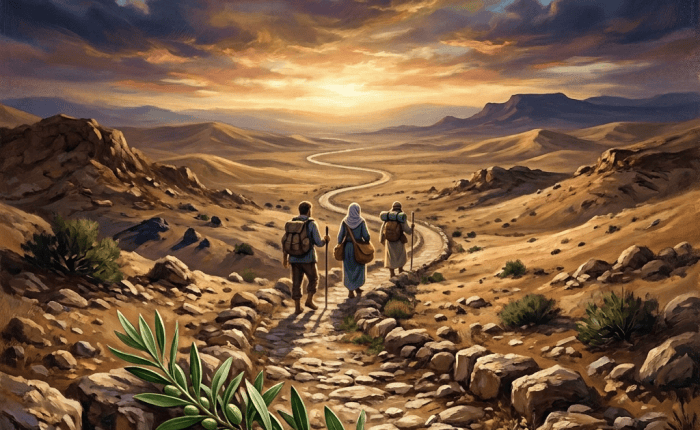
Yahweh says, “I have kept for Myself . . .” He is the author and finisher of faith, but does that remove us and our decisions from the equation? Absolutely NOT! We are still faced with a choice to follow or not to follow. We are still faced with the fork in the road, in one direction there is a wide easy road with many a traveler on it. And in the other direction, a narrow path, with only a few travelers. You see there is still a choice, obedience or not, walking in the spirit or walking in the flesh.
The choice Lot’s wife made to disobey the instruction of fleeing Sodom, she turned back and was turned to a pillar of salt. She chose disobedience. Even Noah’s son who made it on the Ark was later cursed. He wasn’t honoring, he wasn’t obedient. He chose dishonor and suffered for it not only Ham but his descendants. “Cursed be Canaan; a servant of servants shall he be to his brothers.” (Genesis 9:25)
The remnant which is small is based on obedience to the instructions of Elohim. As Paul writes to the Romans of broken branches and grafted in branches it is those who choose to walk in the kindness of Elohim; which is to say, to walk in covenant. Everything is by covenant, hence the term New Covenant. Which is only new in the sense that it is now written on our hearts and on our minds. And we are given a helper, the Holy Spirit, to help us walk it out. To guid us on the narrow road.
“17But if some of the branches were broken off, and you, although a wild olive shoot, were grafted in among the others and now share in the nourishing root of the olive tree, 18do not be arrogant toward the branches. If you are, remember it is not you who support the root, but the root that supports you. 19Then you will say, “Branches were broken off so that I might be grafted in.” 20That is true. They were broken off because of their unbelief, but you stand fast through faith. So do not become proud, but fear.
21For if God did not spare the natural branches, neither will He spare you. 22Note then the kindness and the severity of God: severity toward those who have fallen, but God’s kindness to you, provided you continue in his kindness. Otherwise you too will be cut off. 23And even they, if they do not continue in their unbelief, will be grafted in, for God has the power to graft them in again.” (Romans 11:17-23)
What then does it mean to walk in His kindness? To not be proud, but fear? How often is it written, “the Fear of Adonai is the beginning of wisdom”? Job which is believed by some to predate all of scripture, meaning that it was written even before Moses records Elohim’s Torah. His instruction to His people, of which, as we just read, we are grafted into as gentile believers, or re-grafted in as natural branches by faith. Faith being active, for more on that read this post here: Understanding Faith: Beyond Belief and Action. (Note: Some Rabbinic traditions attribute Job to Moses.)
Regardless of when it was written or who wrote it, it is an ancient writing. A writing in which the author attributes Job to saying, “Behold, the fear of Adonai, that is wisdom and to turn away from evil is understanding.” (Job 28:28) Turning from evil is a choice, fearing Elohim, is also a choice and it is required.
It is required of the remnant of Israel and it is required of those who would choose to be grafted into Israel. There is only one covenant and it is made with Israel, for Israel, and the only way to become a part of it is to join with Israel. The New Covenant remnant. It is no longer a nation, as we define a nation today it is a people of God that choose Yahweh’s instruction, fear, reverence, and the turning from the wickedness of this present age.
There is a second exodus spoken of in Scripture when Elohim will gather His people, both the natural branches that walk in His kindness by Faith, and those foreigners, gentile believers. Who by Faith choose to honor the Father by living in the fruit of the Spirit and not the acts of the flesh.
Will you choose the remnant? Will you choose the narrow way? Will you choose to enter the new covenant? These are the questions only you can answer, choose wisely, as eternity, your eternity and perhaps by implication, the eternity of your family depends on it.
You are loved,
cj