Podcast Episode: Samhain, Halloween and the Church: Testing Tradition by Scripture

Podcast Episode: Samhain, Halloween and the Church: Testing Tradition by Scripture

Pip: Every October, the church faces the same annual identity crisis: candy corn, carved pumpkins, and a theological question nobody quite wants to answer out loud. cj, writing for The Way of the Rabbi, decided to answer it anyway.

Mara: This episode follows that argument — where Halloween’s roots lead when you trace them through Scripture, and what the Bible actually says about borrowing from pagan tradition.

Pip: Let’s start with Samhain, All Saints Day, and the case for testing everything against the text.

Samhain, Halloween and the Church: Testing Tradition by Scripture

Mara: The central tension here is straightforward: when the church adopts a cultural practice to reach people, is it being missional — or is it assimilating into something Scripture explicitly warns against?

Pip: The post opens with the Berean standard as its benchmark, and then drops this from Acts 17:11: “Now the people here in Berea were of nobler character than the ones in Thessalonica; they early welcomed the message, checking the Tanakh every day to see if the things Paul was saying were true.”

Mara: The upshot is that no tradition — not even one sanctioned by a church council — gets a pass from that test. The post is asking readers to apply that same standard to Halloween itself.

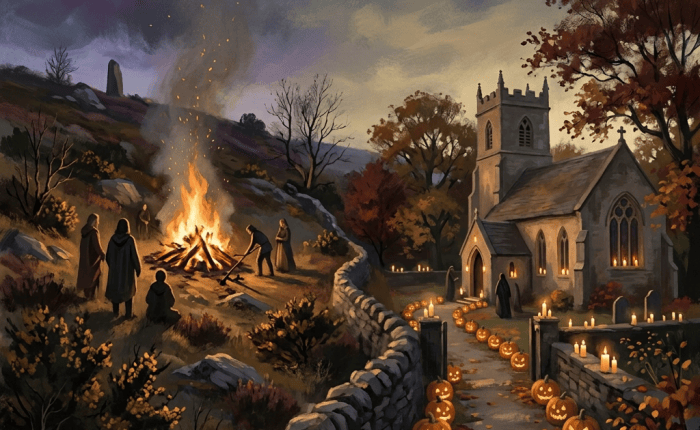
Pip: And when you do apply it, the historical record gets uncomfortable fast. All Saints Day was originally a May festival, moved by papal decree to October 31st specifically to overlay the Celtic observance of Samhain — the night pagans believed the veil between the living and dead grew thin.

Mara: The post is direct about what Scripture says in response. Deuteronomy 12:30 reads: “be careful not to be ensnared by their ways after they have been destroyed before you. Do not inquire about their gods, asking, ‘How do these nations serve their gods? I will do likewise.'”

Pip: So the argument isn’t “Halloween is spooky, therefore bad.” It’s that the mechanism — coopting a pagan observance to make it Christian — has no scriptural warrant, and the text runs the other direction entirely.

Mara: Paul’s instruction to the Thessalonians reinforces it: “Abstain from every form of evil.” The post also points out that Scripture already provides harvest celebrations — the biblical feasts — so the need to borrow from outside isn’t obvious to begin with.

Pip: There’s a prayer request quoted in the post that stops the argument cold — someone writing that they want to leave Halloween behind and finding it genuinely hard to do. That’s not a theological abstraction.

Mara: Right. The post draws a parallel to 2 Chronicles 30, where Hezekiah called Israel back to Passover and the people laughed the couriers out of town. The suggestion is that the dynamic inside the modern church isn’t entirely different.

Pip: Tradition is a powerful current, and ridicule is apparently a timeless crowd management tool.

Mara: The post closes by redirecting toward the biblical feasts — Passover, First Fruits, Pentecost — as the framework already given for marking death, resurrection, and the Spirit. The argument is that the replacement was already there.


Mara: The thread running through all of this is a single question: who gets to define the terms of worship — inherited tradition, or the text itself?

Pip: Apparently that question gets asked every October, and every October most people are busy buying candy. Next time, we’ll see what else is on the table.

Read the post in its entirety here: Samhain, Halloween and the Church: Testing Tradition by Scripture

Samhain, Halloween and the Church: Testing Tradition by Scripture

Samhain, Halloween and the Church: Testing Tradition by Scripture

“Not many of you should become teachers, my brothers, since you know that we will be judged more severely.” James 3:1

There are so many ‘teachers’ out there today it is hard to believe that this verse even exists. Then again, perhaps that’s why the verse is there in the first place, to warn us. Who are you listening to? Who are you allowing to influence your understanding of Scripture? According to James that circle should be very, very, small. In my writing to you it isn’t my goal to teach you but to encourage you, to encourage you to search the Scriptures daily to see whether or not what you are being taught is true. To be Berean, and to meditate on the Word, in order to absorb it into every fiber of your being.

Acts 17:11 “Now the people here in Berea were of nobler character than the ones in Thessalonica; they early welcomed the message, checking the Tanakh (Scriptures) every day to see if the things Paul was saying were true.”

Psalm 1:1-3 “How blessed are those who reject the advice of the wicked, don’t stand on the way of sinners or sit where scoffers sit! Their delight is in Adonai’s Instruction; on His Torah they meditate day and night. They are like trees planted by streams – they bear their fruit in season, their leaves never wither, everything they do succeeds.”

We are on the doorstep of a once prominent Catholic/Christian holiday called All Saints Day. It was established to celebrate and acknowledge saints and martyrs. Originally, it was a festival decreed by the Pope back in 609AD but in the month of May. Later through various Papal decrees it was moved to the Celtic day of Samhain October 31-November 1st in order to Christianize a pagan holiday. Samhain, in pagan tradition and belief is the time of year the veil between the living and the dead is the thinnest and therefore marks the crossing of souls into the afterlife. 

Sounds like a good idea right? Honoring saints and martyrs of Christendom, while attempting to convert pagans by co-opting their holiday. But tradition and reason aside what does the Bible say, you know, Scripture, the Torah, the Tanakh, and what have the writers of the new Testament have to say? The answer may surprise many because many ‘Teachers’ teach that you can redeem pagan things and practices. 

Unfortunately, there is no evidence of this found in Scripture. Actually, the opposite is true. Those who follow Yahweh are called to separate themselves from the worldly culture or  pagan practices and influences that surround them. Lest they fall into the temptation of practicing such things. John in his writing of Revelation says, “Come out of her my people.” Speaking of Mystery Babylon, but why? He explains; “She has become a home for demons and a haunt for every evil spirit, a haunt for every unclean and detestable bird.” What happens if we ignore the warning? “so that you will not share in her sins, so that you will not receive any of her plagues; for her sins are piled up to heaven, and God has remembered her crimes.” Revelation 18 goes into greater detail, detail you should understand.

We are called to avoid evil. Paul writes to the Thessalonians, “Abstain from every form of evil.” (1 Thessalonians 5:22)

Deuteronomy 12:30 – “be careful not to be ensnared by their ways after they have been destroyed before you. Do not inquire about their gods, asking, “How do these nations serve their gods? I will do likewise.” This is in reference to assimilating into or allowing pagan influences into the practice of Worshiping Yahweh. 

Deuteronomy 18:9 – “When you enter the land the Adonai your Elohim is giving you, do not imitate the detestable customs of those nations.” 

I am not sure how much clearer things can be spelled out. God is not honored by His people when they practice any culture other than the one He gave them. Does this mean we cannot have or celebrate culture? Absolutely not! However, it does call us to question motive and tradition. We are called to be separate from not unmistakably conformed to worldly practices and traditions. 

What about harvest festivals? Well, traditionally in Scripture there already are Feasts, in which we are called, to a celebration of the harvest. In fact there are Feasts within Scripture to honor the death and resurrection of our Messiah Yahoshua. It is not Easter, but Passover. The ultimate martyr and victor over sin and death. His resurrection was on First Fruits, which is celebrated and marked by a priest waving a sheaf of the first barley harvest. Pentecost, the day we remember the giving of the Holy Spirit, also lines up with the giving of the Torah on Mount Sinai.

Why does the church try so hard to manipulate God’s instruction for its own traditions? We cannot make things clean or unclean of ourselves of which God Himself has already declared to be true. If you are planning or perhaps already have started your celebration of Halloween or All-Saints-Day, it is my desire that you look into Scripture for your answer. Not the tradition of man, even that of the Pope. Be careful, be diligent, be purposeful, in your walk with Elohim. You cannot be a follower of Yahoshua (Jesus) and not obey His instruction. Yahoshua, is the Word made flesh. 

When coming out of mans tradition and an assimilation into pagan culture one can find it challenging. Especially, when the church you attend is throwing a harvest festival with non-scary costumes of Hollywood, and folklore demigods. A prayer request I came across on a prayer platform read: “I want to stop with the horror and Halloween stuff and I’m having a very hard time doing so. My 12-year-old niece is the same. It’s my fault.” This request grabbed my heart. For so long I was part of that culture of compromise and now that my eyes have been open I see the snare set by the enemy so many willingly walk into and then find it hard to get out.

When stepping out of pagan culture whether you are there intentionally or not is difficult at best. In 2 Chronicles 30 there is a history lesson to be learned. Hezekiah, the King of Judah, was a man who sought God and His ways. He realized that they should have been celebrating the Passover and so he sent out a decree to the tribes of Israel saying:

“O people of Israel, return to Yahweh, the God of Abraham, Isaac, and Israel, that He may turn again to the remnant of you who have escaped from the hand of the kings of Assyria. 7 Do not be like your fathers and your brothers, who were faithless to Yahweh Elohim of their fathers, so that He made them a desolation, as you see. 8 Do not now be stiff-necked as your fathers were, but yield yourselves to Yahweh and come to His sanctuary, which He has consecrated forever, and serve Yahweh your God, that His fierce anger may turn away from you. 9 For if you return to Yahweh, your brothers and your children will find compassion with their captors and return to this land. For Yahweh your God is gracious and merciful and will not turn away His face from you, if you return to Him.” 

But the people for the most part were stuck in their ways. The response to King Hezekiah’s decree was one of doubt and ridicule, in fact it says that most of the people laughed. 2 Chronicles 30:10 says: “So the couriers went from city to city through the country of Ephraim and Manasseh, and as far as Zebulun, but they laughed them to scorn and mocked them.” The church is the same today. Pastors will teach compromise in the spirit of outreach. But that is never prescribed as an avenue of outreach. But what is, is unity, one heart, one mind and the people desired what was being blessed. Besides the ‘Pastor’ of the church will ridicule you, even laugh at you for wanting to honor God the way He instructed us through His Word. The way Yahoshua taught. Not mans traditions but the Fathers instructions. 

There is so much more I could write and perhaps I will write on this but unfortunately most have already stopped reading at this point. Our attention spans have grown short and few desire to read. Rather choosing to be entertained by two minute videos on TicToc that mainly rot one’s brain. 

Wake up Church! Time is ticking away, you are not promised tomorrow so live for Messiah today!  “Come out of her My People!”

You are loved,

cj 

Podcast Episode: Understanding Rosh Hashanah: A Guide to Yom Teruah

Podcast Episode: Understanding Rosh Hashanah: A Guide to Yom Teruah

Pip: The Jewish new year falls in the seventh month. If that sounds like a scheduling conflict, you might be exactly the audience cj is writing for on The Way of the Rabbi.

Mara: This episode follows one extended meditation on Rosh Hashanah — what the Torah actually calls Yom Teruah, what that name means, and why the gap between biblical instruction and modern practice matters more than it might first appear.

Pip: Let’s start with the feast itself — the trumpets, the timing, and what gets lost when the calendar drifts.

Understanding Rosh Hashanah: Yom Teruah and the Call to Return

Mara: The post opens with a distinction that sets the whole argument in motion: Rosh Hashanah, as modern Judaism observes it, is not quite what the Torah prescribes. The biblical feast is Yom Teruah — placed in the seventh month, not the first.

Pip: And the name carries the weight. The post explains that “Teruah, in Hebrew means to cry-out, Shout loudly, and sound the trumpet. It is a call to attention!”

Mara: So the upshot is this: the feast isn’t primarily about a new year — it’s an alarm. Ten days before Yom Kippur, the Day of Atonement, the trumpet blast is meant to wake people up to the need for repentance. The calendar drift softens that urgency.

Pip: The post then takes a long step sideways into 1 Samuel 8, and it’s not actually a detour. The people demand a king; God tells Samuel they haven’t rejected Samuel — they’ve rejected God. It’s the same pattern being traced across millennia.

Mara: And the lesson doesn’t stop at the demand. A few chapters later, in 1 Samuel 10, the people receive exactly the king they asked for and are still dissatisfied. The post draws the parallel plainly: we pray for answers, get them, and remain unhappy.

Pip: Which is a fairly precise description of asking God to move the feast days to more convenient dates.

Mara: The post names that directly. Modern Judaism adjusted the timing. The modern church, the post argues, went further — replacing Passover with Easter, and celebrating the Feast of Tabernacles under the name Christmas, without recognizing what they’re doing.

Pip: The scriptural anchor for why this matters is Daniel 7:25 — the lawless one “intending to change the appointed times and laws.” Drifting calendars aren’t a minor administrative matter in this framework.

Mara: The post closes with the actual Torah instructions from Leviticus 23 and Numbers 29 — a sacred assembly, no regular work, trumpet blasts — and then pivots to the feast’s forward significance. The spring feasts were fulfilled through the death and resurrection of Messiah; the fall feasts, including this one, point to his return.

Pip: First Thessalonians 4 and First Corinthians 15 both land on the same image: a trumpet sounds, the dead rise, and everything changes in the twinkling of an eye.

Mara: The post’s final word is that these are not Jewish feasts or Christian feasts — they are Elohim’s feasts, for Israel and for the foreigner grafted in alike. The instruction is simple: take up the Word and keep them.

Pip: A trumpet as an alarm clock for the whole household — that’s the image the post leaves you with, and it’s hard to shake.


Mara: The thread running through all of this is the gap between what was given and what we’ve made of it — and the cost of not noticing.

Pip: The trumpet is still sounding. Next time, we’ll see what else the calendar has to say.

Read the entire post here: Understanding Rosh Hashanah: A Guide to Yom Teruah

Understanding Rosh Hashanah: A Guide to Yom Teruah

Understanding Rosh Hashanah: A Guide to Yom Teruah

Today on the modern Jewish calendar marks, Rosh Hashanah. The Jewish new year. They have incorporated it into Yom Teruah, the Feast of Trumpets. It is the only Biblical Feast that does not have a known day or hour as it is marked by the sighting of the first sliver of the moon or the waxing crescent. Teruah, in Hebrew means to cry-out, Shout loudly, and sound the trumpet. It is a call to attention! The fall Feast days have arrived and it begins with a call to attention, and a focus on repentance until the day of atonement, Yom Kippur, now 10 days away. Modern Judaism has removed the waiting and marked a generally close proximity start to Rosh Hashanah.

Rosh Hashanah, or Head of the Year. They call it the new year even though quite clearly the Torah calls this Feast Yom Teruah, and places it in the seventh month. Pesach, or Passover, is in Nisan which is the first month of the year according to Torah. They still use it to call in a time of reflection to begin the (spiritual) new year with repentance but obedience is found in the little things. And it is easy, if one isn’t paying attention to lose sight of the little things and thereby missing the entire thing altogether.

In my daily reading of Scripture I am in 1 Samuel. In chapter eight verses six through nine the people ask for a king and Elohim responds to their request by telling Samuel, “But when they said, ‘Give us a king to judge us,’ their demand was displeasing in the sight of Samuel; so he prayed to YHWH. And YHWH said to Samuel, “Listen to the voice of the people in all that they say to you. For it is not you they have rejected, but they have rejected Me as their King. Just as they have done from the day I brought them up out of Egypt until this day, forsaking Me and serving other gods, so they are doing to you. Now listen to their voice; but you must solemnly warn them and show them the manner of the king who will reign over them.”

When I began waking up to Torah and to Faith in Yahoshua as well as obedience to the commandments of Elohim. As Revelation 14:12 says: “Here is a call for the endurance of the saints, those who keep the commandments of God and their faith in Yahoshua (Jesus).” I started by reading and reading and reading the Torah. What is the history being told. When you understand its history and the arch of faith the people of Israel were on you can better understand that the modern church is essentially on this same arch. We have brushed aside the commands of God for the traditions of men. We have demanded our own way and by so doing have rejected God, the one who has brought us out of spiritual bondage.

And even still we are unhappy. Look at the rest of the lesson found in 1 Samuel. Just a few chapters later, ten verse twenty-seven we read: “But some worthless men said, ‘How can this man save us?’ So they despised him and brought him no gifts; but Saul remained silent about it.” God gave them the king they demanded and still they were not happy. Are we not often of the same mind. We pray and pray for answers, and when the answer is given we are still unhappy with the answer.

God has told us in His Word when the Feasts are and what they are meant to accomplish. Yet, modern Judaism has changed their meanings and essentially the timing. The modern church has thrown them out entirely for man made traditions of Christmas, the celebration of Jesus’ birth and coming to dwell with us. Which is the very celebration of the Feast of Booths or Feast of Tabernacles, the last of the Fall Feasts. They have chosen Easter over Passover discarding the very meal they claim to take in remembrance of Him.

Both of these are marks of a rebellious spirit of which we are warned of in Scripture multiple times. Daniel 7:25 says; “He will speak out against the Most High and oppress the saints of the Most High, intending to change the appointed times and laws; and the saints will be given into his hand for a time, and times, and half a time.” ‘He’ who Daniel is referring to is the lawless one, the Anti-Messiah or Anti-Christ. The coming of the lawless one, as we read in 2 Thessalonians 2:9-12 is marked by, well lawlessness, which is to say without Torah.

“The coming of the lawless one will be accompanied by the working of Satan, with every kind of power, sign, and false wonder, and with every wicked deception directed against those who are perishing, because they refused the love of the truth that would have saved them. For this reason God will send them a powerful delusion so that they believe the lie, in order that judgment may come upon all who have disbelieved the truth and delighted in wickedness.” What is the TRUTH, God’s Word is Truth. John 17:17 – “Set them apart for holiness by means of the truth – Your Word is TRUTH.” These are the words Yahoshua prayed before being hung on a tree. And wickedness which they delight are the very acts committed outside of Torah.

Here is the stated instruction for the Feast of Trumpets or Yom Teruah in Leviticus 23:23-25 – “YHWH Adonai also said to Moses, “Speak to the Israelites and say, ‘On the first day of the seventh month you are to have a day of rest, a sacred assembly announced by trumpet blasts. You must not do any regular work, but you are to present a food offering to YHWH.’” Later in Numbers 29:1-6 we read:

“On the first day of the seventh month, you are to hold a sacred assembly, and you must not do any regular work. This will be a day for you to sound the trumpets. As a pleasing aroma to YHWH, you are to present a burnt offering of one young bull, one ram, and seven male lambs a year old, all unblemished, together with their grain offerings of fine flour mixed with oil—three-tenths of an ephah with the bull, two-tenths of an ephah with the ram, and a tenth of an ephah with each of the seven male lambs. Include one male goat as a sin offering to make atonement for you. These are in addition to the monthly and daily burnt offerings with their prescribed grain offerings and drink offerings. They are a pleasing aroma, a food offering to YHWH.”

There are other references throughout the Tenakh of Yom Teruah or the Feast of Trumpets as well. Ezra 3:1-6 and Nehemiah 8:1-12 and a poetic reference in Psalm 81:3. There is also a coming significance to the Feast of Trumpets. Just as Adonai fulfilled the Spring Feasts through the Death and Resurrection of our Messiah Yahoshua, so the Fall Feasts will mark His coming again. This time not as suffering servant but as Adonai and King!

1 Thessalonians 4:16-17
“For Adonai Himself will descend from heaven with a loud command, with the voice of an archangel, and with the trumpet of God, and the dead in Messiah will be the first to rise. After that, we who are alive and remain will be caught up together with them in the clouds to meet Adonai in the air. And so we will always be with Adonai.”

1 Corinthians 15:51-53
“Listen, I tell you a mystery: We will not all sleep, but we will all be changed— in an instant, in the twinkling of an eye, at the last trumpet. For the trumpet will sound, the dead will be raised imperishable, and we will be changed. For the perishable must be clothed with the imperishable, and the mortal with immortality.“

These are not Jewish Feasts, these are Biblical Feasts, they are indeed Elohim’s Feasts and they are for both the Israelite and the foreigner who dwells among them. Those who call on the name of Yahoshua are grafted into the root and that roots foundation is Elohim’s Word which taken in its entirety is not an unbearable yoke but freedom from sin and death.

Take up the Word of Truth and discover all that it has for you in keeping the Feasts of Elohim.

You are loved,
cj

Understanding Faith: Beyond Belief and Action

Understanding Faith: Beyond Belief and Action

What does it mean to have faith, to truly have faith? Often faith and belief are incorrectly considered interchangeable. Belief, is intellectual. It is said, “that even the demons believe and tremble.” Belief isn’t the problem. Many say they believe in an afterlife, even belief in a higher power. That belief gets you nowhere if it is not active. That is where faith comes in. When I enter a room I can believe the lights work, that the switch works, that if I flip the switch it will turn on the light; But, if I don’t actually flip the switch nothing will happen. Or the oven, I know that the oven will cook my food but if I do not turn it on nothing will happen.

When we read about faith in the Tanakh, (Old Testament) we see it as active obedience. Hebrews 11 gives us a quick account of the pillars of Faith. The writer makes it a point to say, by Faith, “By Faith, Noah . . . in reverent fear constructed”, “By Faith, Abraham, obeyed . . .”. The word Faith in Hebrew is אֱמוּנָה – Emunah. It means a steadiness, as in a steady walk of obedience. A steadfastness, faithfulness in keeping the ordinances of God.

The Greek counterpart is πίστις – pistis. The Greek culture was known and is still known for its philosophers, and artisans of various types and skill. Just take a look at any capital city and for the most part you will see a Greco-Roman influence. Rome simply adopted the majority of Greek culture. So when the Apostles wrote their letters, mostly in Greek the word they had for faith was pistis. Having no other real viable choice. Pistis, is faith without power, faith without substance, a mental understanding without an outward expression.

Perhaps this is why James writes pistis, without works is dead. Works in this greek context is Ergon and it means occupation, employment, undertaking. So James is combining two Greek words in order to present one Hebrew truth, Faith is active, it requires action, one cannot say they believe and not show it by their undertakings.

Paul is recorded in Acts as telling those in Ephesus about being watchful for ravenous wolves coming into the flock and deceiving many. Just before that warning he talks about his lifestyle, how he conducted himself and told those under his care to do likewise. He said that he was instructed both the Jew and the Greek (gentile). Now what do you think ravenous wolves would look like? Would you say that they would draw men unto themselves to practice ways foreign to God or do you think ravenous wolves would teach obedience to God?

Before you answer Pharisee, remember Yahoshua (Jesus) called out the Pharisees for teaching the doctrines of man. The message has always been one of repentance, a turning from disobedience to obedience. Turning from the ways of man to the instruction of Elohim. Some will point out Colossians 2:16 and say they aren’t required to keep the ordinances of God any longer. They do so without considering the culture in which this letter was being written. It was a Greek philosophical culture mixed with a sect of Judaism bound in mans traditions. Both equally astray from אֱמוּנָה – Emunah, Faith in YHWH.

Just look at Pauls warning earlier in that same chapter. “Therefore, as you received Messiah Yahoshua your Adonai, so walk in Him, rooted and built up in Him and established in the Faith, just as you were taught, abounding in thanksgiving. See to it that no one takes you captive by philosophy and empty deceit, according to the human tradition, according to the elemental spirits of the world, and not according to Messiah.”

So when Paul is talking about food and drink, or festivals and new moons or Sabbaths he is drawing a contrast between the culture and God’s instruction. He is actually calling on those who would be otherwise chastised for keeping them to do so without condemnation. The Pharisees who were surely to judge the gentile for keeping them and the pagan culture around them for keeping what was considered a “Jewish thing”. Sound familiar? It should because it is the same argument being made today. Sadly, the greek influenced church is the pagan voice today.

Think about it, Paul warns not to be taken captive by philosophy, a major part of Greek culture. Deceit, something Yahoshua also warned about in Matthew 24:4 essentially saying, “Don’t let anyone deceive you.” According to human tradition, now let me ask you, are Christmas, Easter, Sunday, a human tradition or a Scriptural one? In contrast are the Feasts of Elohim; Passover, First Fruits, Pentecost, Atonement, Trumpets, Tabernacles, Sabbath, are they God’s instruction? The Church will fight tooth and nail for human tradition while calling God’s Feasts a thing of the past. Do you think that is according to the elemental spirits of the world?

Certainly not according to Messiah who was the Passover Lamb, the Word (Torah) made flesh, Adonai of the Sabbath, Light of the World, The Way, The Truth and The Life . . . all of which the Torah is described. He is the First Fruits, He is both the Torah revealed to Moses at Mt. Sinai on the Feast of Weeks, Pentecost as well, through Him the gift of the Holy Spirit was given on Pentecost, a.k.a. Feast of Weeks. He is our Atonement, He is coming with a Trumpet blast, He is coming to Tabernacle with us for a Millenia. Are you seeing a pattern?

The devil is a copycat. He has mimicked and attempted to mirror celebrations but he cannot duplicate perfection which is what Torah is. God’s Word is true and He calls us to walk in its light. It isn’t about perfection it is about Faith, Emunah. A steadiness, as in a steady walk of obedience. A steadfastness, faithfulness in keeping the ordinances of God. Do you want human tradition or God’s perfect instruction? Only you can answer that question.

You are loved,
cj

Understanding the New Covenant: Its Roots and Significance

Understanding the New Covenant: Its Roots and Significance

We are currently in the period between the Resurrection of our Messiah Yahoshua (Jesus) and Pentecost. The point in the upper room where the disciples were given the promised gift of the Holy Spirit. Many say it was the installation service of the New Covenant. What exactly is the New Covenant? First, let’s explore what the old covenant is and when it was established.

Did you know Pentecost wasn’t a new event on the calendar? It was and is still the remembrance of the giving of the Torah. The instruction of God to His chosen people. Before you say, “that’s for the Jews.” Ask yourself, are you one of His chosen people today? The Feast of Weeks was the offering of the new grain. It is celebrated fifty days from Passover and the Feast of First Fruits. For perspective, there is Passover, the very next day begins the Feast of Unleavened Bread. On the third day, in the middle of Unleavened Bread is the Feast of First Fruits.

From when the children of Israel departed Egypt, having passed through the Red Sea, until they arrived at Mt Sinai and Moses received the Torah was approximately fifty days. It all aligns with the Feasts of Elohim. These aren’t Israels feasts, although they are commanded to keep them as a remembrance of all God did for them. They are indeed, as God calls them Himself, His Feasts. When we keep His Feasts we honor Him and remember His kept promises as we look to the fulfillment of Yahoshua’s second coming. In which He will rule and reign over His chosen people.

The problem is that the children of Israel did not heed Moses. Shown throughout the account of the Exodus, “and they did not heed Moses“; was a reoccurring theme. It is the reason for the Prophets writings. It is the reason Yahoshua said, “For if you believed Moses, you would believe Me; for he wrote of Me. But if you do not believe his writings, how will you believe My words?”

The New Covenant is written of by the Prophets as a promise. The promise being that God would replace their stone hearts with hearts of flesh. A circumcision of the heart, now where have I heard that before? Even this idea however isn’t a New Testament promise it was written by Moses! It has been and continues to be God’s desire for His people that we have circumcised hearts. Tender and open to all that God has for us. Just a side note the word for New in New Covenant is the same word for New in New Moon. The moon isn’t new every month, no, the cycle is renewed. We become new with the renewing of our hearts towards God.

When we truly have circumcised hearts we become sensitive to the things of God. His instruction to us. We also allow for Him to write His instructions, His Torah, on our hearts and minds. And it is through the promised Holy Spirit, given on the Day of Pentecost, the Feast of Weeks, that we are empowered. Empowered to what exactly? “For this is the Covenant I shall make with the house of Israel after those days, declares YHWH: I shall put My Torah in their inward parts, and write it on their hearts. And I shall be their Elohim, and they shall be My people.” This is the work of the Holy Spirit to draw us back to the commandments of God.

My prayer for us is this, that we will take this period between the Resurrection of our Messiah Yahoshua and the day of Pentecost; That we will seek to know Him through His word. That we will, with circumcised hearts, tender and sensitive, seek the New Covenant spoken of by the prophets. That we would be truly open to the leading of the Holy Spirit as He writes the instruction of Elohim on our hearts and in our inner most beings.

This is the way of the Rabbi,
You are loved,
cj

Living Out ‘Thy Will Be Done’: A Faith Journey

Living Out ‘Thy Will Be Done’: A Faith Journey

It seems every year i circle back to Adonai’s Prayer, commonly called, “The Lord’s Prayer.” As i ask the question, “How do i live, ‘Thy Kingdom come. Thy will be done, on earth as it is in heaven'”? Given the fact that many of the times and seasons observed today are nowhere found in Scripture? We just turned the page on the Gregorian calendar. Good-bye 2025 and hello 2026. We, as they say, “circled the sun.” If you think about the meanings of things. The things we have adopted into our faith system. It seems a rational conclusion, if we are being intellectually honest, things don’t add up. Especially with “Thy Kingdom come, Thy will be done,” as our marker.

What times and season’s is the Father observing? Is it the framework that He Himself established at creation. Then afterward giving direction to His chosen nation to observe for all time. As such establishing them as a beacon to all nations of the earth. They were to be set apart, different than those around them. So much so that He instructs them not to learn the ways of the nations around them. For them, His chosen people, to not even pick up their traditions or habits and ways of worship. Warning them not to integrate or assimilate those things into worship of Him. He told them He is jealous for them and if they follow His ways He would protect them.

The opposite is also true. If they did not observe His times and season. If they did not adhere to His commands and instructions. Then He would remove His protection. Cause the nations around them to swallow them up and scatter them among all the nations of the earth. He said this would happen until they awaken to the error of their ways and repent. Turning from their ignorance and destructive ways to again follow after God. Adhering to all the ways in which He instructed them from the beginning. However, He promised not to leave them alone. He promised there would come One who would restore a right relationship with the Father. Writing the commands of the Father on the hearts and minds of the people. In this way, the One to come establishes the example. This provides the ability to faithfully follow all that the Father commands.

Many twist the writings of one called an Apostle. They do so without understanding. They do so hypocritically. Not understanding the fullness of the promises to come. Another such follower of the Way warned against this very thing. The very word they hold warns that if someone comes and promotes another way, they are a false prophet. Am i saying now that this one is false? By no means, i simply point out this that the warning is true, “many twist his words.” This is not a new teaching. It is established in the Word of God. The very Word the Apostle himself tells the younger minister to follow. To remember all that you have learned for it is good and profitable. It will guide the reader to knowledge. It will rebuke, correct, and train in all righteousness. This so, that the man of God may be complete, equipped for every good work.

Recognizing the present times and seasons. Having to live in and among them as a member of society. Does not require observance. In fact, one could say that not observing them would cause one to stand out. This would make one different and set apart. The very thing we are called to as followers of the Way. Some ignorantly point to passages about judgment without fully recognizing what is being taught. How can we pray for something we are unwilling to even try to observe now? We know the Sabbath, the Feast Days, even the yearly calendar. Yet, like the world without knowledge does they worship what they do not know. While we are called to worship the One True God by His instruction. Not our traditions, not our feast days, not our times, but His. His Kingdom Come, His Will be Done, on Earth AS IT IS IN HEAVEN.

At the start of this Gregorian year, what is your new year’s resolution? Is it to be more like our Messiah? If so, he observed the Sabbath and the Feast Days. These are based on the Calendar of Time established by the Creator of all things. People say praise and worship is practice for heaven. Should we not then also practice the Sabbath and the Feast Days with that same idea? Not only as bench marks that set us apart from the nations, but as practice for His Will Be Done. These are signs, like a wedding ring, they say to the outsider, we belong to the Way. We belong to the Creator of all things. We are members of the Family of God, brothers and sisters of Messiah, heirs of the Kingdom to come.

To this end i wish to live. Therefore, i do not observe the traditions of man but the ways established by the Father. So that i can truly say, “Thy Kingdom come. They will be done. On earth as it is in Heaven.” For this is The Way.

This is the Way of the Rabbi,
You are loved,
cj

Exploring the Connection Between Faith and Obedience

Exploring the Connection Between Faith and Obedience

Why do i choose to observe the Sabbath? The Feast Days? Eat Clean? Is it to be more holy than the next guy? No it is not. Is it because i think i am better than you? No, not by a long shot. Why do i seek to honor the Torah? i do it out of love for Adonai Yahoshua Messiah. His challenge to me, “If you love Me obey My commandment.” (John 14:15) In spit of popular belief He wasn’t talking about any new revelation but the revelation of Torah. Of which He is, the fullness of Elohim.

Many a doctrine is built upon the idea that the law has been done away with abolished. They talk about the new covenant in Messiah. They use verses like Romans 10:4 and say, “See, Jesus is the end of the law!” The more i study the more i realize how unprepared i truly was when entering ministry thirty years ago. i lacked the seriousness of understanding the original texts language and audience. What was being said, how was it being said, and to whom was it being said? These answers are necessary, for only then, can one truly know the depth of Elohim’s Word to us.

“For Messiah is the end of the law, to bring righteousness to everyone who believes.” Romans 10:4 ~

‘End’ in the Greek is Telos. Aristotle said, concerning mans final cause; “Everything has a telos, its final cause, which defines its nature.” Regarding ethics Aristotle said, “For humans, the telos, is living a virtuous life leading to flourishing happiness.”

Telos from the root Tello. Tello means: to set out for a definite point or goal. Telos although does mean end and has been used in termination. It is highly unlikely Paul was using it this way. Telos also means the end result of, it is used also in comparison, to which end. The end to which all things relate, commonality, custom.

Given the fullness of the definition we need to explore more the idea being presented in Romans 10:4. “For Messiah is the definite point of the law, to bring righteousness to everyone who believes.” Believes, is defined by action and activity not simply knowledge of for the demons believe and tremble. “For Messiah is the goal of the law, to bring righteousness to all who obey.” Law is Torah, it is better defined as the way, path or instruction. “For Messiah is the end result of the instruction for all who obey.” “For Messiah is the Telos of the Torah, to bring righteousness to everyone who believes.”

There is a reason Paul said, “Imitate me as I imitate Messiah.” For Messiah is our comparison of what it looks like to live out the Torah. It isn’t that Messiah ended the law but gave us a comparison. To walk out that which is commanded by Elohim to be obeyed by men. As Paul rights in Romans 2. “For it is not the hearers of the Torah who are righteous before God. No indeed, but it is the doers of the Torah who will be declared righteous.” Romans 2:13 ~ What is righteousness? It is things commanded by Elohim to be obeyed by man. Righteousness is obedience.

It is the mark of all those recorded in the Hall of Faith, found in Hebrews. “And it was accredited to him as righteousness.” What was? It was his faith that led to action and activity. It was Abraham taking Isaac to the mountain. It was Noah building a boat not knowing what rain was. It was Enoch living out daily obedience. “And without faith it is impossible to please God. For anyone who approaches Him must believe that He exists and that He rewards those who earnestly seek Him.” How does one earnestly seek Him? By obedience to His Word. “He has shown you owe man what is good and what does He require of you? To Act Justly, To Love Mercy, and To Walk Humbly with Him.” It is action and activity that reveals the heart.

Yahoshua said, “Take My yoke upon you, for My yoke is easy and My burden is light.” He is the Word made flesh. He is our Rabbi, Teacher, who declared, “I am the way, the truth and the life. No one comes to the Father except through Me.” The way, Torah. The Truth, Your word is truth. The Life, man shall not live by bread alone but by every word of Elohim. In other words, the only way to the Father is through the Word.

During the final scenes of this fallen world Revelation reveals the target of Satan’s wrath. “And the dragon was enraged at the woman and went to make war with the rest of her children. Those who keep the commandments of God and hold to the testimony of Yahoshua.” (Revelation 12:17) Two things to note here. First, they keep the commandments of Yahweh. Second, they hold to the testimony of Yahoshua. It isn’t those who seek righteousness within observance of Torah alone. It isn’t those who simply have an intellectual belief in Yahoshua. No, it is both and! “Who keeps the commandments and the testimony.” James puts it this way, “But be doers of the word, and not hearers only, deceiving yourselves.” (James 1:22)

The Word in every one of these instances is talking about the Tanakh. Yahoshua said, “On these two commandments you can hang the whole of Torah and the prophets. To love Elohim with all your heart, soul, mind and strength. The second is like it. Love your neighbor as yourself.” Action and activity. It is believing in something so passionately that you do all you can to obey.

This is the Way of the Rabbi,
You are loved,
cj

Cultural Relevance vs. Biblical Accuracy in Modern Churches

Cultural Relevance vs. Biblical Accuracy in Modern Churches

It seems the more I look at the church today the more I come to realize one glaring point. The modern church here in the west is more concerned about cultural relevance than Biblical accuracy. If it were not so you could talk about Feast Days, Sabbath observance, and eating clean, without being ostracized. Unfortunately, it is true and anyone speaking of these things let alone observing them is immediately labeled, legalistic. As if to say a blatant disregard for the mosaic covenant is absolutely necessary for salvation.

We are heading into the “Holiday Season,” with its twinkle lights and mistletoe. It is a beautiful time of the year. It is marked by family gatherings, office parties, carolers, and holiday parades. The more society buys into the holiday magic, the more the church embraces the culture. I was listening to a ‘Christian’ radio station the other day and the DJ was all in on the holidays. It seems every year the decorations go up earlier. Halloween, begins in September. Hallmark no longer has the monopoly on Christmas in July and folks are setting up their trees November 1st. Thanksgiving? Sandwiched somewhere in there but mostly used to mark ‘Black Friday.’ A relatively new holiday masquerading as a day of discounts and bargains while revealing greed and selfishness.

The problem I see is that the church is more concerned about being cultured than they are about being Biblical. As I mentioned above even Christian radio is all in on culture. Want to decorate early? Go ahead! Want to have a Holy Ghost House, to counter the Haunted House? Go ahead! Want to brake out that elf on shelf in November? Go ahead! Don’t want to bake a turkey for Thanksgiving? Serve a ham instead! Are we really capable of justifying this blatant disregard for Yahweh’s word?

The argument is that the mosaic covenant is part of the Old Testament and we are living in the New. Really? What does that mean, exactly? Can you explain what repentance is necessary if the instruction of Yahweh is put away? Can you explain what it means to be lawless, from a biblical context? Are you prepared to explain the difference between righteousness and unrighteousness? What is the New covenant and how does it differ from the Old?

For too long now the church has ignored the appointed times of Yahweh, for its own traditions. It was this very act that got Israel labeled as an adulterous. It was their high places they set up. Their disregard of the Sabbath. Their lack of attention to the Feast Days. Their man made traditions in place of walking humbly with Yahweh. These things were the reason for their exile and subsequent scattering to the nations. Yet the church feels as though now, somehow, this doesn’t matter to Yahweh? Even though the Bible declares these things will be forever observed.

In fact, in the millennium. If the men do not come to Jerusalem for Sukkot, no rain will fall on their crops. Is Yahweh, messing with us? Is He forgetful of His own Word? No! And cursed is the man who says so. I have grown weary with the church. I have grown weary with my own soul. The battle inside me is a warring of the flesh and the spirit. My flesh wants to put up the tree, slice the ham, and do whatever my heart desires on the Sabbath.

The question is, do I want to worship Elohim? If so, I must do it in the spirit and in truth. I cannot lean on my own understanding but by every word of Elohim, live. If I love Him, I will obey His commandments. If I want to live in truth I must live in His word, for His word is Truth. Therefore, I honor the Sabbath day because Yahoshua honored the Sabbath day. I honor the Feast Days, because Yahoshua honored the Feast Days. I eat clean because Yahoshua ate clean. I do these things because Paul writes, imitate me as I imitate Messiah.

Over 80 times in the book of Acts the Apostles are recorded as honoring the Sabbath Day. Paul records his desire to be in Jerusalem for the Feast Days. Besides these things the Word says to honor them. It declares to the Israelite’s, “If you turn from doing your own pleasure on My Sabbath Day. If you call the Sabbath a delight . . . I will cause you to ride on the heights.” The Word declares that there is one instruction for the native and the foreigner.

Are we being called into lawlessness, and unrighteousness? No, by no means is this true. We are being called into instruction and into righteousness. Righteousness, those things commanded by Elohim to be obeyed by man. We are being called into the Way of the Rabbi. So then what is one to do? Act Justly, Love Mercy, Walk Humbly with Elohim. Put away mans traditions, and worship Elohim in Spirit and in Truth. Observe His Sabbaths and His Feast Days and Walk with Him.

This is the Way of the Rabbi,
You are loved,
cj

Exploring Feast Days vs Holidays: A Scriptural Perspective

Exploring Feast Days vs Holidays: A Scriptural Perspective

i have thought about this series for some time. How do i share my understanding in a way that leads you, the reader, into curiosity? To inspire a deeper look into Scripture. To light a fire within you to be like the people of Berea. Who received with joy, the words being taught to them. But then went and searched the Scriptures to see whether or not it was true. There are plenty of posts you can go over in which i will have touched on these ideas presented here. Although, not so succinctly as i will try in this series of posts. i will present the options and then give my ‘why’s’ trying to be fair to both sides in the end. These are the topics i will present over the next few days. Yahoshua or Jesus (see post); Rabbi or Teacher (see post); Adonai Elohim or Lord God (see post); Feast Days or Holidays (Current Post); Sabbath or Sunday. In the end it will be my goal to have persuaded you to begin to evaluate your ‘why’s’. To ask the question of yourself, “Am I using mans justification or Elohim’s Word, to determine my beliefs?” Let’s continue.

Feast Days or Holidays
“This will be a day for you to remember and celebrate as a festival to Adonai! From generation to generation you are to celebrate it by a perpetual regulation.” Exodus 12:14

“If a foreigner staying with you wants to observe Adonai’s Pesach, all his males must be circumcised. Then he may take part and observe it; he will be like a citizen of the land. But no uncircumcised person is to eat it. The same teaching is to apply equally to the citizen and to the foreigner living among you.” Exodus 12:48-49

“You are to keep the festival of Sukkot for seven days after you have gathered the produce of your threshing-floor and wine press. Rejoice at your festival — you, your sons and daughters, your male and female slaves, the Levite, and the foreigners, orphans and widows living among you. Seven days you are to keep the festival for Adonai your Elohim in the place Adonai your Elohim will choose, because Adonai your Elohim will bless you in all your crops and in all your work, so you are to be full of joy!” Deuteronomy 16:13-15

“For Paul had determined to sail by Ephesus , because he would not spend the time in Asia. For he hasted, if it were possible for him, to be at Jerusalem for the Feast of Weeks, (Pentecost).” Acts 20:16

“Be careful, after they have been destroyed ahead of you, not to be trapped into following them; so that you inquire after their gods and ask, ‘How did these nations serve their gods? I want to do the same.’ You must not do this to Adonai your Elohim! For they have done to their gods all the abominations that Adonai hates! They even burn up their sons and daughters in the fire for their gods!” Deuteronomy 12:30-31

 “But if some of the branches were broken off, and you — a wild olive — were grafted in among them and have become equal sharers in the rich root of the olive tree, then don’t boast as if you were better than the branches! However, if you do boast, remember that you are not supporting the root, the root is supporting you.” Romans 11:11-31

Let me encourage you to go and read the passages above in fullness. Read the chapter, understand its richness. In the highlighted verses above look at who is being addressed. When you see the word foreigner, it is equivalent to the word gentile. We are joining ourselves to Israel and therefore invited to participate in the Feasts of Yahweh. However, we don’t get special license to celebrate our own way. We are called to observe the Feast as Israel did. Israel was warned not to assimilate into the cultures around them but to be separate from them. To show their separateness they followed Elohim’s ordinances.

Forget for a moment any argument that calls Easter or Christmas pagan holidays. Forget for a moment any debate about their origins. Rather, ask yourself, who celebrates Christmas and Easter? Is it only the Church that observes these holidays? When you are at the tree lot buying your annual Christmas tree, can you tell if you are buying it because that’s what you do at Christmas? Can you see the difference? Is it possible for you to discern from the one celebrating the winter solstice, from yourself? i assure you would be surprised. More over does the Church incorporate worldly influences into its celebrations? Things not rooted in Scripture? What does Elohim think of the ways in which the world honors their gods? How does He desire to be honored? Are we to tell Yahweh what He will accept of us, in how we choose, to honor Him? Are we creating the rules of separation? In reality, do these rules separate us from the world around us or from Elohim who we claim to honor? Does placing the nativity scene next to Santa make Christmas holy? Or does a cross by a bunny at Easter make it less separate from Passover?

What about Halloween? We are told to avoid any forms of evil. Halloween is pretty evil. Yet many will justify their celebrations and say they are redeemable. “You don’t know my heart!” They will say this while dressed as a demigod? Yet Yahweh calls anything of the nations abominations. Is Elohim wrong? Did He change His mind? Is the Bible wrong when it declares that Elohim is the same yesterday, today, and forever? Are we greater than our maker capable of saying what it is that honors Him? Especially, when He has already laid out seven feasts.

Yahweh has ordained seven amazing Feasts to honor and celebrate. They are commemorative. Established with a purpose to draw attention to the faithfulness and goodness of Elohim. To remind us that if we keep His commands and statutes we will live blessed and in safety. First, Passover, it is the beginning of the new year. We celebrate the freedom in Elohim as He leads us out of the bondage of sin and death. Through Yahoshua the Covenant reestablished. Second, the Feast of Unleavened Bread. A reminder that we are to remove sin from our lives. What is sin? John explains that sin is “transgression of the Torah, sin is Torahlessness.” Third, First Fruits, the resurrection of our Adonai Yahoshua from the dead but also the provision of Yahweh. Fourth, Pentecost, the celebration of the receiving of the Ten Commandments at Mt Sinai. Even more now the receiving of the Holy Spirit and the Covenant being written on our hearts and minds.

Fifth, Feast of Trumpets, a day to call ourselves in preparation for the Holiest Day of the Year. To prepare for the Sixth Feast. Sixth, the Day of Atonement. The annual remembrance of how our sin separates us from Elohim. Yet, in His Love and Mercy, through Yahoshua, has Atoned for our sin. Calling us back into relationship or renewing our wedding vows of the covenant. The Seventh and Final one is the Feast of Tabernacles. The Feast we look forward to the Kings return and the millennial reign of King Yahoshua! Each of these amazing Feasts will be celebrated in the millennium. In fact, it says if the men don’t go to Israel at the appointed time. Then, rain will not fall on their land. It is still a big deal. With the exception of the Day of Atonement, these are celebrations, block parties, Feasts of Joy and Proclamation!

Yahoshua, and the Apostles after His ascension to the Father all celebrated these feasts. In fact, Josephus and Augustine both record that the early church celebrated these feasts. It was at the council of Nicaea that it was decided to move away from Passover and to celebrate Easter. In Constantine’s letter sent throughout the territory, he decried the Jewish people. He also called for the separation of the church from Judaism. Which goes directly against Romans 11:11-31. The Way of the Rabbi, the Word (Torah) made flesh, is to walk as Yahoshua walked. He is the Way, the Truth, and the Life.

This is the Way of the Rabbi,
You are loved,
cj