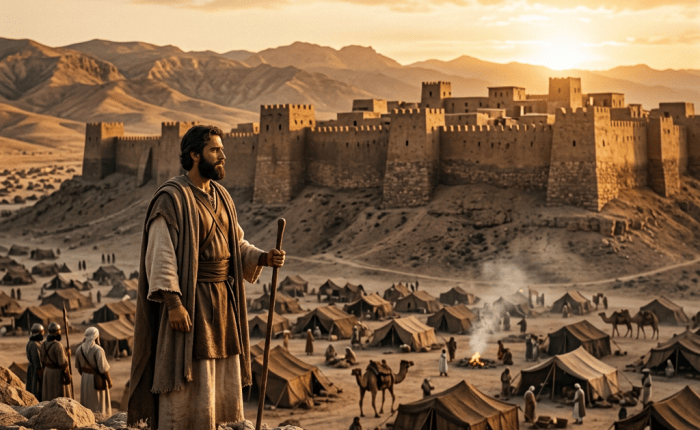
One of my favorite historical events in Scripture is the ‘Battle of Jericho‘. It has always sparked interest into the idea of what it truly means to follow the instruction of God. Joshua, was instructed to lead Israel into battle against the city of Jericho. However, the military tactic employed seems a bit suspect. Joshua 6 is where we read the instructions for battle. Circle the city once a day for six days then on the seventh day circle it seven times. At which point instruct the priests to blow the trumpets, the people to shout, and in this there will be victory? I am no military expert but this doesn’t seem like a winning strategy. Often there are historical accounts that leave humanity scratching their heads. This is one of them. What I think is often missed by many, due to the arbitrary barriers set up to make our Bibles more easily navigable, is what preceded the instruction we read in Joshua 6.
Obedience or disobedience is the trigger. At the end of Joshua 5. Israel had just crossed the Jordan River and were healing from circumcision. They were now also preparing to battle Jericho. “One day, when Joshua was there by Jericho, he raised his eyes and looked; and in front of him stood a man with his drawn sword in his hand. Joshua went over to him and asked him, ‘Are you on our side or on the side of our enemies?’ ‘No,’ he replied, ‘but I am the commander of Adonai’s army; I have come just now.‘” Here is an interaction with an intriguing question. Joshua asks, “Are you on our side or on the side of our enemies?”
Depending on your translation the response from the Commander of Yah’s Army is; ‘Neither’, ‘No’, ‘Nay’, or ‘Truly’. The word being translated is the Hebrew word לֹא – lôʼ – or לֹה lôh; an easy pronunciation is ‘low’. In Hebrew, Aramaic and other poetic languages, word order changes the definition, causing meaning to alter. Sometimes slightly and other times dramatically. In this instance if we look at the variables there are a few defining words that are being overlooked. Those words being, otherwise, whether, and nought. Each of these possibilities relay a message to the question at hand, which is or was, “Are you on our side or on the side of our enemies?” The word I find most fascinating is nought.
His response, “Nought, but I am the commander of Adonai’s army . . .” This is easily glanced over because the chapter comes to a close and in our trained minds we close the chapter and enter the next. Connect, yes, but separate, new thoughts enter and because the poetic nature of the original language is lost we lose the deeper meaning. Even if it is subtly there in the shadows. Nought, from early English, means nothing, a zero sum. However, it is also, whether or otherwise. In this defining moment the Commander of God’s Army is there to instruct and now the variable ‘IF’ comes into play.
Somewhere along the way the modern church has taken walking in obedience to works. And in that definition has labeled work as bad, grace as good, and if obedience is work, then disobedience must by reason mean grace. Can you imagine what would have happen if Joshua had the same modern understanding to God’s instruction? Joshua would have went back to the people of Israel and said, “Ok, the plan is we do nothing because obedience is work and works are bad, so we will be disobedient because disobedience is grace.” Yikes, Jericho doesn’t fall and Israel continues to wander the desert.
You see Nought, Otherwise, Whether; these words tell a story. If you will obey Adonai, you will defeat the enemy and will enter the promise land. The Commander wasn’t say, “No, I am neither here for you nor them.” He was saying in a poetic way which Joshua, a Hebrew would have understood, “If you obey, than I have been commanded to fight for you, but if not than I have been commanded to standby.” Neither for or against but an observer.
Let’s draw on another story which occurs after Jericho has fallen. Joshua is obedient, relays the instruction of Adonai to the people. The people follow the instruction. The Commander of Elohim’s Army, deployed his troops, the walls of Jericho come crumbling down. Israel is victorious. However, one Israelite, Achan, of the tribe of Judah, disobey’s the fullness of the command. He takes from the bounty Adonai said not to. Now when the Israelites go up against Ai they are pushed back and defeated. What happen? Adonai tells Joshua this in the 7th Chapter . . .
“But Adonai said to Joshua, “Stand up! Why have you fallen on your face? Israel has sinned; they have transgressed My covenant that I commanded them, and they have taken some of what was devoted to destruction. Indeed, they have stolen and lied, and they have put these things with their own possessions. This is why the Israelites cannot stand against their enemies.“
Clearly, we see what is at stake when it comes to being obedient to the commandments of God and remaining in covenant with Him. The importance is not lost in the New Covenant found in Jeremiah and Ezekiel, and later quoted in Hebrews. What has changed is the punishment for disobedience. What was the punishment Achan suffered? Well, after he confesses his sin Achan is put to death.
“So Joshua said to Achan, ‘My son, give glory to Adonai, the God of Israel, and make a confession to Him. I urge you to tell me what you have done; do not hide it from me. “It is true,” Achan replied, “I have sinned against Yahweh, the God of Israel. This is what I did: When I saw among the spoils a beautiful cloak from Shinar, two hundred shekels of silver, and a bar of gold weighing fifty shekels, I coveted them and took them. They are hidden in the ground inside my tent, with the silver underneath.’”
Today under the New Covenant, we are no longer under the penalty of sin if we are in Messiah Yahoshua. Instead we are under the Covenant of Grace. Our penalty is paid, but this doesn’t render the Covenant void, by NO MEANS! Rather, by grace we have been saved to walk in the covenant, the commands, ordinances and statutes of Adonai without the fear of death, when we brake His commandments. You see, when we sin, we confess and are forgiven under the new covenant but under the old covenant confession did not lead to a commuting of the death sentence as we read in the account of Achan.
“So Joshua sent messengers who ran to the tent, and there it all was, hidden in his tent, with the silver underneath. They took the things from inside the tent, brought them to Joshua and all the Israelites, and spread them out before Adonai.Then Joshua, together with all Israel, took Achan son of Zerah, the silver, the cloak, the bar of gold, his sons and daughters, his oxen and donkeys and sheep, his tent, and everything else he owned, and brought them to the Valley of Achor. “Why have you brought this trouble upon us?” said Joshua. “Today Adonai will bring trouble upon you!” And all Israel stoned him to death. Then they stoned the others and burned their bodies. And they heaped over Achan a large pile of rocks that remains to this day. So Adonai turned from His burning anger. Therefore that place is called the Valley of Achor to this day.”
Praise be to Adonai that through Yahoshua Messiah we have the forgiveness of sin. Not that we are free to live in sin. But that we walk in freedom, knowing that if we sin trying to walk out obedience, we remain under grace. We only need to repent from our sin, and return to Gods way, return to His instruction, His Torah.
Don’t listen to me but the Word. My hope is that my letters lead you to study the Word not man. Put down the commentary, the latest book by your favorite preacher/teacher and get into the Word. Learn languages, not that you have to become bilingual or multilingual but study its grammar, structure, meanings, to discover the poetic nature of Gods writings so that you can grow in understanding. “Knowing that ALL of Scripture is profitable for instruction, for conviction, for correction, and for training in righteousness, so that the man of God may be complete, fully equipped for every good work.” As Paul writes to Timothy. And know that “every good work”, IS obedience to Gods instruction.
As Joshua challenged Israel so I also challenge you today: “Now, therefore, fear Yahweh and serve Him in sincerity and truth; cast aside the gods your fathers served beyond the Euphrates and in Egypt, and serve Adonai. But if it is unpleasing in your sight to serve Yahweh, then choose for yourselves this day whom you will serve, whether the gods your fathers served beyond the Euphrates, or the gods of the Amorites in whose land you are living. As for me and my house, we will serve Adonai!”
To make this challenge modern and fitting for today I say: Now, therefore, love Adonai our Heavenly Father and serve Him in sincerity and truth; cast aside the gods your fathers served and the traditions of men, and serve Adonai. But if it is unpleasing in your sight to serve God by obeying His Word, then choose for yourselves this day whom you will serve, whether the gods of the land you now dwell or the traditions of man regardless of there basis. As for me and my house, we will serve Adonai, observing all that Yahoshua has taught including keeping the commands of the Father as Revelation 14:12 says: “Here is a call for the perseverance of the saints, who keep the commandments of God and the faith of Yahoshua.”
You are loved,
cj