
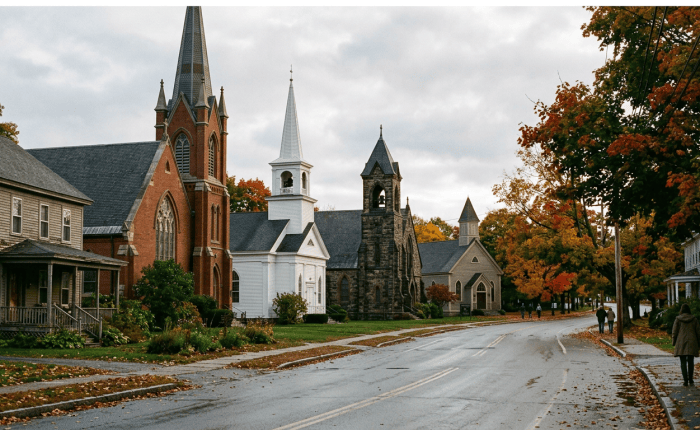
Pip: Every town has a church on every corner, each one claiming to follow the same Rabbi — which raises the obvious question of which version of him they’re actually following.
Mara: That’s the question cj puts at the center of this episode. We’re looking at what discipleship actually means, how love gets defined when you trace it back to its source, and what it looks like to test whether someone is walking the Way.
Pip: Let’s start with the post that names the problem directly — what it means to call yourself a disciple of Christ.
Will the real Jesus please stand up
Mara: The tension here is definitional: the word “disciple” carries a specific weight, and the post asks whether the churches using that label are living up to it.
Pip: The post grounds that in etymology first — “disciple” means to take on, to become like — and then in a striking historical fact: “The Apostles were put to death because they took on their Rabbi, becoming indistinguishable from their teacher in word, deed, and action.”
Mara: So the stakes are not abstract. Indistinguishable. That word does real work — it means the standard isn’t admiration or belief, it’s replication. The early followers weren’t just inspired by their teacher; they became a walking copy of him.
Pip: And the post tests that standard against the modern church’s favorite word: love. Most congregations lead with love God, love others — which sounds right until you ask what love actually means.
Mara: That’s where the post goes to the source text. When Yahoshua is asked about the greatest commandment, he quotes Deuteronomy 6:5 — but the post argues the full passage, Deuteronomy 6:4 through 9, is what he had in mind: “You shall love Yahweh your Elohim with all your heart and with all your soul and with all your might. These words, which I am commanding you today, shall be on your heart. Teach them diligently to your sons.”
Mara: The point is that love toward Elohim isn’t a feeling — it’s a total orientation, lived out in speech, in household practice, written on doorposts, bound on the hand.
Pip: And the second commandment, love your neighbor, gets the same treatment. The post traces it to Leviticus 19:18 and its surrounding context — a whole passage on how you treat other people, simplified down to the golden rule.
Mara: What the post does with both of these is show that Yahoshua wasn’t offering new teaching so much as pointing back to the fullness of Torah. His answer to “what is the greatest commandment” was a quotation, not an invention.
Pip: There’s also a personal admission in here that lands harder than most confessions do — an acknowledgment of acting out of pride, spite, and anger, of projecting rather than loving.
Mara: Right, and that honesty sets up the post’s closing challenge: when you see a sign that says Disciples of Christ, ask whether the people inside are actually walking as he walked. The test is fruit — not words, not a stage thank-you, but a life that has genuinely turned toward the light.
Pip: The post also points readers toward a companion piece called “Shema” for more on this thread — the listening, the hearing, that precedes all of it.
Mara: Which is the right place to end. Discipleship begins with hearing before it becomes doing.
Pip: The through-line here is that the title matters less than the walk — calling yourself a disciple means taking on the shape of the teacher, not just the name.
Mara: And that’s a question worth sitting with well past this episode. What does it look like, in practice, to be indistinguishable from your Rabbi?
Read the whole post here: Will The Real Jesus Please Stand Up

