Podcast Episode: Historical Events Modern Application: Joshua and the Battle of Jericho

Podcast Episode: Historical Events Modern Application: Joshua and the Battle of Jericho

Pip: There is a battle strategy in the Hebrew scriptures that involves walking in circles and shouting, and somehow it works — which raises the obvious question of what exactly is going on beneath the surface of that story.

Mara: That question is exactly where cj takes us on The Way of the Rabbi — into the Battle of Jericho, and what obedience and covenant actually mean when you read the text closely. Let’s start with the walls, and what had to happen before they fell.

Historical Events Modern Application: Joshua and the Battle of Jericho

Pip: The post opens with a military strategy that, on its face, makes no sense — march around a city for six days, then seven laps on day seven, blow some trumpets, shout, and the city falls. The real argument, though, is about what happened the night before any of that, in the chapter break most readers skip right over.

Mara: The setup is Joshua 5, where Joshua encounters a figure with a drawn sword. The post reads the commander’s reply to “Are you on our side or on the side of our enemies?” as something more conditional than a flat no: “Nought, but I am the commander of Adonai’s army.”

Pip: And that word — nought — is doing a lot of work. In early English it means nothing, zero, but also whether or otherwise. So the commander is not saying he is neutral. He is stating a condition: if you obey, I fight for you; if not, I stand aside.

Mara: The post makes the grammar explicit: “If you will obey Adonai, you will defeat the enemy and will enter the promise land. The Commander wasn’t saying, ‘No, I am neither here for you nor them.’ He was saying in a poetic way which Joshua, a Hebrew would have understood, ‘If you obey, than I have been commanded to fight for you, but if not than I have been commanded to standby.'”

Pip: So obedience is not a tactic — it is the condition that determines whether divine backing is even in play. Which makes the Achan episode immediately after Jericho the proof of concept.

Mara: Achan takes from the devoted spoils, and Israel is routed at Ai. Adonai’s explanation to Joshua is direct: “Israel has sinned; they have transgressed My covenant that I commanded them, and they have taken some of what was devoted to destruction. Indeed, they have stolen and lied, and they have put these things with their own possessions. This is why the Israelites cannot stand against their enemies.”

Pip: One person’s disobedience, and the whole army loses its footing. The stakes are not abstract.

Mara: The post then draws the line into the New Covenant — the punishment has changed, death is not the sentence for those in Messiah, but the covenant itself is not void. Confession and repentance replace the death sentence Achan faced, but the call to walk in obedience remains. As the post puts it, grace saves us to walk in the commands, not away from them.

Pip: The modern church has, apparently, run the logic backward — decided that if obedience is work, and works are bad, then disobedience must somehow be grace. The post calls that out pretty directly.

Mara: It closes with Paul’s line to Timothy — “ALL of Scripture is profitable for instruction, for conviction, for correction, and for training in righteousness” — and frames every good work as obedience to God’s instruction. The challenge issued to the reader mirrors Joshua’s challenge to Israel: choose this day whom you will serve.

Pip: Covenant, obedience, consequence — the walls of Jericho are just where the story gets concrete enough to see all three at once.


Mara: What stays with me is the chapter-break problem — meaning hidden in the seam between two passages most readers treat as separate.

Pip: Read the whole thing. The walls are still falling.

Read the entire post here: Historical Events Modern Application: Joshua and the Battle of Jericho

Historical Events Modern Application: Joshua and the Battle of Jericho

Historical Events Modern Application: Joshua and the Battle of Jericho

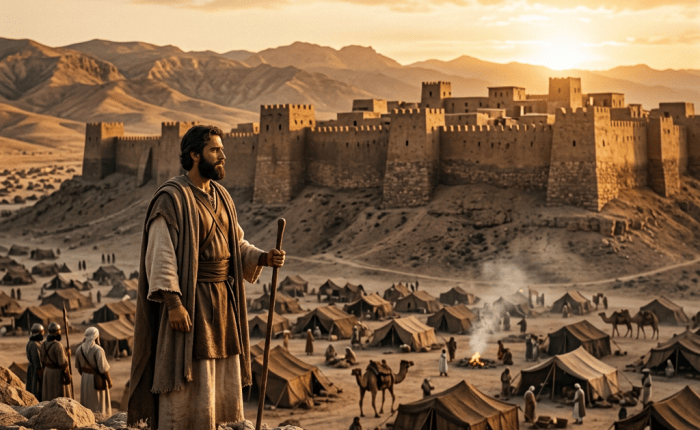
One of my favorite historical events in Scripture is the ‘Battle of Jericho‘. It has always sparked interest into the idea of what it truly means to follow the instruction of God. Joshua, was instructed to lead Israel into battle against the city of Jericho. However, the military tactic employed seems a bit suspect. Joshua 6 is where we read the instructions for battle. Circle the city once a day for six days then on the seventh day circle it seven times. At which point instruct the priests to blow the trumpets, the people to shout, and in this there will be victory? I am no military expert but this doesn’t seem like a winning strategy. Often there are historical accounts that leave humanity scratching their heads. This is one of them. What I think is often missed by many, due to the arbitrary barriers set up to make our Bibles more easily navigable, is what preceded the instruction we read in Joshua 6.

Obedience or disobedience is the trigger. At the end of Joshua 5. Israel had just crossed the Jordan River and were healing from circumcision. They were now also preparing to battle Jericho. “One day, when Joshua was there by Jericho, he raised his eyes and looked; and in front of him stood a man with his drawn sword in his hand. Joshua went over to him and asked him, ‘Are you on our side or on the side of our enemies?’ ‘No,’ he replied, ‘but I am the commander of Adonai’s army; I have come just now.‘” Here is an interaction with an intriguing question. Joshua asks, “Are you on our side or on the side of our enemies?”

Depending on your translation the response from the Commander of Yah’s Army is; ‘Neither’, ‘No’, ‘Nay’, or ‘Truly’. The word being translated is the Hebrew word לֹא – lôʼ – or לֹה lôh; an easy pronunciation is ‘low’. In Hebrew, Aramaic and other poetic languages, word order changes the definition, causing meaning to alter. Sometimes slightly and other times dramatically. In this instance if we look at the variables there are a few defining words that are being overlooked. Those words being, otherwise, whether, and nought. Each of these possibilities relay a message to the question at hand, which is or was, “Are you on our side or on the side of our enemies?” The word I find most fascinating is nought.

His response, “Nought, but I am the commander of Adonai’s army . . .” This is easily glanced over because the chapter comes to a close and in our trained minds we close the chapter and enter the next. Connect, yes, but separate, new thoughts enter and because the poetic nature of the original language is lost we lose the deeper meaning. Even if it is subtly there in the shadows. Nought, from early English, means nothing, a zero sum. However, it is also, whether or otherwise. In this defining moment the Commander of God’s Army is there to instruct and now the variable ‘IF’ comes into play.

Somewhere along the way the modern church has taken walking in obedience to works. And in that definition has labeled work as bad, grace as good, and if obedience is work, then disobedience must by reason mean grace. Can you imagine what would have happen if Joshua had the same modern understanding to God’s instruction? Joshua would have went back to the people of Israel and said, “Ok, the plan is we do nothing because obedience is work and works are bad, so we will be disobedient because disobedience is grace.” Yikes, Jericho doesn’t fall and Israel continues to wander the desert.

You see Nought, Otherwise, Whether; these words tell a story. If you will obey Adonai, you will defeat the enemy and will enter the promise land. The Commander wasn’t say, “No, I am neither here for you nor them.” He was saying in a poetic way which Joshua, a Hebrew would have understood, “If you obey, than I have been commanded to fight for you, but if not than I have been commanded to standby.” Neither for or against but an observer.

Let’s draw on another story which occurs after Jericho has fallen. Joshua is obedient, relays the instruction of Adonai to the people. The people follow the instruction. The Commander of Elohim’s Army, deployed his troops, the walls of Jericho come crumbling down. Israel is victorious. However, one Israelite, Achan, of the tribe of Judah, disobey’s the fullness of the command. He takes from the bounty Adonai said not to. Now when the Israelites go up against Ai they are pushed back and defeated. What happen? Adonai tells Joshua this in the 7th Chapter . . .

“But Adonai said to Joshua, “Stand up! Why have you fallen on your face? Israel has sinned; they have transgressed My covenant that I commanded them, and they have taken some of what was devoted to destruction. Indeed, they have stolen and lied, and they have put these things with their own possessions. This is why the Israelites cannot stand against their enemies.“

Clearly, we see what is at stake when it comes to being obedient to the commandments of God and remaining in covenant with Him. The importance is not lost in the New Covenant found in Jeremiah and Ezekiel, and later quoted in Hebrews. What has changed is the punishment for disobedience. What was the punishment Achan suffered? Well, after he confesses his sin Achan is put to death.

“So Joshua said to Achan, ‘My son, give glory to Adonai, the God of Israel, and make a confession to Him. I urge you to tell me what you have done; do not hide it from me. “It is true,” Achan replied, “I have sinned against Yahweh, the God of Israel. This is what I did: When I saw among the spoils a beautiful cloak from Shinar, two hundred shekels of silver, and a bar of gold weighing fifty shekels, I coveted them and took them. They are hidden in the ground inside my tent, with the silver underneath.’”

Today under the New Covenant, we are no longer under the penalty of sin if we are in Messiah Yahoshua. Instead we are under the Covenant of Grace. Our penalty is paid, but this doesn’t render the Covenant void, by NO MEANS! Rather, by grace we have been saved to walk in the covenant, the commands, ordinances and statutes of Adonai without the fear of death, when we brake His commandments. You see, when we sin, we confess and are forgiven under the new covenant but under the old covenant confession did not lead to a commuting of the death sentence as we read in the account of Achan.

“So Joshua sent messengers who ran to the tent, and there it all was, hidden in his tent, with the silver underneath. They took the things from inside the tent, brought them to Joshua and all the Israelites, and spread them out before Adonai.Then Joshua, together with all Israel, took Achan son of Zerah, the silver, the cloak, the bar of gold, his sons and daughters, his oxen and donkeys and sheep, his tent, and everything else he owned, and brought them to the Valley of Achor. “Why have you brought this trouble upon us?” said Joshua. “Today Adonai will bring trouble upon you!” And all Israel stoned him to death. Then they stoned the others and burned their bodies. And they heaped over Achan a large pile of rocks that remains to this day. So Adonai turned from His burning anger. Therefore that place is called the Valley of Achor to this day.”

Praise be to Adonai that through Yahoshua Messiah we have the forgiveness of sin. Not that we are free to live in sin. But that we walk in freedom, knowing that if we sin trying to walk out obedience, we remain under grace. We only need to repent from our sin, and return to Gods way, return to His instruction, His Torah.

Don’t listen to me but the Word. My hope is that my letters lead you to study the Word not man. Put down the commentary, the latest book by your favorite preacher/teacher and get into the Word. Learn languages, not that you have to become bilingual or multilingual but study its grammar, structure, meanings, to discover the poetic nature of Gods writings so that you can grow in understanding. “Knowing that ALL of Scripture is profitable for instruction, for conviction, for correction, and for training in righteousness, so that the man of God may be complete, fully equipped for every good work.” As Paul writes to Timothy. And know that “every good work”, IS obedience to Gods instruction.

As Joshua challenged Israel so I also challenge you today: “Now, therefore, fear Yahweh and serve Him in sincerity and truth; cast aside the gods your fathers served beyond the Euphrates and in Egypt, and serve Adonai. But if it is unpleasing in your sight to serve Yahweh, then choose for yourselves this day whom you will serve, whether the gods your fathers served beyond the Euphrates, or the gods of the Amorites in whose land you are living. As for me and my house, we will serve Adonai!”

To make this challenge modern and fitting for today I say: Now, therefore, love Adonai our Heavenly Father and serve Him in sincerity and truth; cast aside the gods your fathers served and the traditions of men, and serve Adonai. But if it is unpleasing in your sight to serve God by obeying His Word, then choose for yourselves this day whom you will serve, whether the gods of the land you now dwell or the traditions of man regardless of there basis. As for me and my house, we will serve Adonai, observing all that Yahoshua has taught including keeping the commands of the Father as Revelation 14:12 says: “Here is a call for the perseverance of the saints, who keep the commandments of God and the faith of Yahoshua.”

You are loved,
cj

Choosing to Listen: Embracing God’s Word Daily

Choosing to Listen: Embracing God’s Word Daily

How serious are you, when you attend your church gathering, in hearing the Word of God? What preparation goes into it? Do you pray before asking God to reveal your heart? This is my practice. When I enter the Synagogue I pray, “Adonai, reveal my heart, You know me better than i know myself. Help me to not only hear You but to listen and obey Your instruction.” After this prayer I write out my initial thoughts. This past Sabbath as I prayed this prayer this is the thought given me through that prayer.

“i am not in a right frame of mind. i am not sure what i need to do since it is ultimately a heart issue. i am growing increasingly critical of myself, but lack the strength to change the thought patterns.”

“But you are a chosen race, a royal priesthood, a holy nation. A people for God’s own possession. So that you may proclaim the excellencies of Him who has called you out of darkness into His marvelous light. For you once were not a people, but now you are the people of God. You had not received mercy, but now you have received mercy.” 1 Peter 2:9-10

From this point I begin to prepare my heart and my mind to receive what Adonai has for me. The question was asked, “What is the truth of your calling?” From that question I wrote down the first things that came to mind.
Concert Tour – if you read back in my blog several years. I shared how my family would travel and sing in churches. It was during this time that I believe I received my first calling into ministry.
Visions while Driving – It would become increasingly clear that this calling was sure. You see while friends were talking about their future plans or lack of I was having visions of my calling. It was a mixture of singing and preaching. This would later be the case as in some churches I had to both lead worship and preach.
Jr. High Camp – It was at an evening Chapel service at Jr. High Camp that my calling into ministry would be cemented. It would also face one of its greatest challenges. As the speaker presented the message, it became clear that I was to do this. “This is what I am calling you to do, this is the purpose I have set out for you. To preach My Word.” I could feel the burning inside my heart as I went to the alter that night. I spoke of my calling at our cabin time later.
Prayer Chapel – Years had past and I had forgotten the root of my calling. It was always there but I lacked a seriousness. I would find myself at a crossroads, homeless and jobless, I sought shelter one night in a prayer chapel. It was positioned on a cliff overlooking Puget Sound in Northwest Washington State. It was unlocked and I had prayed here many times before. On this night, although I was physically alone, I was not Spiritually alone. Through the guidance of the Holy Spirit I was reminded of my call. I rededicated my life to the purposes of God that night. The very next day I was blessed with both a house and a job.

Everything in life is a choice. You have to choose one way or another, moment by moment. These choices are often inconsequential. However, there are choices that can be earth shaking. Therefore, every decision made should be made thoughtfully and in some instances with the guidance of others. Perplexing it is that often we find these things out after wrong choices are made. Everything in life is a choice, even allowing yourself to be chosen.

1 Corinthians 6:19-20 . . .
“Do you not know that your body is a temple of the Holy Spirit who is in you, whom you have received from God? You are not your own; you were bought at a price. Therefore glorify God with your body.”

How many times have I defiled the temple? How many times have I brought uncleanness, by choice, into the temple of my body? Proverbs offers wisdom in short, impactful pieces. This is perfect for a generation that cannot focus for more than 30 seconds before scrolling to the next TikTok video. “The foolishness of man ruins his way, and his heart rages against Adonai.” “Also it is not good for a person to be without knowledge, and he who hurries his footsteps errs.” “Many plans are in a man’s heart, but the counsel of Adonai will stand.” “Cease listening, my son, to discipline, and you will stray from the words of knowledge.” (Each of these are found in Proverbs 19).

They are relevant to choice. We can all relate in one way or another in making hasty decisions that ended up being wrong. Some of us carry the burden of those decisions long after the dust has settled. It is an unfortunate truth however, there is still room for choice. Will you wallow in the mud or will you step boldly forward in the Grace of God?

1 John 2:3-6
“By this we know that we have come to know Him, if we keep His commandments. The one who says, “I have come to know Him.” Yet he does not keep His commandments, is a liar, and the truth is not in him. Here is truth, whoever keeps His word, in him the love of God has truly been perfected. By this we know that we are in Him . . . the one who says he abides in Him ought walk in the same manner as He walked.”

John 14:15
“If you love Me, you will keep My commandments.”

IF is the conditional term. If we choose to allow ourselves to be chosen. We then must choose to walk in the manner worthy of that calling. In what manner? What are his ways? Do our ways conflict with what He has instructed? Are following the traditions of man over the instruction of God? Tradition, does not make disobedience to His word less disobedient. There is no such thing as acceptable sin. What is sin as defined by the Apostle John in 1 John 3:4? “Everyone who practices sin also practices lawlessness; and sin is lawlessness.” Lawlessness is defined as being without Torah. Likewise, being without Torah is known as being in darkness. Therefore, being in Torah is then being in the light.

“But you are a chosen race, a royal priesthood, a holy nation. A people for God’s own possession. So that you may proclaim the excellencies of Him who has called you out of darkness into His marvelous light. For you once were not a people, but now you are the people of God. You had not received mercy, but now you have received mercy.” 1 Peter 2:9-10

Sin, or as many like to say, to lessen the blow, missing the mark. Whether in ignorance or intentional, when found out, repentance is required. A turning away from that sin is a choice and a matter of the heart. When you break relationship, dishonoring someone, that guilt is conviction. That conviction is dealt with by repentance. That repentance is a choice, as much as sin was a choice. “IF My people, who bear My name, will humble themselves, pray, seek My face and turn from their evil ways, I will hear from heaven, forgive their sin and heal their land.”

Trust in Adonai with all your heart;
do not rely on your own understanding.
In all your ways acknowledge him;
then he will level your paths
.
Proverbs 3:5-6

Here is where we are in the cycle of life. We are in a famine. The famine is severe, so severe that it has become normal. So normal in fact that most people don’t even know what they are missing and they don’t care to know. Even some who sense there is something deeper, a calling, a choice to be made, they too are starved. They don’t choose, whether out of fear of making a wrong choice or seeing it as inconsequential either way. The famine shouldn’t surprise anyone. It was foretold by the Prophet Amos.

“The time is coming,” says Adonai Elohim,
“when I will send famine over the land,
not a famine of bread or a thirst for water,
but of hearing the words of Adonai.
People will stagger from sea to sea
and from north to east, running back and forth,
seeking the word of Adonai;
but they will not find it
.”
Amos 8:11-12

However, those who are in Messiah Yahoshua, we are at an advantage. We have the Word made flesh. He promises the new covenant will be written on our minds. It will also be inscribed on our hearts. So that we can be the Temple, that we can be the city on a hill. So that we can stand out separate from the world, sanctified by the Word of Truth. As Yahoshua prayed for us to be.

“I have given them your word, and the world hated them, because they do not belong to the world — just as I myself do not belong to the world. I don’t ask you to take them out of the world, but to protect them from the Evil One. They do not belong to the world, just as I do not belong to the world. Set them apart for holiness by means of the truth — your word is truth. Just as you sent me into the world, I have sent them into the world. On their behalf I am setting myself apart for holiness, so that they too may be set apart for holiness by means of the truth.” John 17:14-19

Sometimes I have to write to remind myself of whose I am. That I am no longer my own but have been bought at a price. It is no longer I who live but Messiah who lives in me and through me. I don’t always make the right choice, I am thankful for Grace. But one thing I do, forgetting that which is behind me. I strain for what is ahead of me in Messiah Yahoshua.

“It is not that I have already obtained it or already reached the goal — no, I keep pursuing it in the hope of taking hold of that for which the Messiah Yahoshua took hold of me. Brothers, I, for my part, do not think of myself as having yet gotten hold of it; but one thing I do: forgetting what is behind me and straining forward toward what lies ahead, I keep pursuing the goal in order to win the prize offered by God’s upward calling in the Messiah Yahoshua. Therefore, as many of us as are mature, let us keep paying attention to this; and if you are differently minded about anything, God will also reveal this to you. Only let our conduct fit the level we have already reached.” Philippians 3:12-16

You see it is a constant choice, moment by moment, decision by decision, we choose. What will you choose?

This is the way of the Rabbi,
You are loved,
cj