
Podcast Episode: Understanding God’s Covenant: Written on Our Hearts

Podcast Episode: Understanding God’s Covenant: Written on Our Hearts

Pip: There is a corner of the internet telling you not to be afraid — 365 times a year, apparently — and then there is cj, writing for The Way of the Rabbi, who would like a word about what the fear of God actually means.

Mara: This episode goes deep into Hebrews 10 — covenant, Torah, sacrifice, and what it means to have God’s instruction written on your heart rather than carved in stone.

Pip: Let’s start with the covenant itself.

Understanding God’s Covenant: Written on Our Hearts

Mara: The post opens with a tension the internet tends to flatten: the difference between “fear not” as comfort and the fear of God as the beginning of wisdom. Both live in Hebrews 10, and the post argues the church has traded one for the other at its own cost.

Pip: The anchor quote comes early, and it does not ease you in. “It is a terrifying thing to fall into the hands of the living God.” That is Hebrews 10:31, and it is not a metaphor being softened anywhere in this piece.

Mara: What that verse is doing is framing the whole chapter. Hebrews 10 opens as a commentary on Psalm 40, arguing that the Torah’s yearly sacrifices were a shadow — not the substance. The substance is Messiah’s offering, which accomplished what the shadow could only gesture toward: the exchange of sin for righteousness.

Pip: So the yearly sacrifice covered. The one offering exchanged. That is a meaningful distinction — covering versus exchange is not just a theological nicety, it is the hinge the rest of the argument swings on.

Mara: And the post brings that home through Jeremiah 31, quoted in Hebrews 10. “This is the covenant that I will make with them after those days, says YHWH: I will put My Torah upon their heart, and on their mind I will write them.”

Pip: Which raises the honest question the post actually asks out loud: if Torah is abolished, why write it on anyone’s heart?

Mara: The answer the post gives is precise. What Messiah’s blood removes is the law of sin and its consequence — death. Not the call to walk in obedience. The covenant written on the heart beckons toward the throne of grace, not away from instruction.

Pip: Holiness as destination, not as the price of entry. That reframe is doing a lot of work quietly.

Mara: It lands in Hebrews 10:19-25 — the “let us” passage. Draw near, hold fast, spur one another on. And then the warning: willful sin after receiving the truth leaves no remaining sacrifice. The post closes on Revelation 14:12 — “the perseverance of the saints who keep the commandments of God and their faith in Yahoshua.”

Pip: Fear and confidence, written on the same heart.


Mara: The thread running through all of this is covenant as living obligation — not abolished, not optional, written inward.

Pip: Next time, we will see where that obligation leads when it walks out the door and into the world.

Read the full post: Understanding God’s Covenant: Written on our Hearts
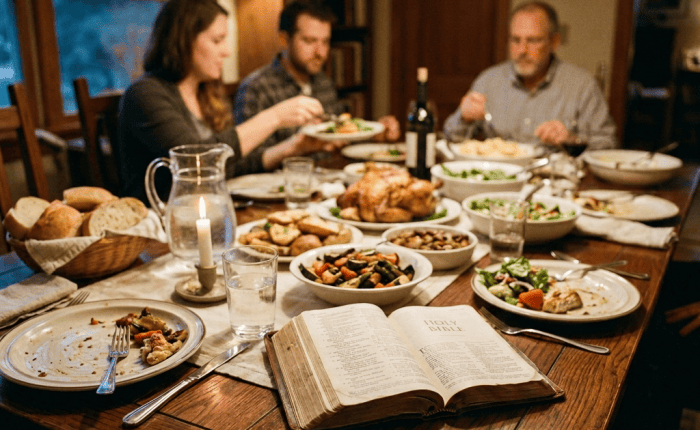
Podcast Episode: Gluttons of Grace: The Spiritual Dangers of Gluttony

Podcast Episode: Gluttons of Grace: The Spiritual Dangers of Gluttony

Pip: There’s a spiritual danger hiding in plain sight — and it’s not the one the church usually wants to talk about at the potluck.

Mara: cj’s latest post on The Way of the Rabbi takes on gluttony — not just the physical kind, but what the piece calls “gluttony of grace,” the habit of treating God’s patience as a license to keep sinning. Let’s start with what that actually means and why it matters.

Gluttons of Grace: The Spiritual Dangers of Gluttony

Pip: The post opens with a disarmingly ordinary scene — a fast food order, a one-dollar add-on, and a question: is that gluttony? But that small moment is a doorway into something much larger, the idea that we overindulge spiritually the same way we overindulge at the counter.

Mara: The post grounds the argument in Ephesians 2:10, setting up the kind of life we’re actually called to: “For we are God’s workmanship, created in Messiah Yahoshua to do good works, which God prepared in advance as our way of life.”

Pip: So the stakes here aren’t just dietary. The argument is that grace was never meant to be a standing permission slip — it was meant to launch us into something, a life shaped by the Father’s instruction, the Torah.

Mara: Right, and the post is careful to separate that from works-based salvation. The point isn’t that obedience earns anything. It’s that continuing deliberately in sin while claiming grace is its own kind of excess — the “gluttony of grace” the title names.

Pip: The church’s reluctance to preach on gluttony gets a dry observation here — that it hits too close to home and is harder to hide than most sins. Which is a fair point. Gluttony is the one vice you can’t keep in a private browser tab.

Mara: The post invokes Ezekiel 36:26-27 to answer the objection that Torah-keeping is simply impossible: “I will put My Spirit within you and cause you to walk in My statutes, and you will keep My judgments and do them.” The Spirit, not willpower, is the mechanism.

Pip: And then Paul — the one, as the post puts it, “in whom so many twist to justify their sinful natures” — gets quoted directly against that very use. Shall we continue in sin so grace may increase? Certainly not.

Mara: The post closes on Matthew 7, the sobering passage where Yahoshua tells those who performed miracles in his name: “I never knew you; depart from Me, you workers of lawlessness.” That’s the endpoint of gluttony of grace taken to its conclusion.

Pip: And the landing is Proverbs 23 — a father’s plea to a son to guide his heart on the right course. The frame shifts from warning to invitation.

Mara: Which is really the post’s whole posture. Not condemnation, but a call to search out truth and walk in it — a heart of flesh instead of stone.


Pip: Grace as a floor rather than a ceiling — that reframe does a lot of quiet work.

Mara: It does. The question underneath all of it is what we’re actually being saved toward, not just saved from. Worth sitting with until next time.

Read the full post: Gluttons of Grace: The Spiritual Dangers of Gluttony

Podcast Episode: Transforming Lives: Conforming vs. Standing Out

Podcast Episode: Transforming Lives: Conforming vs. Standing Out

Pip: There is a children’s Christmas program somewhere in the annals of history where one kid showed up in a three-piece brown suit, and it turns out that is the whole sermon.

Mara: That story comes from cj, writing at The Way of the Rabbi — and today we are sitting with what it actually means to live as someone set apart, from conformity and identity to the call to stand out in a world pulling hard the other direction.

Pip: Let’s start with the brown suit and what Romans has to say about it.

—

Conforming vs. Standing Out

Mara: The central tension here is one believers navigate constantly — the pull to blend in versus the call to be genuinely different, not as a performance but as a lived reality. The question is what that actually looks like when no one is watching.

Pip: The setup is a second-grade Christmas program, one kid in a chocolate brown three-piece suit in a sea of green, and a teacher who thought putting him front and center as the trunk of the tree would help. It did not help. But the pivot to Romans 12 is where the real argument lands, and the text is direct: “Do not be conformed to this world, but be transformed by the renewing of your mind. Then you will be able to test and approve what is the good, pleasing, and perfect will of God.”

Mara: So the upshot is that transformation is inward first — the visible difference in how someone lives is the outward sign of something already changed at the level of mind and orientation, not a set of external markers bolted on afterward.

Pip: And the post is careful to name what standing out is not. It is not a bumper sticker. It is not a Bible verse posted to social media. The question asked is sharper than that.

Mara: Right — “When you say no words what do your actions say? When you are at work, what does your production say? When you are out with friends, what do your habits say?” The measure is lifestyle, not signal.

Pip: There is also a warning woven in about comfort. The image used is a pot beginning to boil — too many people are so settled into the surrounding culture that they do not notice the temperature rising.

Mara: The passage from Micah gets pulled in here as well: “to act justly, to love mercy, and to walk humbly with your Elohim.” That requirement, the post argues, is consistent across Moses, the prophets, and Paul — the Father’s standard does not shift.

Pip: The call at the end is to learn the way of the Rabbi, Yahoshua, and to study rather than inherit someone else’s tradition wholesale.

Mara: Standing out, it turns out, is less about being conspicuous and more about being rooted — which is a different kind of visible entirely.

—


Pip: A brown suit in a sea of green. It is a small image for a large idea — that what you are wearing, spiritually speaking, should be unmistakable.

Mara: More from The Way of the Rabbi next time.

Read the post here: Transforming Lives: Conforming vs. Standing Out

Podcast Episode: Reflecting on the Past: The Journey of Growth in Truth

Podcast Episode: Reflecting on the Past: The Journey of Growth in Truth

Pip: There’s a certain genre of birthday reflection that goes: “I’m older, possibly wiser, and here’s what Scripture says about it.” cj has written one, and it’s more rigorous than that description suggests.

Mara: This episode covers one extended meditation on memory, growth, and what the New Covenant actually asks of us — looking back at the past without being chained to it.

Pip: Let’s start with what it means to sit with your shoulda-coulda-wouldas and actually do something useful with them.

Reflecting on the Past: Learning Without Being Chained

Mara: The post opens on familiar ground — the mental loop of regret, the “shoulda, coulda, woulda’s of life” — but the argument is that those thoughts aren’t worthless. The question is whether they become a foundation or a trap.

Pip: The anchor here is a quote from Yahoshua, set up as a warning about nostalgia: “No one who puts his hand to the plow and then looks back is fit for the kingdom of God.”

Mara: And the post immediately asks whether that means never look back — then answers its own question. Obviously not, or Hebrews 11, the whole hall of faith, would be unreadable. Looking back has a purpose; it’s the posture that determines whether it helps or harms.

Pip: So the post draws a practical distinction — learning from past mistakes, using moments of forgiveness received as motivation to forgive others, pondering what you’ve learned to better understand truth. That’s looking back with healthy perspective.

Mara: The accountability piece lands hard. The post names pride as the specific obstacle: “The problem many run into is that they don’t like to admit to their mistakes. Instead they blame others for their misfortunes.” Owning your choices, not just the bad luck, is where truth gets discovered.

Pip: And then it reframes the whole idea of being shaped by your past. Not “we are the sum of our mistakes” — that’s called only half truth — but “we are the sum of our choices, good, bad, indifferent.”

Mara: The resolution is grounded in the New Covenant. Paul writes to Timothy: “Study to show yourself approved, a workman, who rightly handles the word of truth.” The past informs the student; the word directs what the student does next.

Pip: So the shoulda-coulda-wouldas aren’t the enemy. Staying in them is.


Mara: The core argument holds: the past is material for growth, not a verdict.

Pip: Learn from it, grow from it — just don’t set up a residence there. More from The Way of the Rabbi next time.

Podcast Episode: Breaking Free from Legalism: Embracing Messiah’s Love

Podcast Episode: Breaking Free from Legalism: Embracing Messiah’s Love

Pip: There’s a question that doesn’t get asked often enough in religious circles: if someone suffered horribly so you’d be free from all obligation, who exactly is the abuser in that story?

Mara: That’s the provocation cj opens with on The Way of the Rabbi, and it sets up the territory we’re covering today — the line between legalism and genuine faith, and what a life shaped by Messiah’s example actually looks like.

Pip: Let’s start with where that tension lives.

Breaking Free from Legalism, Embracing Messiah’s Love

Mara: The central question here is whether following God’s commands and trusting in Messiah are two separate things — or whether they were always meant to be inseparable.

Pip: And the post doesn’t ease into that. It opens with a scenario: you look at everything Yahoshua endured, and your takeaway is that you no longer have to keep the law. The post asks you to say that out loud and notice what it sounds like.

Mara: From Galatians, Paul’s words are quoted directly: “You stupid Galatians! Who has put you under a spell? Having begun with the Spirit’s power, do you think you can reach the goal under your own power?”

Pip: That’s not a gentle pastoral nudge. Paul is saying the Galatians made the same error many make today — they separated the practice from the person, making Torah observance a performance rather than a response to trust.

Mara: And that distinction is the spine of the argument. Abraham is the example: he trusted God, acted on that trust, and obedience followed naturally. The post draws on Romans 6 to sharpen this — “Shall we continue in sin so that grace may increase? Certainly not.” Then 1 John 3:4 defines sin plainly as lawlessness, as being outside Torah.

Pip: So the post isn’t arguing for rule-keeping as a transaction. It’s saying faith without the life that reflects it is the same problem, just wearing different clothes.

Mara: The resolution the post offers is relational. It uses the image of a long marriage — both partners seeking to honor the other more than themselves. That’s the model for how trust in Messiah is meant to work: not obligation, but orientation.

Pip: Which is why the closing image lands. Psalm 51 — a broken and contrite heart, a renewed spirit, and then the line: “I will teach transgressors Your ways, and sinners will return to You.”

Mara: The post ends on Revelation 14:12: “Here is a call for the perseverance of the saints, who keep the commandments of God and the faith of Yahoshua.” Both together. Neither alone.

Pip: Faith and faithfulness — turns out they were always the same direction.


Mara: The thread running through all of this is that relationship and obedience aren’t opposites — one is how the other shows up in a life.

Pip: Next time, we’ll see where that thread leads.

Read the full post here: Breaking Free from Legalism: Embracing Messiah’s Love

Podcast Episode: Living a Lifestyle of Prayer: Lessons from David and Messiah

Podcast Episode: Living a Lifestyle of Prayer: Lessons from David and Messiah

Pip: If you have ever felt like the world is pulling you in every direction except the one that matters, cj at The Way of the Rabbi has a psalm and a prayer that might reorient your morning.

Mara: This episode follows one sustained thread — what it actually looks like to build a life around prayer and imitation of Messiah, drawing from David's Psalm 5 and Yahoshua's prayer in John 17.

Pip: Let's start with what a lifestyle of prayer looks like in practice.

—

Living a Lifestyle of Prayer: Lessons from David and Messiah

Mara: The central question here is how the phrase "a lifestyle, not a religion" becomes something real and practiced rather than just a slogan — and the post answers it by looking at how both David and Messiah actually lived.

Pip: The anchor is Paul's line in First Corinthians, but the post moves quickly to Psalm 5 as the concrete illustration. David opens with a direct, unguarded address to God — and the post quotes it plainly: "Give ear to my words, Adonai, consider my inmost thoughts."

Mara: What that means in practice is full transparency before God — the post says, "Hide nothing, for nothing in the end is hid from Him." This isn't a posture of performance; it's a posture of relationship.

Pip: And then the pattern sharpens. David doesn't just pray once — he declares, "in the morning you WILL hear my voice." The post draws a direct line from that to Mark 1:35, where Yahoshua rises early, slips away from the crowds, and goes to a solitary place. Morning prayer isn't incidental; it's the architecture of the day.

Mara: The post also works through the contrast David builds in the middle verses of Psalm 5 — God does not take pleasure in wickedness, evil cannot remain with Him. But the post is careful to note this isn't a detour. David is framing why the posture of the righteous matters: those who walk in God's instruction enter His house because "God is rich in mercy, grace, and love."

Pip: Grateful entry leads to the next move — "I will bow down toward Your holy Temple in reverence for You." Reverence follows mercy, not the other way around. That's a sequence worth sitting with.

Mara: The post also unpacks the Hebrew behind David's request to be led in righteousness — the word tsᵉdâqâh, meaning right actions. David is asking to be led in God's right actions, which the post reads as walking in the light of Torah.

Pip: So the whole arc — Psalm 5, Yahoshua's John 17 prayer, Paul's call to imitation — lands in one place: being set apart not as an abstraction but as a lived pattern, daily, morning by morning.

Mara: Yahoshua's own words from John 17 close the loop: "On their behalf I am setting Myself apart for holiness, so that they too may be set apart for holiness by means of the truth." The invitation is to the same kind of life He lived.

Pip: Which makes the question less "do I have a religion" and more "does my morning look anything like His."

—


Mara: What stays with me is the dailiness of it — David's morning voice, Yahoshua's solitary place before dawn. Holiness as habit, not event.

Pip: More on what that looks like in practice, next time.

Podcast Episode: Living Life His Way: A Perspective on Faith

Podcast Episode: Living Life His Way: A Perspective on Faith

Pip: There is a Frank Sinatra song that has apparently been haunting cj for some time, and honestly, as spiritual provocations go, “My Way” is not the worst place to start.

Mara: cj’s latest post at The Way of the Rabbi pulls that song apart and rebuilds it around a single question: whose way are we actually living by? Let’s start with faith, tradition, and the tension between God’s instruction and doing things on our own terms.

Living by Whose Instructions?

Mara: The post opens with a direct challenge to personal autonomy as a spiritual default — the idea that pride, comfort, and cultural tradition have quietly displaced what Scripture actually asks of us.

Pip: The verse from Acts 5 is where it lands: “But if it is of God, you cannot overthrow it — lest you be found to fight against God.”

Mara: That’s the hinge the whole piece turns on. If something is genuinely of God, resistance to it isn’t preference or tradition — it’s opposition. The stakes shift from lifestyle choice to something considerably heavier.

Pip: And the post is careful about where that resistance comes from. It’s not just secular culture pulling against God’s instruction — it’s church tradition, family tradition, human additions layered onto Scripture until the original is barely visible. The Pharisees get named directly: taking Torah and lacing it with tradition until the yoke became unbearable.

Mara: John’s first epistle gets quoted at length to sharpen the point. “For this is the love of God, that we keep His commandments. And His commandments are not burdensome. For everyone who has been born of God overcomes the world — and this is the victory that has overcome the world — our faith.”

Pip: So the commandments aren’t a burden; the flesh is the burden. That’s a reframe worth sitting with.

Mara: Paul reinforces it from two directions — Romans and Galatians both get cited, arguing that walking by the Spirit is the practical mechanism for not gratifying the flesh. And John defines sin plainly as lawlessness, living outside of Torah, which the post notes sits uncomfortably against the modern Christian tendency to treat the commands as optional or already fulfilled away.

Pip: There is a certain irony in a Sinatra song becoming the clearest argument for obedience. But the rewritten lyrics at the close earn it — “The record shows HE took my blows, and I did it HIS way” is a genuinely different song.

Mara: The post closes on a Proverb: “Whoever turns his ear away from hearing the Torah, even his prayer is detestable.” Torah as guardrail, not cage — that’s the frame the whole piece is building toward.


Pip: The question underneath all of this is simple and not simple at all: when the final curtain closes, whose way will it have been?

Mara: That’s the thread worth carrying into whatever comes next — how instruction and faith and daily habit actually connect. More from The Way of the Rabbi next time.

Glowing anatomical heart entwined with compass surrounded by stars
A vibrant cosmic heart intertwined with a glowing compass, symbolizing guidance and emotion.

Podcast Episode: Navigating Life with Zeal and Purpose

Podcast Episode: Navigating Life with Zeal and Purpose

Pip: There's a particular kind of person who takes notes at church camp in junior high — not because anyone told them to, but because someone they admired was doing it. That person grew up to write for The Way of the Rabbi, and honestly, the notes never stopped.

Mara: This episode follows cj through one post that doubles as a live notebook — questions written during a Sabbath teaching, worked through in public, on the theme of zeal, purpose, and what it actually costs to lead with passion. Let's start with that question: who are you a hero to?

Navigating Life with Zeal and Purpose

Pip: The post opens with a question a pastor asked mid-sermon, and it lands differently than most sermon prompts because the writer admits it cracked something open — a lifelong hero complex, relationships damaged by the need to fix, and the double-edged nature of passion itself.

Mara: The post frames it directly: "Passion and zeal are a double-edged sword. You will either be admired or despised because of it."

Pip: That's the honest tension at the center of everything that follows — zeal is not automatically a virtue. The motivation is what determines whether passion serves God or serves the self.

Mara: David becomes the pivot point here. The post quotes Psalm 119:57 — "Indignation has taken hold of me because of the wicked who forsake Your Torah!" — and the argument is that David's passion was finally oriented toward what God desired, not toward David's own need to be the hero. That reorientation is what earns him the "heart after God's own heart" description.

Pip: So the question shifts from "am I zealous?" to "what is my zeal actually for?" And the post works through that honestly — naming gossip, hurtful speech, the temptation to enforce rather than witness.

Mara: The temple scene from John 2 does real work in that argument. Yahoshua's action there wasn't impulsive; it was proportional to the location, the violation, and the stakes. Time and place matter, the post says. Zeal without that discernment is just force.

Pip: And then the post turns inward — fear of failure, fear of other people's opinions, doubt in past failures. The quip writes itself, but the list is genuinely searching.

Mara: It lands on legacy. The closing questions are for the children watching: not followers, but servant leaders. "Act Justly, Love Mercy, Walk Humbly." And the final line leans on Proverbs — trust, submit, and the path gets made straight.

Pip: Zeal pointed inward corrodes; zeal surrendered outward builds something. That's the distinction worth sitting with.


Mara: The questions in this post aren't rhetorical — they're the kind you write down and carry home.

Pip: Right. A junior high kid saw someone taking notes and started taking notes. That's how it spreads. More from The Way of the Rabbi next time.

Podcast Episode: The Ancient Paths: Following God’s Word in Modern Times

Podcast Episode: The Ancient Paths: Following God’s Word in Modern Times

Pip: There is a woman in a crowd who interrupts a sermon to compliment the speaker's mother, and somehow that two-thousand-year-old moment becomes the sharpest possible diagnosis of where religious attention goes wrong. That is the kind of move cj makes on The Way of the Rabbi.

Mara: This episode follows one extended argument about obedience, distraction, and what it actually means to believe — tracing from the Gospels through the Torah and back to a crossroads in Jeremiah. Let's start with the ancient paths themselves.

The Ancient Paths: Hearing, Believing, Doing

Pip: The post opens with a scene most readers would gloss over — a woman in the crowd praising the mother of Yahoshua — and uses it to ask a harder question: what pulls our attention away from the instruction itself and toward the person delivering it?

Mara: The anchor is Luke 11:28, and the post frames it as a corrective: "blessed are those who hear the word of God and keep it." That word "keep" is doing real work here, and the post unpacks exactly why.

Pip: The upshot is that hearing alone is not enough. The post argues that Yahoshua is consistently calling people back to active obedience — not passive acknowledgment — and that the distractions are everywhere, from elevated figures to misread letters.

Mara: The linguistic argument is where this gets precise. The Aramaic word for "believe" used by Yahoshua is "haymen," rooted in the Hebrew "aman" — the same root that gives us "amen." The post defines it plainly: "to support, prop up, or make firm. It is NOT passive, rather it is indeed, active."

Pip: So when Yahoshua says "believe," he is not describing a feeling. He is describing something you do with your feet.

Mara: Exactly, and the post applies that reading across several passages in John — 6:29, 6:38 through 40, and 6:47 — each time returning to the same Aramaic root to make the case consistent. The companion piece, Understanding Faith Beyond Faith and Action, develops this thread further for readers who want to stay in it.

Pip: The Jeremiah crossroads image is where it lands — stand at the ancient paths, ask which is the good way, take it. The post notes the answer given in Jeremiah is not a triumphant yes. It is "We will not take it."

Mara: And that refusal is what the post calls the real distraction: not wickedness in some dramatic sense, but simply declining to seek the instruction and walk in it.


Pip: A crowd shouts praise at the wrong thing, and the Teacher redirects to the Word. That tension has not resolved in two thousand years.

Mara: More to come from The Way of the Rabbi — same crossroads, next episode.

Podcast Episode: Reflections on Family and Faith in Daily Life

Podcast Episode: Reflections on Family and Faith in Daily Life

Pip: There’s a site called The Way of the Rabbi, and it turns out the way involves grandchildren, wood stoves, and the early church — sometimes in the same paragraph.

Mara: cj’s recent writing pulls those threads together deliberately — family life as a lens for early Ekklesia practice, and what it might look like to strip tradition down to something simpler. Let’s start with exactly that territory.

Reflections on Family and Faith in Daily Life

Pip: The post opens with a vacation, but it isn’t really about a vacation. It’s asking whether the thing the early church had — that magnetic, communal pull — is something ordinary people still stumble into without naming it.

Mara: The setup is a visit to two adult sons, watching them work side by side on each other’s projects. Then the post pivots to Acts 2, and the quote lands hard: “They devoted themselves to the apostles’ teaching and to the fellowship, to the breaking of bread and to prayer. All the believers were together and had everything in common. Selling their possessions and goods, they shared with anyone who was in need.”

Pip: So the upshot is that the early community wasn’t a program — it was a household logic applied outward, and watching his sons operate that way made the ancient description feel less like history.

Mara: That’s the connection the post is making. Those early believers weren’t called Christians — the post notes that term was a mocking insult. They were “Followers of the Way,” meeting in homes, sharing meals at sundown on Friday, attending synagogue on the Sabbath. The structure was relational before it was institutional.

Pip: And the post doesn’t let that observation sit comfortably. It turns to the Pharisees and quotes Jesus directly on why his disciples didn’t fast: “Besides that, after drinking old wine, people don’t want new: because they say, ‘The old is better.'”

Mara: Right, and the application is pointed — not just at first-century religious leaders but at the church today, which the post argues has layered on its own traditions in the same way. The Bereans get cited again, as they have in recent posts: receiving the message with eagerness and examining Scripture daily to test what they were taught.

Pip: The whole piece lands on a question rather than a conclusion — what do you want others to see in you — and the answer offered is deliberately spare: simplicity, humility, a reflection of Messiah.

Mara: That word “simplicity” is doing a lot of work. The post frames it as stripping away pomp and circumstance to look, as it puts it, “beyond the torn veil into the perfect instruction of God” — in community, not in isolation.


Pip: Old wine, new systems, wood stoves — the resistance to change is remarkably consistent across centuries.

Mara: What the post keeps returning to is whether the early church’s attractiveness was a strategy or just a byproduct of people genuinely living it. Worth sitting with until next time.

Read the entire post here: Reflections on Family and Faith in Life