Yahoshua’s Challenge: Unity in Torah for Believers

Yahoshua’s Challenge: Unity in Torah for Believers

Luke 7:23 – Yahoshua said, “Blessed is the one who does not fall away on account of Me.” The word for ‘fall away’ is, skandalizō it is often translated, “offended by”. A deep dive into the definition reveals these facts. 1. It is a word that describes a stumbling block. 2. It is a word that describes an enticement to sin. 3. It is a word that describes one who becomes irritated at a thing it once found desirable. Yahoshua uses the term in a specific context. He was speaking to John’s disciples. In this context, we can see that ‘fall away’ is a better translation.

Why would Yahoshua be concerned that people would ‘Fall Away’ on account of Him? For this we need to understand what the people of Israel were expecting. In the Gospel of John 12:34 we get a clue. “The crowd answered, ‘We have learned from the Torah that the Messiah remains forever. how is it that You say the Son of Man has to be ‘lifted up’? Who is this Son of Man?‘” Their understanding was for the Messiah to come and rule in Jerusalem as King, reclaiming the Kingdom of Israel. Instead, Yahoshua went to the Temple and overturned the money tables.

Another aspect of the idea of falling away on account of Him, is perhaps, His direct challenge to the Pharisees. Yahoshua often challenged them calling them a brood of vipers, or white washed tombs. He did however, encourage His followers and the people in general to listen to them. For they sat in the seat of Moses. When they would teach in the Synagogue they would read from the Torah. It was this instruction they were told to listen to and obey. “Do as they say, not as they do.”

However, for us today I believe this carries a whole new meaning. One in which many fall away from observing Torah and reading the Tanakh. They twist Paul’s writings and minimize Yahoshua’s words, “IF you love Me, you WILL obey My commandments.” Christian’s today separate themselves from Israel as if the Kingdom of Elohim is divided. When in reality throughout the Scripture we read that the two people will become one. Ultimately, that one people will live with Yahoshua as King and we will observe the Torah.

John writes, “And everyone who has this hope in him continues purifying himself, since Elohim is pure. Everyone who keeps sinning is violating Torah – indeed, sin is violation of the Torah. You know that He appeared in order to take away sins, and that there is no sin in Him. So no one who remains united with Him continues sinning. Everyone who does continue sinning has neither seen Him nor known Him.” 1 John 3:3-6

Paul writes something similar, to the followers of the Way, residing in Philippi, regarding this pursuit of purification. “It is not that I have already obtained it or already reached the goal – no, I keep pursing it in the hope of taking hold of that for which the Messiah Yahoshua took hold of me. Brothers, I, for my part, do not think of myself as having yet gotten hold of it; but one thing I do: forgetting what is behind me and straining forward toward what lies ahead, I keep pursuing the goal in order to win the prize offered by Elohim’s upward calling in the Messiah Yahoshua. Therefore, as many of us as aer mature, let us keep paying attention to this; and if you are differently minded about anythings, Elohim will also reveal this to you. Only let our conduct fit the level we have already reached.” (Philippians 3:12-16)

This idea of progressing towards the goal is lost on modern Christians as they take Paul’s words and twist them. They also will point to the council in Jerusalem and their letter to the gentiles. A closer examination of that text will reveal that the council understood this pursuit. Paul captures in this letter to the Philippians, that it is ongoing. For reference let’s look at what the Jerusalem council said.

Therefore it is my judgment that we do not trouble those who are turning to God from among the Gentiles, but that we write to them that they abstain from things contaminated by idols and from fornication and from what is strangled and from blood. For Moses from ancient generations has in every city those who preach him, since he is read in the synagogues every Sabbath.” Acts 15:19-21

Why such a short list? We hear Jame’s heart in the matter, “that we do not trouble those who are turning.” This was a step in the right direction. Let’s encourage them and not over burden them. Why? James continues, “For Moses from ancient generations has in every city those who preach him.” You see they expected that these new converts to the Way would hear Moses taught. Where? “Since he is read in the synagogues every Sabbath.” Not only did they expect them to hear the words of Moses taught. They also expected it to be done in the synagogues on the Sabbath. They knew that if they were genuine converts to the Way, they would continue to pursue their faith. And so they did!

There is not one instruction for the Gentile and one instruction for Israel. They weren’t to segregate. They were to merge and become one body of faith in Yahoshua Messiah. Israel isn’t to assimilate into the cultures around them. Why? Because they were outside of Torah. If gentiles come to faith in Messiah, they must eventually disassociate from pagan practices around them. Otherwise, they will have no part in the Kingdom. For the government of the Kingdom is Torah. Perhaps I will explore this more in future posts, stay tuned.

This is the Way of the Rabbi,
You are loved,
cj

Finding Joy in the Moment: A Guide to Mindful Living

Finding Joy in the Moment: A Guide to Mindful Living

I have spent a good portion of my life living for tomorrow. Hoping that tomorrow will be brighter. Singing, “The sun’ll come out tomorrow, bet your bottom dollar that tomorrow, there’ll be sun! Just thinkin’ about tomorrow, clears away the cobwebs and the sorrow ’til there’s none! When I’m stuck with a day that’s grey and lonely. I just stick out my chin and grin and say: ‘Oh! The sun’ll come out tomorrow so ya gotta hang on ’til tomorrow come what may!’ Tomorrow, tomorrow! I love ya tomorrow! You’re always a day away!” (TOMORROW – Lyrics from Annie – C. Strouse/M. Charnin) Sadly, this is still true at times. It’s hard not to think about tomorrow. What will it bring, how will one get by never-mind survive?

In that time I have preached a number of messages on “Don’t worry about tomorrow!” With a scripture to match, Matthew 6:34. “Therefore, do not worry about tomorrow, for tomorrow will worry about itself. Today has enough trouble of its own.” Is hoping for, or planning for a better tomorrow bad? Not necessarily, only when it becomes the crux of who you are. Not only is the passage found in Matthew great advice it is medically proven. Those that live a life of worry don’t have to worry long because their lives are usually shortened. Stress, can reduce the quality of life, cause heart problems and countless other medical challenges.

I am not saying throw caution to the wind, by no means. What I am trying to say is live in the moments of life. Don’t judge a book by its cover, open it up and read it. Don’t judge a plate by its appearance, take a bite. (Although, it’s probably a good idea to judge a plate by its smell. Don’t eat garbage.) When life is hard. Take a breath. Listen. Listen to the birds, and the leaves rustling in the wind. Listen to the dog barking and listen to the people laughter in the distance. Life, is happening around you, embrace it. Step into it.

I have started to embrace the moments. I try to be present in every conversation. What is the other person saying? How are they saying it and why are they saying it? Listening to what they are saying is key to living in the moment. This creates a different problem, living in the past. Often we are so wrapped up in ourselves that when someone is speaking our thoughts are on our response. We are not truly listening if we are preparing our response. Nor rushing to tell someone of our own like experience, minimizing theirs. It’s hard to do. You hear someone tell a story, it reminds you of a personal experience, and you want to share. What’s wrong with that? Well, nothing really, if you do it having listened first. We don’t do much listening anymore. Everyone wants to talk, but no one listens.

We live in the past, we worry about tomorrow, we are dying in the present. What does Yahoshua teach? Well, in that same passage of Scripture from earlier, He says this: “But seek first the kingdom of Elohim and His righteousness, and all these things will be added unto you.” The instruction is easy to hear, easy to celebrate, easy to repeat, hard to live. What does it even mean to seek first the kingdom? In Adonai’s prayer He teaches us to pray, “Your kingdom come.” His kingdom, living in the moment, is about living in the Kingdom. Luke 17:21 says: “…Because, you see, the Kingdom of Elohim is among you.”

We are the light of the world as we live in the kingdom. We have love, joy, peace, patience, kindness, goodness, faithfulness, gentleness, self-control; against such things there is no law. Live in the moment. Love others. Sing for joy. Live at peace. Practice patience. Be kind. Be good. Be faithful. Be gentle. Have self-control. If you are in a gray period of life, know that just above the clouds the sun is shining. And if you are living in a dark place? Love harder. Sing louder. Choose shalom. Have patience. Be kinder. Be the good. Remain faithful. Be gentler. Pray for self-control.

I promise you, you don’t have to wait until tomorrow for the Kingdom of Elohim is among you. This is the way of the Rabbi.

You are loved,
cj

Understanding Truth in Religious Conversations

Understanding Truth in Religious Conversations

Part 6 of my on going communication with two Mormon Missionaries. I don’t know how many more of these there will be as we keep circling the same ground. Yet, as long as they reply I suppose I will likewise. (You can read a part one, two, three, four, five)

Gentlemen, 
Thank you. I am feeling better. However, work has been a bit stressful of late. My time has been occupied with things that pay the bills but drain the soul. 

I have no doubt that your prayers are sincere. I didn’t mean to imply otherwise. Simply my goal was to point out that although our prayers are sincere, deception is real. The devil prowls around like a lion seeking whom he may devour. We must diligently seek Truth through prayer and His Word is Truth. The difference that we have is what we consider His Word to be. 

In Adonai’s prayer as you broke it down I would ask, what is the sin that we are repenting of? As you said, repent of all sins? What defines sin? Here I would like to point out that John defines sin in 1 John 3:4. “Whosoever committeth sin transgresseth also the law: for sin is the transgression of the law.” The law in reference here is Torah, sin is the transgression of Torah. It isn’t debatable it is indeed what John wrote. 

We don’t differ on the significance of Yahoshua’s sacrifice either. It is absolutely necessary for salvation. Also, your understanding of the Passover and even Yahoshua’s time in Gethsemane, from what you state, we are similar. However, does this absolve us from obedience? Does it allow us to “do as thou wilt?” As the satanic bible declares will be the whole of the law? By no means. As you yourselves have stated we will know who belongs to the kingdom by their fruits. Our differences lie in what is the sign of good fruit? I say it is sealed by our partaking in the covenant. To put on the Sabbath like a wedding ring. The ring doesn’t save us but it shows the world to Whom we belong. 

I would point out that the cup that Yahoshua prayed about was not a new revelation either. It was the cup of the adulterous bride that we read about in Numbers 5:11-31. The test of adultery of which the people of Israel were guilty. We as well, before coming into covenant relationship with Yahweh through the work of Yahoshua. He drank our cup, took our guilt and shame, bore our iniquity, that we might be forgiven and live. 

There is no need to have deeper meaning within Passover if one truly understands Passover. Yahoshua, the Lamb of Elohim. The perfect sacrifice. We can debate the timing of the crucifixion. Some would say all took place according to the times set forth for Passover. That His death, and resurrection were indeed three literal days and nights. We read that the tomb was discovered empty in the early dawn of the first day. However, this doesn’t mean Yahoshua wasn’t gone long before. Perhaps arising just after sunset or at dusk at the end of the third day. Although, fascinating I don’t believe this is important to our discussion. 

The deep seated importance and symbolism of the Passover was there all along and for all to see. Indeed Yahoshua Himself highlighted these things through out His ministry. And as previously stated, began with the proclamation of John the Baptist on the shores of the Jordan. He said, “Behold the Lamb of Elohim Who takes away the sin of the world.” The breaking of bread has its meaning, the cup in which they partook has meaning. But also there is the idea of the covenant meal. Some refer to this as communion, I did for so time, or the Lord’s Supper, the Eucharist, etc. 

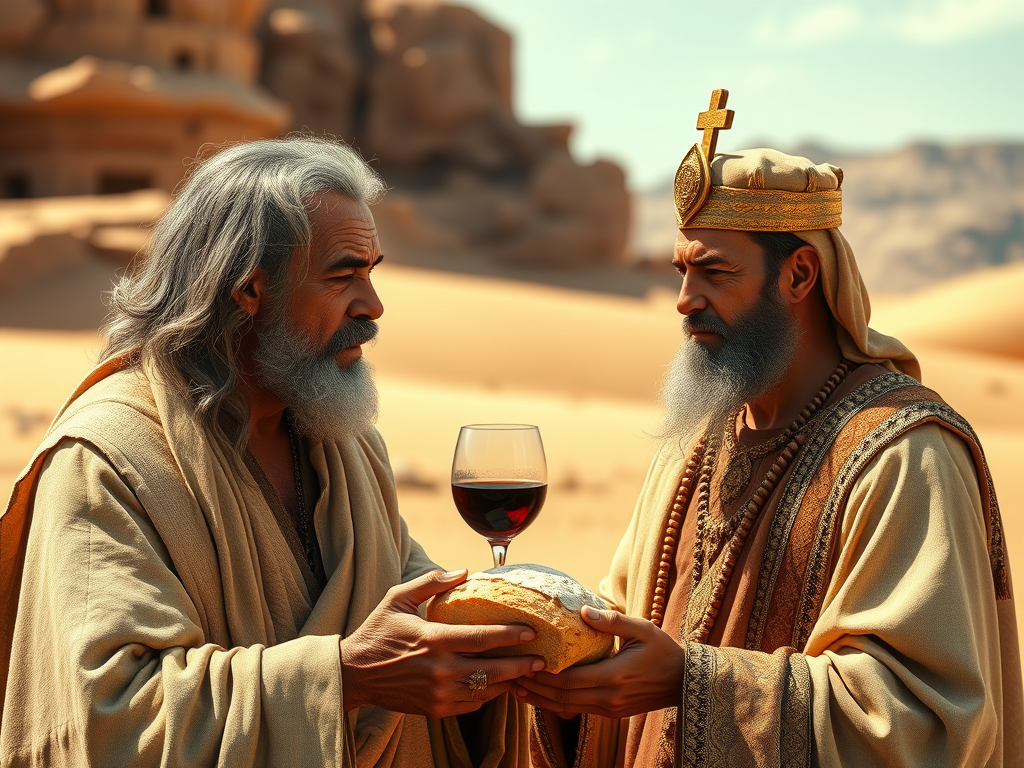
We first see the covenant meal between Abraham and Melchizedek. “Then Melchizedek king of Salem brought out bread and wine; he was the priest of Elohim Most High. And he blessed him and said: “Blessed be Abram of Elohim Most High. Possessor of heaven and earth; And blessed be Elohim Most High, Who has delivered your enemies into your hand.” Genesis 14:18-20. I would point out the beauty of Adonai’s prayer found in John 17. The whole thing is beautiful and revealing. An in-depth study reveals the vast richness of the heart of Elohim and His Son Yahoshua. One point I have tried to key in on is verses 17-19 “Sanctify them by Your truth. Your word is truth. As You sent Me into the world, I also have sent them into the world. And for their sake’s I sanctify Myself, that they also may be sanctified by the truth.” What is truth? “Your word is truth.” His Word, Elohim’s Word, is truth. 

When Paul wrote to Timothy he said something very important. “But you must continue in the things which you have learned and been assured of, knowing from whom you have learned them, and that from childhood you have known the Holy Scriptures, which are able to make you wise for salvation through faith which is in Christ Jesus. All Scripture is given by inspiration of God, and is profitable for doctrine, for reproof, for correction, for instruction in righteousness, that the man of God may be complete, thoroughly equipped for every good work.” (2 Timothy 3:14-17).

There isn’t a need for new revelation, or clarification in Paul’s writing to Timothy. He simply states, “continue.” What we need can be found in what has been provided. Anything that alters that course is as Paul writes, “But evil men and impostors will grow worse and worse, deceiving and being deceived.” This just before he says, “continue.” 

Gentlemen, I present my point simply. With the Tanakh, and specifically the Torah, I have all that I need to know, to grow and to be. There is nothing more required other than to believe, and to continue. I hope that your Thanksgivings are filled with family, friends, and the making of great memories.

You are loved, 
cj

Cultural Relevance vs. Biblical Accuracy in Modern Churches

Cultural Relevance vs. Biblical Accuracy in Modern Churches

It seems the more I look at the church today the more I come to realize one glaring point. The modern church here in the west is more concerned about cultural relevance than Biblical accuracy. If it were not so you could talk about Feast Days, Sabbath observance, and eating clean, without being ostracized. Unfortunately, it is true and anyone speaking of these things let alone observing them is immediately labeled, legalistic. As if to say a blatant disregard for the mosaic covenant is absolutely necessary for salvation.

We are heading into the “Holiday Season,” with its twinkle lights and mistletoe. It is a beautiful time of the year. It is marked by family gatherings, office parties, carolers, and holiday parades. The more society buys into the holiday magic, the more the church embraces the culture. I was listening to a ‘Christian’ radio station the other day and the DJ was all in on the holidays. It seems every year the decorations go up earlier. Halloween, begins in September. Hallmark no longer has the monopoly on Christmas in July and folks are setting up their trees November 1st. Thanksgiving? Sandwiched somewhere in there but mostly used to mark ‘Black Friday.’ A relatively new holiday masquerading as a day of discounts and bargains while revealing greed and selfishness.

The problem I see is that the church is more concerned about being cultured than they are about being Biblical. As I mentioned above even Christian radio is all in on culture. Want to decorate early? Go ahead! Want to have a Holy Ghost House, to counter the Haunted House? Go ahead! Want to brake out that elf on shelf in November? Go ahead! Don’t want to bake a turkey for Thanksgiving? Serve a ham instead! Are we really capable of justifying this blatant disregard for Yahweh’s word?

The argument is that the mosaic covenant is part of the Old Testament and we are living in the New. Really? What does that mean, exactly? Can you explain what repentance is necessary if the instruction of Yahweh is put away? Can you explain what it means to be lawless, from a biblical context? Are you prepared to explain the difference between righteousness and unrighteousness? What is the New covenant and how does it differ from the Old?

For too long now the church has ignored the appointed times of Yahweh, for its own traditions. It was this very act that got Israel labeled as an adulterous. It was their high places they set up. Their disregard of the Sabbath. Their lack of attention to the Feast Days. Their man made traditions in place of walking humbly with Yahweh. These things were the reason for their exile and subsequent scattering to the nations. Yet the church feels as though now, somehow, this doesn’t matter to Yahweh? Even though the Bible declares these things will be forever observed.

In fact, in the millennium. If the men do not come to Jerusalem for Sukkot, no rain will fall on their crops. Is Yahweh, messing with us? Is He forgetful of His own Word? No! And cursed is the man who says so. I have grown weary with the church. I have grown weary with my own soul. The battle inside me is a warring of the flesh and the spirit. My flesh wants to put up the tree, slice the ham, and do whatever my heart desires on the Sabbath.

The question is, do I want to worship Elohim? If so, I must do it in the spirit and in truth. I cannot lean on my own understanding but by every word of Elohim, live. If I love Him, I will obey His commandments. If I want to live in truth I must live in His word, for His word is Truth. Therefore, I honor the Sabbath day because Yahoshua honored the Sabbath day. I honor the Feast Days, because Yahoshua honored the Feast Days. I eat clean because Yahoshua ate clean. I do these things because Paul writes, imitate me as I imitate Messiah.

Over 80 times in the book of Acts the Apostles are recorded as honoring the Sabbath Day. Paul records his desire to be in Jerusalem for the Feast Days. Besides these things the Word says to honor them. It declares to the Israelite’s, “If you turn from doing your own pleasure on My Sabbath Day. If you call the Sabbath a delight . . . I will cause you to ride on the heights.” The Word declares that there is one instruction for the native and the foreigner.

Are we being called into lawlessness, and unrighteousness? No, by no means is this true. We are being called into instruction and into righteousness. Righteousness, those things commanded by Elohim to be obeyed by man. We are being called into the Way of the Rabbi. So then what is one to do? Act Justly, Love Mercy, Walk Humbly with Elohim. Put away mans traditions, and worship Elohim in Spirit and in Truth. Observe His Sabbaths and His Feast Days and Walk with Him.

This is the Way of the Rabbi,
You are loved,
cj

Navigating Deception in the Age of AI

Navigating Deception in the Age of AI

“Behold, the days are coming,” declares Yahweh Elohim, “When I will send a famine on the land – not a famine of bread, nor a thirst for water but of hearing the Words of Yahweh.” Amos 8:11

We are living in a time when wisdom and discernment are lacking. AI technology is advancing at such a rapid rate. The internet is now flooded with AI video’s nearly indistinguishable from the real thing. Unfortunately, a large swath of the population are being fooled into thinking they are real. It doesn’t stop there with advancement in Photoshop and AI people are posting fake social media posts. These posts appear to be real and from a famous person. When in fact it was designed in the basement of someone’s parent’s home or an office of government propaganda. People see the fake post, believe it, and re-post it. This distorts the truth, confuses the masses, and adds fuel to the fire of division.

AI has also entered academia and the professional worlds. Students are using it to write their papers and those seeking work are using it to create resumes. There isn’t a part of society it hasn’t infiltrated. To be transparent even i rely on AI to generate the cover photos for my posts. To say AI is entirely useless, or evil even, only makes one look a fool. However, one revealing fact of AI, it is robbing humanity of its creativity. Which is what makes humanity unique from all other life on earth. Well, besides the fact that we are created in the image of Elohim that is.

The AI phenomena is also making many a pastor lazy. One thing missing in our pulpits and society is a genuine desire to learn from Scripture. Rather, folks are content listening to regurgitated messages that tickle the ears but never challenge the heart. Because of this AI generated sermons are on the surge and they aren’t always biblical. Unfortunately, due to a lack of desire folks are not studying the Word on their own. Which lends to a persons inability to discern whether what they are being taught is true. It sounds good, so then it must be true, right? Wrong.

Deception is all around us and it is up to us to seek out what is true. Either, that or we will be swept away by it. The coming great deception, will fool many even those who may think they are prepared for it. Let’s examine a few passages of Scripture to make this point more clear.

Matthew 24:4 – Here Yahoshua warns the hearer not to be deceived. Don’t be led astray. Many will come in His name but we aren’t to listen to them or follow them. Who are those we aren’t to follow? Those that come in name only, they claim the name but not the lifestyle.

Mark 4 – The majority of this chapter is on parables with one underlying commonality, pay attention. The sower sows the seed. Some of the seed lands on good soil others in the rocks and on the path. It is up to the hearer to be good soil. Study, seek truth, become aware of Yahoshua’s lifestyle so that you can imitate Him. Many are called but few choose to be a part of the chosen.

Luke 8:18 – Living the light of Messiah. For if we do not seek truth, even what we think we might have or know, will be taken. There is coming a day of deception and it is upon us to know which voice to listen to. Which is of the Holy Spirit and which is of the desires of the flesh.

2 Thessalonians 2 – This chapter is entirely on not being deceived. Don’t fall for the lies of the enemy. He is coming, he will be lawless (without Torah) and he will lead many astray. In order to be a part of the remnant you must be aware and ready. Having enough oil in your lamp to get through the night.

The devil isn’t busting on the scene, the red-caped villain, the world thinks him to be. He won’t have the horns or the tail, but he will have charisma. He will come with promises of everything you dreamed of success and happiness. He will come with temptations of the heart and mind, like that of the fruit in the garden. It will be pleasing to the eye and your stomach will crave it. He will come, in fact he is already here and he is deceiving many. He has whispered in the ear of the believer that it is okay to partake in unrighteousness.

2 Thessalonians 2:11-12 – “Therefore, God sends them a strong delusion. So that they may believe what is false. In order that all may be condemned who did not believe the truth but had pleasure in unrighteousness.” Many believe this warning is for the unchurched, but it is not. It is a warning even to those who claim to be a member of the church. What is the description, ‘they took pleasure in unrighteousness.’ This is the Greek root word adikia, which is wickedness. Alternatively, it’s opposite is dikaiosynē. Both are descriptive of how one might treat the law of Elohim. One is seeking the Truth, what is Truth? Elohim’s Word is truth.

The interesting thing about the word dikaiosynē, is its definition. Simply, “Things commanded by Elohim to be obeyed by man.” So if we are being unrighteous, we are ‘Not doing the things commanded by Elohim. Can this be said of the modern Church? Well, do they observe the Sabbath? The Sabbath is commanded by Elohim. Do they observe the Feast Days? The Feast Days are commanded by Elohim. The debate comes down to what is Truth?

John 17:17 – “Set them apart for holiness by means of the truth — your Word is Truth.” So if His Word is Truth the question becomes am i being obedient? Think about what Yahoshua said. Matthew 15:8-9 – “These people honor me with their lips, but their hearts are far away from me. Their worship of me is useless, because they teach man-made rules as if they were doctrines.” Are we living in deception and can that be classified as unrighteousness? It certainly can if we know what we are doing is wrong. James 4:17. – “So then, anyone who knows the right thing to do and fails to do it is committing a sin.”

Deception is coming, great deception is coming, are you ready? Or are you already living in deception? The man of sin that is coming on the scene will be lawless (Torahless). What law will he be without? The law of Elohim. Which is the Torah, that is to say the instruction of Elohim. The things commanded by Elohim to be obeyed by man. i also lean towards best practice, and being open to correction. The quest is to live righteously. To that end, what is my motivation? It is to live a life pleasing to Elohim. What then is my part?

As Micah 6:8 says, “Act justly, love mercy, and walk humbly WITH Elohim.” He is walking in His Word, therefore, i want to walk in His Word. So every day the question i ask myself is, ‘How can i do better?’ Why? Because, i want to honor the words of my Messiah as He prayed for me. “I have given them Your Word, and the world hated them. Because they do not belong to the world — just as I myself do not belong to the world. I don’t ask You to take them out of the world, but to protect them from the Evil One. They do not belong to the world, just as I do not belong to the world. Set them apart for holiness by means of the truth — Your Word is Truth. Just as You sent me into the world, I have sent them into the world. On their behalf I am setting myself apart for holiness. So that they too may be set apart for holiness by means of the Truth.” John 17:14-19

His WORD is TRUTH,
This is the Way of the Rabbi,
You are loved,
cj

Examining Scriptural Authority in Modern Contexts

Examining Scriptural Authority in Modern Contexts

An on going email conversation with two Mormon Missionaries. Part 5. i encourage you to go back and read parts one, two, three, and four. Although, it isn’t absolutely necessary it would be beneficial.

my friends,

Let me begin by saying there is no need to apologize or explain any delay. This is the joy of email. We get to take our time. Allow life to happen around us while at the same time continue in dialogue.

Have you ever used the word love to express a feeling? For example, one might say, “I love taco’s.” Or “I love my wife.” Or “I love my kids.” Or “I love God.” A couple of points we would agree, all of these things are awesome. In English, we understand that in each instance what we mean by love is different in each of these circumstances. It is true that i love taco’s and i love my kids. However, i do not love them in the same way obviously. Of course my love for Elohim is beyond the limits of our English definition of love. English is a terrible language, it is full of inconsistencies. Partly because over time meanings have changed but also the English language is lacking in depth. 

For a time i taught 6th grade. During class one day we were having a discussion on classic works. We were reading as a class “A Christmas Carol,” by Charles Dickens. As well discussing classic Christmas songs. For the sixth grade mind this wasn’t too far a leap. In the discussion one of the kids genuinely asked, “Why are they putting on gay clothes?” There is a classic Christmas Carol wherein there is a line, “Now we dawn our gay apparel.” Thinking they were putting on flamboyant gay-pride sort of clothing. This allowed for the conversation on language evolution. Gay once meant happy, to be gay didn’t mean to be homosexual, but to be joyful. So context, culture, language, audience, these things matter.

More deeply let us consider the letter ‘J’. When originally introduced had a soft ‘Y’ sound like the Latin ‘J’ still has to this day. For example the name Juan still carries the soft ‘Y’ in its pronunciation. However, even here there has been an evolution of the ‘J’ from that found in ‘Wahn’ to ‘Hey’. It is why the Hispanic cultures pronounce Jesus, Hey-Soos. It is the evolution of language and it can be found in every tongue. Therefore, we must be careful when interpreting things to always go back to as close to the original as possible. Who was the intended target? What was the overarching context? What other words are used that may alter the meanings? How would the original hearers have received the information. Perhaps most importantly from Whom is the origin and what have we been told about Him?

For instance, in Hosea, a book of redemption. A call to repentance, to turn from doing your own way to following the Way of Adonai. We read, “Whoever is wise, let him understand these things; whoever is discerning, let him know them. For the ways of Adonai are right, and the righteous walk in them but the rebellious stumble in them.” Hosea 14:9

Without these steps we are guessing at meanings, applying modern understandings. Over simplifying or over complicating words and meanings. We must be intellectually honest with the text in order to truly understand its meaning. As you state, “So what matters is whether the man who translated it had authority from God to do so.” i would assert that the same intended original meaning, is the same intended meaning for today. For Elohim is the same, yesterday, today and forever. This is His nature, this is what He says of Himself. The origin of the written Word is the Word Himself.  

When talking about authority we must take into account all of this, culture, context, language etc. Who is authorized to speak on behalf of Elohim? Is precisely the point i am trying to make. “But even if we — or, for that matter, an angel from heaven! — were to announce to you some so-called “Good News” contrary to the Good News we did announce to you, let him be under a curse forever!” Galatians 1:8

In all of this what is the test? i would agree it is the Holy Spirits work within the believer to teach and lead in all righteousness. Yet still how do we test the Spirit as we are called to do? We test the Spirit by the Word. Did you know that within the pages of the Quran the reader is instructed to pray for wisdom? 

“My Lord, increase me in knowledge.” Surah Taha 20:114
“O believers! Seek comfort in patience and prayer. Allah is truly with those who are patient” Surah Al-Baqarah 2:153                                        
“Successful indeed are the believers: those who humble themselves in prayer” Surah Al-Mu’minun 23:1-2

We must be careful when instructing others to pray over material, books, writings, notes, even situations. “Stay sober, stay alert! Your enemy, the Adversary, stalks about like a roaring lion looking for someone to devour.” 1 Peter 5:8

“You believe that “God is one”? Good for you! The demons believe it too — the thought makes them shudder with fear!” James 2:19

The fact is that such men are pseudo-emissaries: they tell lies about their work and masquerade as emissaries of the Messiah. There is nothing surprising in that, for the Adversary himself masquerades as an angel of light; so it’s no great thing if his workers masquerade as servants of righteousness. They will meet the end their deeds deserve.” 2 Corinthians 11:13-15

Now the Bereans here were of nobler character than the ones in Thessalonica; they eagerly welcomed the message, checking the Tanakh every day to see if the things Paul was saying were true.” Acts 17:11

This brings me to your point of the Canon of Scripture. The council of Nicea was an abomination. They lacked authority and were lead by pagan “converts” lacking wisdom, knowledge, and integrity. i am sorry you miss understood my point about John and Revelation. Here i was simply trying to state that of all the writers of what we call the New Testament. Only John makes a reference to His letter being for all ages to the end. Not in so many words but the emphasis is there. My point, simply, that Matthew, Mark, Luke, Peter, James, Jude, even Paul himself didn’t write with the intention of Moses. In that what they were saying, wasn’t going to supersede the Torah or the Tanakh. They quoted from the Tanakh. In Acts we read, “On hearing it, they praised Elohim; but they also said to him, ‘You see, brother, how many tens of thousands of believers there are, and they are all zealots for the Torah.’” Acts 21:20

Peter actually speaks directly against the idea that Paul was somehow preaching against the Torah. He writes, “Indeed, he speaks about these things in all his letters. They contain some things that are hard to understand, things which the uninstructed and unstable distort, to their own destruction, as they do the other Scriptures.” 2 Peter 3:16

From this, how do we know one is truly walking in the Word? Anointed and worthy of listening? What are the fruits we are to look for? Yes, we can certainly see from ones life, are they a good person. But there are a lot of “good people,” doing a lot of good things, but they deny the Savior Yahoshua. Are these fruits still good to consume, when it comes to how to walk out a life of Faith in Messiah? No, even if we can learn from them on how to care for those around us. We aren’t to listen to them in matters of the Spirit and of Faith.

How do we know someone is walking with Elohim in order to avoid, confusion, contentions, and contradictions? Do they honor the Sabbath? In the book of Acts there are 85 references to the early believers observing the Sabbath Day. Do they honor the Feast Days? Paul in more than one letter talked about His desire to get back to Jerusalem to honor the Feasts. These are the marks of the followers of Elohim. To make this point further let me ask a question, what is sin? Based on the definition of sin, then what is repentance? What did Yahoshua mean when He said, “I am the Way, the Truth, and the Life, no one comes to the Father except through Me.”?

First, what is sin? For the simplest most straightforward answer we can look to John. John writes, “Everyone who keeps sinning is violating Torah — indeed, sin is violation of Torah.” 1 John 3:4 – Of course as i have stated in previous emails the word Torah is translated law. Most Bibles, of course, read “sin is lawlessness.” Truer yet, sin is Torahlessness. 

There are several references to the lawless one. Also known as the Anti-Christ. Anti or opposition/opposing. What law is he without? What law does he oppose? It isn’t the law of the land, it is indeed the Torah. He opposes Elohim and His Word, therefore he is referred to as Torahless or lawless. 

If we are to repent when we come into relationship with Yahoshua, what is it that we are repenting of? Sin? Which is? It is of course what John sights, “Sin is violation of Torah.” Yahoshua is said to be the Word made flesh. Another quote from John. He said, that He only speaks what the Father speaks and does what the Father does. John 5:19.

To close this point for now let me finish my thought with this quote of Yahoshua. “For if you believed Moses, you would believe me; for he wrote of me. But if you do not believe his writings, how will you believe My words?” John 5:46-47. This is the point. We only know sin by the Torah. We only know repentance, through Torah. You only truly understand Yahoshua through Torah.

When Yahoshua, made the statement that He was the Way, the Truth, and the Life. The hearers would have recognized the saying. For you see, the Torah was known as, The Way, Path, and Instruction. It was known as the Truth, “Your Word is Truth.” It was known as the Life, “Man shall not live by bread alone but by every Word of Elohim.” 

There is much more that can be said on this subject. However, this is also a good stopping point. 

If you are just joining the conversation, please go back and read parts one, two, three, and four. (links above in the introduction)

You are loved,
cj

Understanding Hebrew Roots and 7th Day Adventists

Understanding Hebrew Roots and 7th Day Adventists

An on going email conversation with two Mormon Missionaries. Part 1.

Greetings friends,

To the question of differences between the 7th Day Adventists and Hebrew Roots, I must clarify. i am neither but somewhere in-between. 7th Day’ers as well as most of modern Christianity, separate Elohim’s laws into categories. Whether it be the Moral Law, Ceremonial Law, or the Civil Law. Yet, unlike modern Christianity, they hold that all 10 commandments are to be observed. These commandments fall under the category of Moral Law. Whereas modern Christianity moves the observance of the 7th Day Sabbath. They use names like the Lord’s Day, 8th Day Sabbath, or Head of the Week. Likening it to the Head of the Church. Dependent only on how one might define their rebellion.

7th Day’ers also adhere to the dietary law, some in fact, hearkening back to Genesis and being vegetarians. However this is where the separation begins with the Hebrew Roots movement. The idea being found throughout scripture that the law applies to both the Hebrew and the foreigner living among them. In Romans it says that the Gentile is grafted into Israel. The Covenants made with Israel are “Forever”. Therefore one simply concludes that the gentile is to learn the way of the Hebrew. This of course presented in a nutshell, isn’t wrong in its understanding but begins to vary in its application. 

The monicker i choose to go by is Messianic, however this too is problematic at best. The original followers of Yahoshua were of course Talmidim, which is where we today get Disciples, they were students. The classification given to them early on was, “Followers of the Way.” These words are simply based on the very words of Yahoshua. He said, “I am the Way, the Truth and the Life. No one comes to the Father except through Me.” Of course we read in Acts that eventually they became known as Christians. Which if broken down means, little Christs. Why? They emulated or imitated Yahoshua closely. In an attempt to shame them, Christian was thrown around like a slur. 

But i am sure you don’t need a history lesson. The Hebrew Roots movements ultimate desire is to be like those early Christians. Those who so closely imitated Yahoshua they were called, little Christ (in the greek of course). Where i differ with the Hebrew Roots movement is they have gone back to Rabbinic tradition. If we are being intellectually honest, Yahoshua had a BIG problem with mans rabbinic tradition. As those traditions were used it to supersede the Torah and the Tanakh. Which is what Yahoshua kept pointing out to the Pharisees and the Scribes. This of course ruffled feathers. Do you like to be called wrong on something you have believed to be true for your entire life? Perhaps, not even to any fault of your own but simply what you have been taught? This is what Paul struggled with and even writes about in his letters.

You see, this is where i was and if i am being honest still am. As i learn more every day. Not only did i believe that i had it all figured out. i believed the way that i was taught was superior to others. We had the lock on truth. When in reality we were guilty of exactly the same thing the Scribes and the Pharisees were guilty of . . . mans tradition over the very WORD of YHWH. What are we called to do? How are we called to do it? How can we do some of these things given we are not in the Holy Land? What is important? What is useless? 

In the book of Ecclesiastes, Solomon writes, “When all has been heard, the conclusion of the matter is this: Fear Elohim and keep His commandments, because this is the whole duty of man. For Elohim will bring every deed into judgment, along with every hidden thing, whether good or evil.” (Ecclesiastes 12:13-14). Micah writes, “He has shown you oh man what is good and what does Adonai require of you. To do justly, love mercy, and to walk humbly with your Elohim.” (Micah 6:8). Paul tells Timothy, “All Scripture is breathed out by Elohim and profitable for teaching, for reproof, for correction, and for training in righteousness, that the man of Elohim may be complete, equipped for every good work.” (2 Timothy 3:16).

When Paul wrote those words somewhere around 66 AD (CE) the “New” Testament had not been compiled. Paul was referring to the Tanakh. He was saying all the information you need to teach the followers of the Way is this . . . the Torah and Tanakh. This scripture everyone loves to quote, but fail to recognize the implication. Just before this Paul writes; “But as for you, continue in what you have learned and have firmly believed, knowing from whom you learned it and how from childhood you have been acquainted with the sacred writings, which are able to make you wise for salvation through faith in Messiah Yahoshua.”

Do you hear what Paul was saying? All we need to know is found in the Torah, and the Prophets. Do i love the writings of the Apostles? Of course I do. They are explanations of how to live out this lifestyle known to them as “The Way”. This is the way to life. Do i believe they were inspired by Elohim to write them, without a doubt. Do i think they thought their writings would one day supersede those of the Tanakh? Heaven forbid! Without question they did not hold this view. In every letter they quote from the pages of the Torah and from the Prophets. This is where the Way is found. Not in man, not in his traditions. (Not that all of mans traditions are bad only when held in place of or above the WORD of Elohim). 

Satan has been creeping in since the garden, attempting to lead men astray. Even as recorded in 3 Nephi, “Now the cause of this iniquity of the people was this–Satan had great power, unto the stirring up of the people to do all manner of iniquity, and to the puffing them up with pride tempting them to seek for power, and authority, and riches, and vain things of the world.” (3 Nephi 6:15). If truth never changes, and Elohim is Truth, and if the Word points to the Torah and the Prophets. If John the Baptist declared, “Behold the Lamb of Elohim!” And John writes, “The WORD became flesh. . .” Should we not then be more concerned with this Truth over anything else man has produced? Even if led by Elohim to write? Since, He cannot contradict Himself. Rather, in the light of the Tanakh, read the Apostles and other writings from inspired men, even my own. 

This seems a good place to stop. i look forward to our continued discussion.

Keep reading – Part Two, Second Email Response

This is the Way of the Rabbi,
You are loved,
cj

Understanding Yahoshua’s (Jesus’) Teachings

Understanding Yahoshua’s (Jesus’) Teachings
Daily writing prompt
What’s something you believe everyone should know.

An on going email conversation with two Mormon Missionaries. Part 4. i encourage you to go back and read parts one, two and three. Although, it isn’t absolutely necessary it would be beneficial.

Greetings Elders,

First, thank you for your in-depth and thoughtful response. There is much we agree on but of course this discourse is intended to highlight our differences. This not to argue but to convince, in a debate of ideas and understanding. Is this not the concept of disciple making? To present truth in hopes that one receive it and choose it . . . the very idea of changing ones mind. To this i venture. 

A divergence of understanding appears to be in the idea of what was intended by the Sermon on the Mount. Although, i do agree it was to present clarity and a deeper understanding of how to live life. In my previous response i mentioned definitions for what i believe much of this debate hinges on these understandings. As you mentioned Yahoshua said, “Do not think that I have come to abolish the Law or the Prophets. I have not come to abolish them but to fulfill them.” (Matthew 5:17). – If we stop here, even with little understanding, we should be able to draw a conclusion. What Yahoshua intended the meaning to be.

Even more so, His audience who were mostly Jews of the tribe of Judah. As well, ‘Benjamites’ of the tribe of Benjamin. Of course, perhaps a remnant of the other tribes. Certainly some Levites, but at this time in history only the southern kingdom had been regathered after the Babylonian exile. As we would later read, Yahoshua says, that even those remaining would soon be scattered. So what was His intended meaning? To abolish is to eradicate, to do away with completely. Whereas, He did not come to do such a thing but to fulfill them. What fulfillment was necessary? The idea here is not fulfill in terms of ending them. 

As you quoted from Alma 34: 14. “And behold, this is the whole meaning of the law, every whit pointing to that great and last sacrifice; and that great and last sacrifice will be the Son of God, yea, infinite and eternal.” i would have to agree. Yahoshua is the perfect atoning sacrifice. This Atonement was necessary and did fulfill once for all the requirement of death for sin. It did not end the necessity for sacrifice altogether however, as i alluded to in my previous email. The sacrificial system will return during the millennial reign of Yahoshua. Why? Briefly so that i may make my point. The Levitical Priesthood will be reinstated and as we read in the Torah, the Levites were not to own land. They were not given a portion of the inheritance like the other tribes of Israel. Rather, within the tribes they were given homes. This was due to their intended purpose as priests and ministers. The sacrificial system was, of course, pleasing to Elohim. It also provided offerings to take care of the Levites with food and provisions. This again will be the case.

So back to the idea of fulfillment. If there is no temple and no Levitical Priesthood there is no opportunity for sacrifice. Nor is there a need to provide for a Levitical Priesthood within the realm of tribal land. So with this knowledge let us look at possible definitions for the term fulfill based on this context.

Fulfilled: “to fulfill” is used in Torah to reference sacrifice. In the context stated above this seems to correlate well with what Yahoshua was presenting. As John the Baptist declared on the shores of the river. “Behold the Lamb of Elohim, who takes away the sin of the world.” Further, a deeper examination of the word fulfill shows it means to “fill up.” It also means “to make full” or “to bring fullness.” If we were to stop at verse 17, these ideas might not work entirely by themselves. However, it doesn’t end with 17. Yahoshua continues; “For truly, I say to you, until heaven and earth pass away. Not an iota, not a dot, will pass from the Law until all is accomplished.”

Now in light of verse 18, the definition “to bring fullness” makes much more sense than to end. Here, accomplish, becomes the defining word of the statement, which is to say; “end of.” So what then defines accomplished? A new heaven and a new earth. To my knowledge this has yet to occur. Could we still debate the matter even in light of verse 18? Perhaps, if we wanted to argue semantics. However i feel verse 19 closes any such debate. “Therefore whoever relaxes one of the least of these commandments and teaches others to do the same will be called least in the Kingdom of heaven. But whoever does them and teaches them, will be called great in the Kingdom of heaven.” It seems quite clear to me, a westerner peering into a culture not my own. A simple graft into the natural branch as Paul writes in Romans. What is being communicated. 

With all of this, we must then take into account, who again was His intended audience at this moment? This will reveal even greater understanding as we listen with their ears. You see the Torah, was intended as a permanent covenant and the Sabbath as an eternal symbol of that covenant. (See Exodus 31:13 & 17). It was instituted not with the giving of the Torah but at creation itself. To do away with it would be to call Elohim a liar, heaven forbid we do such a thing. To say Yahoshua presented a different gospel message is to call Him a false prophet. A liar even, heaven forbid!    

Law: For further clarification our modern translations do humanity an injustice as they have translated Torah to Law when a more true definition of Torah is: Instruction, or Teaching and Instruction. So are we to say that YHWH’s teaching and instruction is done away with? By no means, may it not be so . . . Yahoshua brought depth of meaning and an exemplary lifestyle. To say it wasn’t possible to know all that would happen, cannot be said, for Yahoshua taught from the Tanakh. “And beginning with Moses and all the Prophets, He interpreted them in all the Scriptures the things concerning Himself.” Luke 24:27

Perfect Law: Regarding “Perfect Law” we can take from it the same principle as above and say, “Perfect Instruction.” When Yahoshua was confronted and asked, “’Teacher, what is the greatest commandment (OR instruction)?’ Yahoshua replied, ‘You shall love Adonai your Elohim with all your heart and with all your soul and with all your mind. This is the greatest and first commandment. And a second is like it: You shall love your neighbor as yourself. On these two commandments depend all the Law (Instruction) and the Prophets.” The response of the Pharisees and Scribes was one of acceptance. Why? Because it wasn’t new. Yahoshua was quoting from the Torah. He was in fact quoting from Deuteronomy 6:4-5. “Hear, O Israel:” This phrase in Hebrew is ‘SHEMA’ and it means ‘Hear and Obey’.

The whole passage here in Deuteronomy became known as the Shema, a daily prayer. “Hear and Obey, O people Israel, YHWH our Elohim, YHWH is one. You shall love YHWH your Elohim with all your heart and with all your soul and with all your might.” Although, this is where Yahoshua’s quote ends. We can conclude very reasonably that those hearing Him would have known the exact context of it. Continuing with verse 6-9. “You shall teach them diligently to your children. You shall talk of them regularly. When you sit in your house, when you walk by the way, when you lie down, and when you rise. You shall bind them as a sign on your hand, and they shall be as frontlets between your eyes. You shall write them on the doorposts of your house and on your gates.” 

There was nothing new being presented. Only a fuller understanding. You have been told My people how to live and how to worship and how to honor. Yahoshua adds to the answer to the Scribes and Pharisees. “And a second is like it: You shall love your neighbor as yourself. On these two commandments depend all the Law (instruction) and the Prophets.” Here Yahoshua draws from Leviticus 19:18. “You shall not take vengeance or bear a grudge against the sons of your own people, but you shall love your neighbor as yourself. I am YHWH.” This was surely a stinging rebuke to the Scribes and Pharisee. Who were not only jealous of Yahoshua’s following, but His command of Scripture as well. Are these perfect law? Yes, i would agree but they are not new revelations but a deeper, fuller understanding of Torah. It is why an understanding of Torah is absolutely necessary to discern what is truth and what is a lie. To see what has always been and what has been added or even removed.  

The Word made Flesh: The Apostle John writes, “In the beginning was the Word, and the Word was with Elohim and the Word was Elohim.” Later in the same chapter he writes, “. . . And the Word became flesh and dwelt among us.” Isaiah says, “. . . and they shall call His name Emmanuel, which is translated, ‘Elohim with us.’” Understanding this makes it difficult to believe that Yahoshua would change the character of Elohim. It also makes it difficult to believe that He would alter the instruction or nature of Elohim. The Psalmist writes, “The Torah of YHWH is perfect. It revives the soul. The testimony of YHWH is trustworthy. It makes wise the simple.” (Psalm 19:7). Yahoshua is recorded by John in Chapter 17 in what is known as the High Priestly Prayer. He says: “I have given them Your Word.” He then says, “Set them apart for holiness, by means of the Truth. Your Word is Truth.” The very idea that Elohim would change after chastising, rebuking, and exiling His set apart people is nowhere found in Scripture. Yahoshua came and said, and did, only what was instructed by the Father.

Contradiction: Clearly, as stated and presented here, there is no room for contradiction. If there is one present, there are only two conclusions. One, we have misinterpreted a passage or two, there is a false teacher/prophet spouting things they should not. i would continue but i fear to beat a dead horse.

i am sorry to hear of Elder –– departure i hope that all is well and it is not for any major concerns, health or otherwise. Will his email still be active? Corresponding with him and you via email would still be something i would hope to continue. 

Until the next . . .
You are loved,
cj  

Finding Strength in Brokenness: My Path to Healing

Finding Strength in Brokenness: My Path to Healing
Daily writing prompt
What have you been working on?

me. For years and years, i had believed it, it was my responsibility to work on other people. So much so, i neglected myself. In so doing, my life is tattered with failures and brokenness. In 2020, during a strange year in history, i made a series of poor choices. These choices led to the breaking of my marriage, family, and ministry. To top things off my mom passed away from colon cancer. It was rapid and felt like a whirlwind. my life was collapsing around me and it was now out of my control. A place i did not know, for i prided myself on being in control.

The only good thing is that i still had my relationship with Jesus. In all the brokenness, He never left, He never let go. In fact, He stirred me. He awakened in me a desire to know Him more intimately. This became my driving force. i sought him eagerly. A daily routine was made in which i started and ended my day with Him. my day was also filled with prayer, better yet, conversations with Jesus. In one of those mornings, i read Philippians 2:12. This wasn’t unfamiliar to me, i had read it many times, probably preached on it hundreds of times. It says: “Therefore, my beloved, as you have always obeyed, so now, not only as in my presence but much more in my absence, work out your own salvation with fear and trembling, for it is God who works in you, both to will and to work for His good pleasure.”

my ongoing conversation with God was, “What now, Lord?” “So now.” As i read this tears filled my eyes. It was as if the voice of the Lord was saying, “What now you ask? So now, obey my instruction. Even if you feel I am a million miles away, obey. Stop worrying about what others are doing and start caring about what you are doing. Work out your own salvation with Me. Learn what it is to love and to honor. What does fear and trembling mean to you? For it is ME who works in you and it brings Me great pleasure to so.”

This began my journey of working on me. In so doing i sought God through it all. Leaned on Him for understanding and wisdom. Putting behind me what i thought i knew and like a new born baby, craved the Word like milk. And the comforting presence of the Holy Spirit, like a mother’s embrace. The last five years have been, me working on me, with direction from the Word. It has lead me into discovering the Way of the Rabbi. It has stirred in me a desire to call Jesus by His given name, Yahoshua. To call the Father Yahweh. To refer to Him as Elohim, and Adonai. It has brought me to the Abrahamic covenant, the order of Melchizedek, to Moses, and the Way of the Rabbi. Yahoshua, the Word made flesh.

And now, i write about Elohim, working on me. To make me what He wants me to be and what i have learned along the way. In hopes that it inspires others. You even, who are reading this right now, to do the same. To “work out your own salvation with fear and trembling.” i invite you to join me on my journey, i call the Way of the Rabbi. You can read my transformation through the years. i hope that my working on myself, if anything, inspires you to work on yourself.

You are loved,
cj

Navigating Belonging: My Journey with Faith and Identity

Navigating Belonging: My Journey with Faith and Identity
Daily writing prompt
Tell us about a time when you felt out of place.

I feel out of place pretty much everywhere I go. The reality is I don’t know how to fit in! What does it look like? I try to be me no matter what is going on. Some would say that is boring and predictable, maybe. Yet, still, it is where I am most comfortable. Do I have my moments, surely I do. And, I regret them every single time. I try to learn from those experiences and hopefully not repeat them again. However, with all that, what really makes me feel out of place is my heartbeat.

I have a growing desire to live for Yahoshua, as He lived. Recently, I sat down with a couple of Mormon Missionaries. They had shown up at my door one evening that I was feeling particularly vulnerable for someone to talk to. This doesn’t happen often as I am a hermit by nature. A dwelling in the cleft of a rock or a tiny home in Alaska. All I would need is some food, a wood burning stove, some books and a typewriter. Leave me alone and GET OFF MY LAWN! Regardless, I invited them back to discuss faith and life.

Which they of course gladly accepted, although they pushed for it more than I offered. When they arrived I felt guilty as my intention was to put the smack down on their faith. You see, admittedly, at times I feel superior in knowledge. At other times I feel as if I know nothing at all. This is a big reason for feeling out of place everywhere I go. In the end, after they arrived and were seated, I confessed to them my previous intention. I gave them the history of my life. I then asked them where they were from and we parted ways with the idea of further communication via email.

The following is the my latest response to them regarding a question of differences. I am sharing it here to express my feelings of being out of place. Even in my journey of faith, I feel homeless. Even still I hope that this will inspire you to read, research, and explore. The idea of what is to walk, the way of the Rabbi.

Greetings Friends.
To the question of differences between the 7th Day Adventists and Hebrew Roots. i must before i dive into this answer state that i am neither but somewhere in-between. 7th Day as well as most of modern Christianity, separate Elohim’s laws into categories. Whether it be the Moral Law, Ceremonial Law, or the Civil Law. However, they differ from modern Christianity. They hold that all 10 commandments, which fall under the category of Moral Law, are to be observed. Whereas modern Christianity moves the observance of the 7th Day Sabbath to the Lord’s Day, 8th Day Sabbath, Head of the Week – Head of the Church, however, one might define their rebellion. 

7th Day’ers also adhere to the dietary law, some in fact, hearkening back to Genesis and being vegetarians. However this is where the separation begins with the Hebrew Roots movement. The idea being found throughout scripture that the law applies to both the Hebrew and the foreigner living among them. In Romans it says that the Gentile is grafted into Israel. The Covenants made with Israel are “Forever.” Therefore, one simply concludes that the gentile is to learn the way of the Hebrew. This of course in a nutshell, isn’t wrong in its understanding but begins to vary in its application. 

The moniker i choose to go by is Messianic, however this too is problematic at best. The original followers of Yahoshua were of course Talmidim, which is where we today get Disciples, they were students. The classification given to them early on was, “Followers of the Way.” Simply, based on the very words of Yahoshua, “I am the Way, the Truth and the Life, no one comes to the Father except through Me.” Of course we read in Acts that eventually they became known as Christians. Which if broken down means, little Christs. Why? Because they emulated or imitated Yahoshua so closely in an attempt to shame them, Christian, was thrown around like a slur. 

But i am sure you don’t need a history lesson. The ultimate desire of the Hebrew Roots movement is to be like those early Christians. These Christians so closely imitated Yahoshua that they were called, little Christ (in the Greek of course). Where i differ with the Hebrew Roots movement is they have gone back to Rabbinic tradition and well. If we are being intellectually honest, Yahoshua had a BIG problem with mans rabbinic tradition. They used it to supersede the Torah and the Prophets. Which is what Yahoshua kept pointing out to the Pharisees and the Scribes. This of course ruffled feathers. Do you like to be called wrong on something you have believed to be true for your entire life? Perhaps not even to any fault of your own but simply what you have been taught? This is what Paul struggled with and even writes about in his letters.

You see this is where i was and if i am being honest still am. As i learn more every day. i believed that i had it all figured out. i also thought the way that i was taught was superior to others. We had the lock on truth. When in reality we were guilty of exactly the same thing the Scribes and the Pharisees were guilty of . . . mans tradition over the very WORD of YHWH. What are we called to do? How are we called to do it? How can we do some of these things given we are not in the Holy Land? What is important? What is useless? 

In the book of Ecclesiastes, Solomon writes, “When all has been heard, the conclusion of the matter is this: Fear Elohim and keep His commandments, because this is the whole duty of man. For Elohim will bring every deed into judgment, along with every hidden thing, whether good or evil.” (Ecclesiastes 12:13-14) Micah writes, “He has shown you oh man what is good and what does Adonai require of you. To do justly, love mercy, and to walk humbly with your Elohim.” (Micah 6:8) Paul tells Timothy, “All Scripture is breathed out by Elohim and profitable for teaching, for reproof, for correction, and for training in righteousness, that the man of Elohim may be complete, equipped for every good work.” (2 Timothy 3:16) When Paul wrote those words somewhere around 66 AD (CE) the “New” Testament had not been compiled. Paul was referring to the Tanakh. He was saying all the information you need to teach the followers of the Way is this . . . the Torah and Tanakh. This scripture everyone loves to quote, but fail to recognize the implication. Just before this Paul writes, “But as for you, continue in what you have learned and have firmly believed, knowing from whom you learned it and how from childhood you have been acquainted with the sacred writings, which are able to make you wise for salvation through faith in Messiah Yahoshua.”

Do you hear what Paul was saying? All we need to know is found in the Torah, and the Prophets. Do i love the writings of the Apostles? Of course, I do! They are explanations of how to live out this lifestyle. Known to them as “The Way” this is the way to life. Do i believe they were inspired by Elohim to write them, without a doubt. Do i thing they thought their writings would one day supersede those of the Tanakh? Heaven forbid! Without question they did not hold this view. In every letter they quote from the pages of the Torah and from the Prophets. This is where the Way is found. Not in man, not in his traditions (not that all of mans traditions are bad only when held in place of or above the WORD of Elohim). 

Satan has been creeping in since the garden, attempting to lead men astray, even as recorded in 3 Nephi; “Now the cause of this iniquity of the people was this–Satan had great power, unto the stirring up of the people to do all manner of iniquity, and to the puffing them up with pride tempting them to seek for power, and authority, and riches, and vain things of the world.” (3 Nephi 6:15). If truth never changes, and Elohim is Truth, and if the Word points to the Torah and the Prophets; If John the Baptist declared, “Behold the Lamb of Elohim!” And John writes, “The WORD became flesh. . .” should we not then be more concerned with this Truth over anything else man has produced even if led by Elohim to write? Since, He cannot contradict Himself. Rather, in the light of the Tanakh, read the Apostles and other writings from inspired men, even my own? 

What are your thoughts? I would love to hear them. . .

This is the way of the Rabbi,
You are loved,
cj