From the back, the church lady clapped

And when He (Yahoshua) drew near and saw the city, (Jerusalem) He wept over it, saying, ‘Would that you, even you, had known on this day the things that make for peace! But now they are hidden from your eyes.’” Luke 19:41-42

Yahoshua, knowing the future fate of Jerusalem, wept for He knew what was to come of not only the city but those who dwelt within its walls. As we look out at humanity and those living without the knowledge or hope of the Savior we too should weep. Our hearts should break also for the faithful who have made poor decisions, struggled or stumbled. (Good Intentions) Yet, unfortunately the church is the first to pick up stones, to cast judgment, and to condemn. This should not be so.

The writer to the Romans points out in the twelfth chapter (16-21), “Live in harmony with with one another. Do not be haughty, but associate with the lowly. Never be wise in your own sight. Repay no one evil for evil, but give thought to do what is honorable in the sight of all. If possible, so far as it depends on you, live peaceably with all. Beloved, never avenge yourselves, but leave it to the wrath of Elohim, for it is written, ‘Vengeance is mine, I will repay, says YHWH.’ To the contrary, ‘if your enemy is hungry, feed him; if he is thirsty, give him something to drink; for by so doing you will heap burning coals on his head.’ Do not be overcome by evil, but overcome evil with good.”

Taking joy in another’s misery is not at all how Yahoshua lived. He wept over Jerusalem and their apathy. He knew their hearts. Elohim knows the heart; there is nothing hid from Him. We need to trust His judgment whether we see it or not and not weary ourselves. What we should be worried about is Matthew 25:31-46. The final judgment of Elohim where Yahoshua will separate the sheep and the goats, not the worlds definition of these two terms but Elohim’s. The world has inverted these two, they say it is bad to be a sheep and good to be a goat yet we are told here in Matthew the opposite. To the sheep He will say, “‘I was hungry and you gave me food, I was thirsty and you gave me drink, I was a stranger and you welcomed me, I was naked and you clothed me, I was sick and you visited me, I was in prison and you came to me.’ Then the righteous will answer Him, saying, ‘Adonai, when did we see you hungry and feed You, or thirsty and give You drink? And when did we see you a stranger and welcome You, or naked and clothe You? And when did we see You sick or in prison and visit You?’ And the King will answer them, ‘Truly, I say to you, as you did it to one of the least of these my brothers, you did it to Me.’” The goats will ask the same question but the answer they are given is that they did none of these to the least.

We must have the heart of Yahoshua, not the heart of Jonah. We must live from a place of forgiveness and compassion. The key to forgiveness is forgiving. We are instructed in Adon’s prayer, “and forgive us our sins, as we also have forgiven our debtors.” He expounds on this just a few verses later (Matthew 6:12, 14-15), “For if you forgive others their trespasses, your Heavenly Father will also forgive you, but if you do not forgive others their trespasses, neither will your Father forgive your trespasses.” It is from a heart of forgiveness that i try to live. It certainly isn’t easy, and i require constant reminders and patience in prayer to do so but it is my hearts desire to live in a place of forgiveness. It is foundational. And it is i believe wrapped up in the final statement of Yahoshua during His sermon on the mount.

Everyone then who hears these words of mine and does them will be like a wise man who built his house on the rock. And the rains fell, and the floods came, and the winds blew and beat on that house, but it did not fall, because it had been founded on the rock. And everyone who hears these words of mine and does not do them will be like a foolish man who built his house on the sand. And the rain fell, and the floods came, and the winds blew and beat against that house, and it fell, and great was the fall of it.” Matthew 7:24-27

Storms are nothing new to me, mostly of my own doing, even if stirred by others looking for lightning to strike me dead. If we do what was taught, then on the day when the trials or testing come, we can be confident our response will show a foundation built on the rock of Yahoshua. The other option, the sand of self-will and worldly wisdom, only leads to a total collapse. Our hearts are revealed in this matter as well when we look at the plight of others, even if the plight is self inflicted. The sting of the cheers is hurtful and heartbreaking. May our hearts align with Yahoshua, may we weep, and may we pray, and may we build upon the ROCK.

From the back, the church lady clapped.

You are loved,
cj

Christian (part five)

Christian (part five)

The current political and social climate is really rather dark. We can look at the latest news on any channel and it definitely seems as if the sky is falling. It doesn’t stop there either, there is a radicalization of both sides and a few in-between that are for a wild-west solution, “meet me in the street at sunset” or Old Testament solutions, “an eye for an eye” sort of solution. It has been quoted, “If they go low we kick them!” or “Chase them out of restaurants, form mobs around them!” Even, images of decapitated bodies, threats, bomb scares, fear-mongering, and bully pulpits are the norm. So how is a Christian supposed to respond? And how can you tell if one is truly trying to live the life of one?

Bless those who persecute you; bless and do not curse them. Rejoice with those who rejoice, weep with those who weep. Live in harmony with one another. Do not be haughty, but associate with the lowly. Never be conceited. Repay no one evil for evil, but give thought to do what is honorable in the sight of all. If possible, so far as it depends on you, live peaceably with all. Beloved, never avenge yourselves, but leave it to the wrath of God, for it is written, ‘Vengeance is mine, I will repay, says the Lord.’ To the contrary, ‘if your enemy is hungry, feed him; if he is thirsty, give him something to drink; for by so doing you will heap burning coals on his head.’ Do not be overcome by evil, but overcome evil with good.” Romans 12:14-21

There are several elements that we can take out of this passage. Let me highlight this one, “If possible, so far as it depends on you, live peaceably with all.” Here is the key, if possible. Let me stress that it will not always be possible to live peaceably as it takes two to bring peace. You can try until you are blue in the face but if the other does not want peace . . . what we do is, “leave it to the wrath of God.” In so doing we live the higher road, the one less traveled and puts us in a position of influence later on in that situation or in life.

Not only is this the command of God to us of the Way, but it also leaves justice to the one who judges righteously. When we live a life of love to those who persecute us we allow God’s Spirit room to move in our lives and their lives. It will be either a blessing or a curse depending on their openness. It will either bring goodness or “burning hot coals” and not like you might think but metaphorically speaking. God’s ability to bring wrath is greater than anything we could ever imagine so let us be about the task of love. Loving our neighbors. Loving those who spitefully use us. Love our enemies. Love our families. Love.

You are loved,

cj

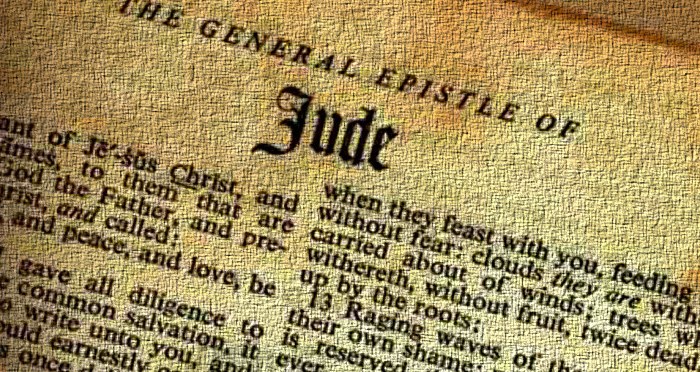
Jude (a final thought)

Jude (a final thought)

Let us consider for a moment, who was Jude? We know that from verse one he is the brother of James. We know of a few Jude’s in scripture, but only one who is a brother to James and that James was the half-brother of Jesus. Making Jude (a form of Judas) also a half-brother of Jesus. i didn’t mention this in the introduction because i didn’t want to influence your reading too much. i wanted you to go in and take each word without that influence because i think we have a tendency to over think things. Besides, i suppose there is some question as to whether or not it is true, i am of the camp that sees it as true.

Jude never mentions he is a brother of Jesus. Nor does James, rather, they identify themselves as bondservants. They had no special entrance into the Kingdom, they entered the same way you and i did/do, by faith in Jesus the Messiah. In fact, we can read that at one point Jesus’ family was not impressed by His declaration and thought maybe He had gone mad. They even tried to influence Him in Mark 3:31-32 we read, “And His mother and His brothers came, and standing outside they sent to Him and called Him. And a crowd was sitting around Him, ‘Your mother and Your brothers are outside, seeking you‘” Now it is unclear what their intentions were but many believe, as do i, that they were there attempting to “calm” Him down from His rhetoric because He was really beginning to stir the pot and bring shame in a sense to His family, “Is not this the carpenter’s son? Is not His mother called Mary? And are not His brothers James and Joseph and Simon and Judas (Jude)?” Matthew 13:55

Jesus’, response to them brings light to the nature of the Church. (Mark 3:33-35) “And He answered them, ‘Who are My mother and My brothers?’ And looking about at those who sat around Him, He said, ‘Here are My mother and My brothers! Whoever does the will of God, He is My brother and sister and mother.‘” Blood maybe thinker than water, but obedience to God’s will is paramount! Want to be included in the family of God? Be obedient to the will of your Heavenly Father. Jesus says, “If you love Me, you will keep My commandments.” (John 14:15 ESV) Later in that same chapter (v23-24) Jesus says, “If anyone loves Me, he will keep My word, and My Father will love him, and We will come to him and make Our home with him.  Whoever does not love Me does not keep My words. And the word that you hear is not Mine but the Father’s who sent me.” 

Jude came to faith after Jesus was resurrected, as did James. It is another, proof, if you will, of the power of the resurrection and the truth of it! God, shows no partiality and recognizes those who obey His word as, family. Which brings us back to the stern warning in the book of Jude. That judgment is real, and there will be some that scoff, even within the “Church” and they will bring division. It is a great introduction to the book of Revelation, which starts out with its own warnings to the Churches. Therefore the true believer is to, “build yourselves up in your most holy faith; pray in the Holy Spirit; keep yourselves in the love of God, waiting for the mercy of our Lord Jesus Christ that leads to eternal life. And have mercy on those who doubt; save others by snatching them out of the fire; to others show mercy with fear, hating even the garment stained by the flesh.” Jude 20-23 (All Bible references are from the ESV).

You are loved,

cj

Jude (Part 3)

Jude (Part 3)

We now find ourselves in a unique place in Scripture, the 14 verse of Jude 1. Here he references a Prophet named Enoch. We read of him in the old testament book of Genesis, the beginning. In Chapter 5 we read that Enoch was the seventh from Adam. He had children. He lived 365 years and “Enoch walked with God, and he was not, for God took him.” Enoch never died but was taken into heaven, there is only one other we know of who was taken to heaven before death, Elijah. In Jude, he quotes Enoch saying, “Behold, the Lord came with ten thousands of His holy ones, to execute judgment on all and to convict all the ungodly of all their deeds of ungodliness that they have committed in such an ungodly way, and of all the harsh things that ungodly sinners have spoken against Him.

Interestingly, there is a book of Enoch, it is not in the Canon of Scripture, never was, the Jews did not include it in their collection either. It wasn’t written by Enoch, best we know, although he was taken so, well you never know i guess. However, Jude thought so well of it that he quotes Enoch 1:9 in Jude 1:14-15. The writer of Hebrews also thought to include Enoch in his writing in Hebrews 11:5 all-be-it not as inclusive as Jude. Yet, here we are faced with the idea of Enoch and what or why did Jude include him in his warning? If you were to read Enoch in Chapter 1:2 you will see that the book is written for a generation yet to come, “…but not for this generation, but for a distant generation that will come.” So Jude taking this prophecy somewhat seriously to have included it in his writing to the Church.

The fear of the Lord is a real thing and in it, we must conclude that fear and respect, humility and self-control are absolutely required characteristics of the Church, and of the individual Christian. For here is the description of the other, “These are grumblers, malcontents, following their own sinful desires; they are loud-mouthed boasters, showing favoritism to gain advantage.” Jude 1:16

This is a difficult passage. Not because of its teaching, but because of its implications to the whole. Judgment, wrath, and doomsday are real ideas, thought so highly of by one of the Fathers of the Church that he writes a very poignant letter of warning. Should we not then take heed of it? Let us sit here, pray, listen, and wait for the Lord to reveal to us His truth.

You are loved,

cj