In the distance a man is stopped at a crosswalk. As he waits he reaches into his pocket and pulls out a pack of cigarettes and proceeds to light one. Touching it to his mouth he takes drag, as he exhales the light turns green and he enters the intersection. The smoke from his cigarette lingers briefly. When I reach the intersection, I catch a hint of its scent. Instantly, I am whisked away to places and times nearly forgotten, if not for these subtle reminders.
I walked into a used bookstore the other day. The musty smell of dusty books hit me. I pause, close my eyes and when I open them I am eight years old. It’s raining and the Burbank Public Library stands majestically between my school and my home. Rather, than continue home in the pouring rain I slip inside, the scent of the books hits me. I want to read, I want to read every book in that library. There is just one problem, I don’t know how. Whatever sort of learning disability I had growing up prevented me from doing the one thing I desperately desired. That day, I walked through the library, through the sense smell, it was like I was reading every page. Through my imagination the wonders unfolded with every turn.
Not long ago I made pumpkin pancakes. It was my mom’s recipe, although I am sure it’s not a secret, I tell no one. As I mix and pour I can smell the cinnamon and the nutmeg and the vanilla. my mom is there and she is humming a melody soft and sweet. “Then sings my soul. My Savior God to Thee. How great Thou art, How great Thou art.” The pancakes are ready and she burst into song to let the family know. “Oh I’m feeling mighty fine!“
“WELL, I WOKE UP THIS MORNING FEELING FINE. I WOKE UP WITH HEAVEN ON MY MIND. I WOKE UP WITH JOY IN MY SOUL. FOR I KNEW MY LORD HAD CONTROL. AND I KNEW I WAS WALKING IN THE LIGHT. FOR I’D BEEN ON MY KNEES IN THE NIGHT. AND I PRAYED ‘TIL THE LORD GAVE ME SIGHT AND NOW I’M FEELING MIGHTY FINE.”
Coffee is brewing, I can hear the water perking through the small black machine on my counter. The smell of the coffee fills the room and calls to my palate. The aroma stirs in me a passion for the day, for life even. I wait with anticipation, what will today bring? Whatever it is, I am sure of one thing. It will either whisk me away to a time long ago. Or it will plant a seed to be remembered years down the line.
Why do i choose to observe the Sabbath? The Feast Days? Eat Clean? Is it to be more holy than the next guy? No it is not. Is it because i think i am better than you? No, not by a long shot. Why do i seek to honor the Torah? i do it out of love for Adonai Yahoshua Messiah. His challenge to me, “If you love Me obey My commandment.” (John 14:15) In spit of popular belief He wasn’t talking about any new revelation but the revelation of Torah. Of which He is, the fullness of Elohim.
Many a doctrine is built upon the idea that the law has been done away with abolished. They talk about the new covenant in Messiah. They use verses like Romans 10:4 and say, “See, Jesus is the end of the law!” The more i study the more i realize how unprepared i truly was when entering ministry thirty years ago. i lacked the seriousness of understanding the original texts language and audience. What was being said, how was it being said, and to whom was it being said? These answers are necessary, for only then, can one truly know the depth of Elohim’s Word to us.
“For Messiah is the end of the law, to bring righteousness to everyone who believes.” Romans 10:4 ~
‘End’ in the Greek is Telos. Aristotle said, concerning mans final cause; “Everything has a telos, its final cause, which defines its nature.” Regarding ethics Aristotle said, “For humans, the telos, is living a virtuous life leading to flourishing happiness.”
Telos from the root Tello. Tello means: to set out for a definite point or goal. Telos although does mean end and has been used in termination. It is highly unlikely Paul was using it this way. Telos also means the end result of, it is used also in comparison, to which end. The end to which all things relate, commonality, custom.
Given the fullness of the definition we need to explore more the idea being presented in Romans 10:4. “For Messiah is the definite point of the law, to bring righteousness to everyone who believes.” Believes, is defined by action and activity not simply knowledge of for the demons believe and tremble. “For Messiah is the goal of the law, to bring righteousness to all who obey.” Law is Torah, it is better defined as the way, path or instruction. “For Messiah is the end result of the instruction for all who obey.” “For Messiah is the Telos of the Torah, to bring righteousness to everyone who believes.”
There is a reason Paul said, “Imitate me as I imitate Messiah.” For Messiah is our comparison of what it looks like to live out the Torah. It isn’t that Messiah ended the law but gave us a comparison. To walk out that which is commanded by Elohim to be obeyed by men. As Paul rights in Romans 2. “For it is not the hearers of the Torah who are righteous before God. No indeed, but it is the doers of the Torah who will be declared righteous.” Romans 2:13 ~ What is righteousness? It is things commanded by Elohim to be obeyed by man. Righteousness is obedience.
It is the mark of all those recorded in the Hall of Faith, found in Hebrews. “And it was accredited to him as righteousness.” What was? It was his faith that led to action and activity. It was Abraham taking Isaac to the mountain. It was Noah building a boat not knowing what rain was. It was Enoch living out daily obedience. “And without faith it is impossible to please God. For anyone who approaches Him must believe that He exists and that He rewards those who earnestly seek Him.” How does one earnestly seek Him? By obedience to His Word. “He has shown you owe man what is good and what does He require of you? To Act Justly, To Love Mercy, and To Walk Humbly with Him.” It is action and activity that reveals the heart.
Yahoshua said, “Take My yoke upon you, for My yoke is easy and My burden is light.” He is the Word made flesh. He is our Rabbi, Teacher, who declared, “I am the way, the truth and the life. No one comes to the Father except through Me.” The way, Torah. The Truth, Your word is truth. The Life, man shall not live by bread alone but by every word of Elohim. In other words, the only way to the Father is through the Word.
During the final scenes of this fallen world Revelation reveals the target of Satan’s wrath. “And the dragon was enraged at the woman and went to make war with the rest of her children. Those who keep the commandments of God and hold to the testimony of Yahoshua.” (Revelation 12:17) Two things to note here. First, they keep the commandments of Yahweh. Second, they hold to the testimony of Yahoshua. It isn’t those who seek righteousness within observance of Torah alone. It isn’t those who simply have an intellectual belief in Yahoshua. No, it is both and! “Who keeps the commandments and the testimony.” James puts it this way, “But be doers of the word, and not hearers only, deceiving yourselves.” (James 1:22)
The Word in every one of these instances is talking about the Tanakh. Yahoshua said, “On these two commandments you can hang the whole of Torah and the prophets. To love Elohim with all your heart, soul, mind and strength. The second is like it. Love your neighbor as yourself.” Action and activity. It is believing in something so passionately that you do all you can to obey.
When i was a teen growing up in the foothills of Southern California, life was much different than today. The most advanced gaming system was a Nintendo. VCR’s were in competition with Beta Players, and cassette tapes were the method of choice for recording music. We listened to the radio all day hoping they would play our song at least once. Where i lived, life seemed slower, and communal. It wasn’t perfect but it felt like home.
The place i lived was a campground and it had T-Shirts that said, “Follow me to Follows Camp.” We wore them proudly every Friday night. To the skating rink, football games, or wherever a Friday night adventure would take us. We were as a pack of coyotes, loyal to each other, protective even. If one of us was in danger, or needed help, we were there. i remember one time some vandals mistreated a part of the campground. We called it the Little “Chapel of the Canyon.” We came together and we repaired it, good as new. “Follow me” was more than a catchy phrase for the campground it was a rallying cry of the community.
It was 167 B.C. The Maccabees, lead by the Priest Mattathias, and his sons, the main one being Judas, led a revolt. For what reason? Against the decree by King Antiochus IV Epiphanes that band covenant worship of Yahweh. King Antiochus IV, forced Hellenization on all the inhabitants of Jerusalem. Along with the surrounding area, now under the control of the Seleucid Empire. He desecrated the Temple in Jerusalem by sacrificing a pig on the altar. He outlawed, Sabbath observance, eating clean foods, daily sacrifices, essentially anything to do with Torah. Instead, he implemented Greek idol worship and killed any who resisted.
The Maccabees, lead by Judas, an expert in gorilla warfare, put on their “Follow Me,” t-shirts. They led a seven year military campaign for freedom. This is the origin of Hanukkah. Once they took out the Seleucid Empire, they tore down the idols, the pagan altar’s, and restored the Temple. Hanukkah is known as the Feast of Dedication, they rededicated the Temple of Yahweh and restored covenant worship.
In life we need community. We need a pack. We need a cause. In Ephesians we read Elohim’s heart, through Paul’s hand, on the matter. “Therefore remember that formerly you who are Gentiles in the flesh and called uncircumcised by the so-called circumcision. That done in the body by human hands. — Remember that at that time you were separate from Messiah. Alienated from the commonwealth of Israel, and strangers to the covenants of the promise. You were without hope and without Elohim in the world. But now in Messiah Yahoshua you who once were far away have been brought near through the blood of Messiah.” (Ephesians 2:11-13)
Before we come into Messiah we are alienated from the commonwealth and the covenants. But once we enter through Messiah we join ourselves to the people of promise becoming one. As the letter to the Ephesians continues Paul writes about this truth. “There is one body and one Spirit. Just as you were called to one hope when you were called. One Lord, one faith, one baptism;one God and Father of all. Who is over all and through all and in all.” When we enter into fellowship with Messiah, we put on His clothes, His Follow Me t-shirts. As Paul also writes, “Imitate me as I imitate Messiah.”
What does it look like to be part of the covenants of promise? We need to read the Torah to find out. The entire volume of Messianic writings point to the Torah. Just as the Torah points to the Messiah. If you want the full communal experience, you must put on the fullness of truth, His Word is Truth! Unfortunately, not many religious leaders today believe this. Although, they say they believe in Jesus. They follow a misunderstood and twisted understanding of Paul’s writings. They don’t see themselves entering into the covenants of promise. Only that they will receive the promises based on the new covenant. Which if studied clearly say, that the new is simply the old written on the heart. It becomes a desire not a compulsion.
Instead of Hellenization like the Maccabees, it is assimilation. Rather, than standing out, they blend in. Instead of denouncing pagan traditions they sprinkle them into the churches. Instead of calling folks back to the covenants of promise, they tantalize people with empty promises. Why empty? Because the promises come in covenant. They come in obedience.
When the angel came to Mary to tell her she had been chosen her response teaches us a great truth. Belief is displayed in obedience. Luke records this encounter in which Gabriel, an angel of Yahweh, tells her she will give birth to the Messiah. Mary at first is frightened and confused but in the end she says, “I am the Lord’s servant,” Mary answered. “May it happen to me according to your word.” Yahoshua, Jesus, is birthed from the covenant of promise, and calls us back to it. “Yahoshua went on to say, ‘You neatly set aside the command of God to maintain your own tradition.'”
What traditions are in focus for you? Are you even seeking the Way? Yahoshua says to us, “Come and See,” He says to us, “Follow Me.” Who are you following? As for me, i will follow Yahoshua, the Way, the Truth, the Life, as He declared. The Word made flesh. Did you know that the Torah is known as The Way, Path, and Instruction? Did you know that the Torah, Elohim’s Word is called the Truth? Did you know that Life comes through every Word of Elohim? This is the Way of the Rabbi.
i want to be a man of virtue. – Moral excellence, goodness, righteousness. To conform my life and conduct to moral and ethical principles. To this end i will seek to achieve the virtue of knowing my weaknesses.
I haven’t always lived up to this virtuous standard. In fact, some might say the very opposite is true. Is it in my head? Perhaps. Some might say I need deliverance, from my thoughts, attitudes and false beliefs. This is probably true. However, as I continue to learn and grow, one thing stands out, it is never too late to change. Some people may never change their opinion of you, or me as this is about me, so be it. Their thoughts towards me (you) should not stifle us from reaching towards our goal. How the majority of people remember you can change today, with a change of heart. Like the book by Charles Dickens, “A Christmas Carol.”
Two verses I want to share here. The first is Micah 6:8. “He has shown you, O man, what is good. And what does Yahweh require of you? It is to act justly, to love mercy, and to walk humbly with your Elohim!” The idea of being or becoming a man or person of virtue begins here. Belief is more than knowing but doing. Scripture says, the demons believe and tremble, so if belief was all that was required they’d be in. No, belief requires action. It calls us to act justly. To love mercy. To walk humbly.
In the Christmas Carol, Scrooge, has spent his entire adult life acting unjustly, being merciless, and walking in arrogance. Charles Dickens walks his character first through his past. He does this to show that at one point he was a different person. Growing bitter, yes, but there was hope. The scene then changes to the now and he shows his character who he has become. This realization is difficult to take in at first. But necessary if one is going to change. Aton Chekhov, was a Russian play write. He wrote, “Man will only become better when you make him see what he is like.”
In the final attempt to change the heart of old Scrooge he is shown the future. It is the natural end of who he had become to that point. However, as Scrooge asks over and over, “these are only things that may come to pass?” He wanted another chance, he wanted to change, and he did. After the night was over he awoke a new man. One of justice, mercy, and humility. He became a man of virtue.
I was not visited by three ghosts but I have had the scales removed from my eyes. What was revealed was not who I ever wanted to be. Acting unjustly, without mercy, and in arrogance, “I am right and I will prove it!” If not for my hope in the gospel I would be lost. You see I believe in who many call Jesus, I prefer His Hebrew name, Yahoshua (Yeshua). It is in believing that I find strength for a new day, an evolving me. One who still has time to act justly, love mercy, and walk humbly with my Elohim.
To this end i know that there will be struggles and weaknesses revealed. That’s okay because i also now have the resolve to correct them. To seek advice from others and lean on them in times of struggle. It isn’t that i have to walk alone or even to have all the answers. Not knowing something isn’t a sign of weakness, however, pretending to know is. Failing, isn’t weakness, but giving up is. Therefore, i will continue to endeavor, to conform my life and conduct to moral and ethical principles. i will seek to achieve the virtue of knowing my weaknesses.
The second verse in two parts Philippians 3:12-14 and 15-16. “Not that I have already obtained all this, or have already been made perfect. Yet, I press on to take hold of that for which Messiah Yahoshua took hold of me. Brothers, I do not consider myself yet to have taken hold of it. But one thing I do! Forgetting what is behind and straining toward what is ahead. I press on toward the goal to win the prize of Elohim’s heavenly calling in Messiah Yahoshua.”
We are a work in progress. There will be good days and there will be bad ones. You cannot get hung up on either. Celebrate the victories, yes, but don’t dwell there. Be frustrated at the bad ones, yes, but don’t dwell there. Pick yourself up, dust yourself off, and move forward. Life isn’t a sprint, its a marathon, steady the legs and press on.
Let me conclude with this from Philippians 3:15-16. “All of us who are mature should embrace this point of view. And if you think differently about some issue, Elohim (God) will reveal this to you as well. Nevertheless, we must live up to what we have already attained.” So what do I hope people will say about me? That my belief in Yahoshua, guides my thoughts and actions. That I am a man of virtue. That I do justly, love mercy, and walk humbly with Elohim. This is the way of the Rabbi.
Luke 7:23 – Yahoshua said, “Blessed is the one who does not fall away on account of Me.” The word for ‘fall away’ is, skandalizō it is often translated, “offended by”. A deep dive into the definition reveals these facts. 1. It is a word that describes a stumbling block. 2. It is a word that describes an enticement to sin. 3. It is a word that describes one who becomes irritated at a thing it once found desirable. Yahoshua uses the term in a specific context. He was speaking to John’s disciples. In this context, we can see that ‘fall away’ is a better translation.
Why would Yahoshua be concerned that people would ‘Fall Away’ on account of Him? For this we need to understand what the people of Israel were expecting. In the Gospel of John 12:34 we get a clue. “The crowd answered, ‘We have learned from the Torah that the Messiah remains forever. how is it that You say the Son of Man has to be ‘lifted up’? Who is this Son of Man?‘” Their understanding was for the Messiah to come and rule in Jerusalem as King, reclaiming the Kingdom of Israel. Instead, Yahoshua went to the Temple and overturned the money tables.
Another aspect of the idea of falling away on account of Him, is perhaps, His direct challenge to the Pharisees. Yahoshua often challenged them calling them a brood of vipers, or white washed tombs. He did however, encourage His followers and the people in general to listen to them. For they sat in the seat of Moses. When they would teach in the Synagogue they would read from the Torah. It was this instruction they were told to listen to and obey. “Do as they say, not as they do.”
However, for us today I believe this carries a whole new meaning. One in which many fall away from observing Torah and reading the Tanakh. They twist Paul’s writings and minimize Yahoshua’s words, “IF you love Me, you WILL obey My commandments.” Christian’s today separate themselves from Israel as if the Kingdom of Elohim is divided. When in reality throughout the Scripture we read that the two people will become one. Ultimately, that one people will live with Yahoshua as King and we will observe the Torah.
John writes, “And everyone who has this hope in him continues purifying himself, since Elohim is pure. Everyone who keeps sinning is violating Torah – indeed, sin is violation of the Torah. You know that He appeared in order to take away sins, and that there is no sin in Him. So no one who remains united with Him continues sinning. Everyone who does continue sinning has neither seen Him nor known Him.” 1 John 3:3-6
Paul writes something similar, to the followers of the Way, residing in Philippi, regarding this pursuit of purification. “It is not that I have already obtained it or already reached the goal – no, I keep pursing it in the hope of taking hold of that for which the Messiah Yahoshua took hold of me. Brothers, I, for my part, do not think of myself as having yet gotten hold of it; but one thing I do: forgetting what is behind me and straining forward toward what lies ahead, I keep pursuing the goal in order to win the prize offered by Elohim’s upward calling in the Messiah Yahoshua. Therefore, as many of us as aer mature, let us keep paying attention to this; and if you are differently minded about anythings, Elohim will also reveal this to you. Only let our conduct fit the level we have already reached.” (Philippians 3:12-16)
This idea of progressing towards the goal is lost on modern Christians as they take Paul’s words and twist them. They also will point to the council in Jerusalem and their letter to the gentiles. A closer examination of that text will reveal that the council understood this pursuit. Paul captures in this letter to the Philippians, that it is ongoing. For reference let’s look at what the Jerusalem council said.
“Therefore it is my judgment that we do not trouble those who are turning to God from among the Gentiles, but that we write to them that they abstain from things contaminated by idols and from fornication and from what is strangled and from blood. For Moses from ancient generations has in every city those who preach him, since he is read in the synagogues every Sabbath.” Acts 15:19-21
Why such a short list? We hear Jame’s heart in the matter, “that we do not trouble those who are turning.” This was a step in the right direction. Let’s encourage them and not over burden them. Why? James continues, “For Moses from ancient generations has in every city those who preach him.” You see they expected that these new converts to the Way would hear Moses taught. Where? “Since he is read in the synagogues every Sabbath.” Not only did they expect them to hear the words of Moses taught. They also expected it to be done in the synagogues on the Sabbath. They knew that if they were genuine converts to the Way, they would continue to pursue their faith. And so they did!
There is not one instruction for the Gentile and one instruction for Israel. They weren’t to segregate. They were to merge and become one body of faith in Yahoshua Messiah. Israel isn’t to assimilate into the cultures around them. Why? Because they were outside of Torah. If gentiles come to faith in Messiah, they must eventually disassociate from pagan practices around them. Otherwise, they will have no part in the Kingdom. For the government of the Kingdom is Torah. Perhaps I will explore this more in future posts, stay tuned.
I have spent a good portion of my life living for tomorrow. Hoping that tomorrow will be brighter. Singing, “The sun’ll come out tomorrow, bet your bottom dollar that tomorrow, there’ll be sun! Just thinkin’ about tomorrow, clears away the cobwebs and the sorrow ’til there’s none! When I’m stuck with a day that’s grey and lonely. I just stick out my chin and grin and say: ‘Oh! The sun’ll come out tomorrow so ya gotta hang on ’til tomorrow come what may!’ Tomorrow, tomorrow! I love ya tomorrow! You’re always a day away!” (TOMORROW – Lyrics from Annie – C. Strouse/M. Charnin) Sadly, this is still true at times. It’s hard not to think about tomorrow. What will it bring, how will one get by never-mind survive?
In that time I have preached a number of messages on “Don’t worry about tomorrow!” With a scripture to match, Matthew 6:34. “Therefore, do not worry about tomorrow, for tomorrow will worry about itself. Today has enough trouble of its own.” Is hoping for, or planning for a better tomorrow bad? Not necessarily, only when it becomes the crux of who you are. Not only is the passage found in Matthew great advice it is medically proven. Those that live a life of worry don’t have to worry long because their lives are usually shortened. Stress, can reduce the quality of life, cause heart problems and countless other medical challenges.
I am not saying throw caution to the wind, by no means. What I am trying to say is live in the moments of life. Don’t judge a book by its cover, open it up and read it. Don’t judge a plate by its appearance, take a bite. (Although, it’s probably a good idea to judge a plate by its smell. Don’t eat garbage.) When life is hard. Take a breath. Listen. Listen to the birds, and the leaves rustling in the wind. Listen to the dog barking and listen to the people laughter in the distance. Life, is happening around you, embrace it. Step into it.
I have started to embrace the moments. I try to be present in every conversation. What is the other person saying? How are they saying it and why are they saying it? Listening to what they are saying is key to living in the moment. This creates a different problem, living in the past. Often we are so wrapped up in ourselves that when someone is speaking our thoughts are on our response. We are not truly listening if we are preparing our response. Nor rushing to tell someone of our own like experience, minimizing theirs. It’s hard to do. You hear someone tell a story, it reminds you of a personal experience, and you want to share. What’s wrong with that? Well, nothing really, if you do it having listened first. We don’t do much listening anymore. Everyone wants to talk, but no one listens.
We live in the past, we worry about tomorrow, we are dying in the present. What does Yahoshua teach? Well, in that same passage of Scripture from earlier, He says this: “But seek first the kingdom of Elohim and His righteousness, and all these things will be added unto you.” The instruction is easy to hear, easy to celebrate, easy to repeat, hard to live. What does it even mean to seek first the kingdom? In Adonai’s prayer He teaches us to pray, “Your kingdom come.” His kingdom, living in the moment, is about living in the Kingdom. Luke 17:21 says: “…Because, you see, the Kingdom of Elohim is among you.”
We are the light of the world as we live in the kingdom. We have love, joy, peace, patience, kindness, goodness, faithfulness, gentleness, self-control; against such things there is no law. Live in the moment. Love others. Sing for joy. Live at peace. Practice patience. Be kind. Be good. Be faithful. Be gentle. Have self-control. If you are in a gray period of life, know that just above the clouds the sun is shining. And if you are living in a dark place? Love harder. Sing louder. Choose shalom. Have patience. Be kinder. Be the good. Remain faithful. Be gentler. Pray for self-control.
I promise you, you don’t have to wait until tomorrow for the Kingdom of Elohim is among you. This is the way of the Rabbi.
Part 6 of my on going communication with two Mormon Missionaries. I don’t know how many more of these there will be as we keep circling the same ground. Yet, as long as they reply I suppose I will likewise. (You can read a part one, two, three, four, five)
Gentlemen, Thank you. I am feeling better. However, work has been a bit stressful of late. My time has been occupied with things that pay the bills but drain the soul.
I have no doubt that your prayers are sincere. I didn’t mean to imply otherwise. Simply my goal was to point out that although our prayers are sincere, deception is real. The devil prowls around like a lion seeking whom he may devour. We must diligently seek Truth through prayer and His Word is Truth. The difference that we have is what we consider His Word to be.
In Adonai’s prayer as you broke it down I would ask, what is the sin that we are repenting of? As you said, repent of all sins? What defines sin? Here I would like to point out that John defines sin in 1 John 3:4. “Whosoever committeth sin transgresseth also the law: for sin is the transgression of the law.” The law in reference here is Torah, sin is the transgression of Torah. It isn’t debatable it is indeed what John wrote.
We don’t differ on the significance of Yahoshua’s sacrifice either. It is absolutely necessary for salvation. Also, your understanding of the Passover and even Yahoshua’s time in Gethsemane, from what you state, we are similar. However, does this absolve us from obedience? Does it allow us to “do as thou wilt?” As the satanic bible declares will be the whole of the law? By no means. As you yourselves have stated we will know who belongs to the kingdom by their fruits. Our differences lie in what is the sign of good fruit? I say it is sealed by our partaking in the covenant. To put on the Sabbath like a wedding ring. The ring doesn’t save us but it shows the world to Whom we belong.
I would point out that the cup that Yahoshua prayed about was not a new revelation either. It was the cup of the adulterous bride that we read about in Numbers 5:11-31. The test of adultery of which the people of Israel were guilty. We as well, before coming into covenant relationship with Yahweh through the work of Yahoshua. He drank our cup, took our guilt and shame, bore our iniquity, that we might be forgiven and live.
There is no need to have deeper meaning within Passover if one truly understands Passover. Yahoshua, the Lamb of Elohim. The perfect sacrifice. We can debate the timing of the crucifixion. Some would say all took place according to the times set forth for Passover. That His death, and resurrection were indeed three literal days and nights. We read that the tomb was discovered empty in the early dawn of the first day. However, this doesn’t mean Yahoshua wasn’t gone long before. Perhaps arising just after sunset or at dusk at the end of the third day. Although, fascinating I don’t believe this is important to our discussion.
The deep seated importance and symbolism of the Passover was there all along and for all to see. Indeed Yahoshua Himself highlighted these things through out His ministry. And as previously stated, began with the proclamation of John the Baptist on the shores of the Jordan. He said, “Behold the Lamb of Elohim Who takes away the sin of the world.” The breaking of bread has its meaning, the cup in which they partook has meaning. But also there is the idea of the covenant meal. Some refer to this as communion, I did for so time, or the Lord’s Supper, the Eucharist, etc.
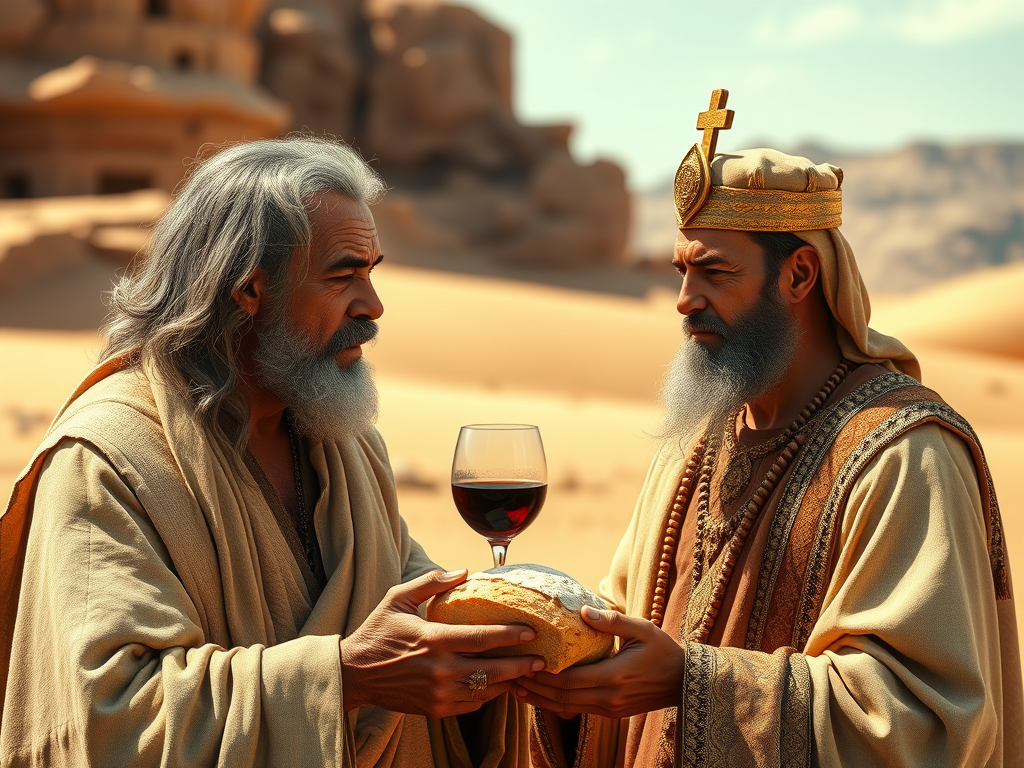
We first see the covenant meal between Abraham and Melchizedek. “Then Melchizedek king of Salem brought out bread and wine; he was the priest of Elohim Most High.And he blessed him and said: “Blessed be Abram of Elohim Most High. Possessor of heaven and earth; And blessed be Elohim Most High, Who has delivered your enemies into your hand.” Genesis 14:18-20. I would point out the beauty of Adonai’s prayer found in John 17. The whole thing is beautiful and revealing. An in-depth study reveals the vast richness of the heart of Elohim and His Son Yahoshua. One point I have tried to key in on is verses 17-19 “Sanctify them by Your truth. Your word is truth. As You sent Me into the world, I also have sent them into the world. And for their sake’s I sanctify Myself, that they also may be sanctified by the truth.” What is truth? “Your word is truth.” His Word, Elohim’s Word, is truth.
When Paul wrote to Timothy he said something very important. “But you must continue in the things which you have learned and been assured of, knowing from whom you have learned them,and that from childhood you have known the Holy Scriptures, which are able to make you wise for salvation through faith which is in Christ Jesus. All Scripture is given by inspiration of God, and is profitable for doctrine, for reproof, for correction, for instruction in righteousness,that the man of God may be complete, thoroughly equipped for every good work.” (2 Timothy 3:14-17).
There isn’t a need for new revelation, or clarification in Paul’s writing to Timothy. He simply states, “continue.” What we need can be found in what has been provided. Anything that alters that course is as Paul writes, “But evil men and impostors will grow worse and worse, deceiving and being deceived.” This just before he says, “continue.”
Gentlemen, I present my point simply. With the Tanakh, and specifically the Torah, I have all that I need to know, to grow and to be. There is nothing more required other than to believe, and to continue. I hope that your Thanksgivings are filled with family, friends, and the making of great memories.
It seems the more I look at the church today the more I come to realize one glaring point. The modern church here in the west is more concerned about cultural relevance than Biblical accuracy. If it were not so you could talk about Feast Days, Sabbath observance, and eating clean, without being ostracized. Unfortunately, it is true and anyone speaking of these things let alone observing them is immediately labeled, legalistic. As if to say a blatant disregard for the mosaic covenant is absolutely necessary for salvation.
We are heading into the “Holiday Season,” with its twinkle lights and mistletoe. It is a beautiful time of the year. It is marked by family gatherings, office parties, carolers, and holiday parades. The more society buys into the holiday magic, the more the church embraces the culture. I was listening to a ‘Christian’ radio station the other day and the DJ was all in on the holidays. It seems every year the decorations go up earlier. Halloween, begins in September. Hallmark no longer has the monopoly on Christmas in July and folks are setting up their trees November 1st. Thanksgiving? Sandwiched somewhere in there but mostly used to mark ‘Black Friday.’ A relatively new holiday masquerading as a day of discounts and bargains while revealing greed and selfishness.
The problem I see is that the church is more concerned about being cultured than they are about being Biblical. As I mentioned above even Christian radio is all in on culture. Want to decorate early? Go ahead! Want to have a Holy Ghost House, to counter the Haunted House? Go ahead! Want to brake out that elf on shelf in November? Go ahead! Don’t want to bake a turkey for Thanksgiving? Serve a ham instead! Are we really capable of justifying this blatant disregard for Yahweh’s word?
The argument is that the mosaic covenant is part of the Old Testament and we are living in the New. Really? What does that mean, exactly? Can you explain what repentance is necessary if the instruction of Yahweh is put away? Can you explain what it means to be lawless, from a biblical context? Are you prepared to explain the difference between righteousness and unrighteousness? What is the New covenant and how does it differ from the Old?
For too long now the church has ignored the appointed times of Yahweh, for its own traditions. It was this very act that got Israel labeled as an adulterous. It was their high places they set up. Their disregard of the Sabbath. Their lack of attention to the Feast Days. Their man made traditions in place of walking humbly with Yahweh. These things were the reason for their exile and subsequent scattering to the nations. Yet the church feels as though now, somehow, this doesn’t matter to Yahweh? Even though the Bible declares these things will be forever observed.
In fact, in the millennium. If the men do not come to Jerusalem for Sukkot, no rain will fall on their crops. Is Yahweh, messing with us? Is He forgetful of His own Word? No! And cursed is the man who says so. I have grown weary with the church. I have grown weary with my own soul. The battle inside me is a warring of the flesh and the spirit. My flesh wants to put up the tree, slice the ham, and do whatever my heart desires on the Sabbath.
The question is, do I want to worship Elohim? If so, I must do it in the spirit and in truth. I cannot lean on my own understanding but by every word of Elohim, live. If I love Him, I will obey His commandments. If I want to live in truth I must live in His word, for His word is Truth. Therefore, I honor the Sabbath day because Yahoshua honored the Sabbath day. I honor the Feast Days, because Yahoshua honored the Feast Days. I eat clean because Yahoshua ate clean. I do these things because Paul writes, imitate me as I imitate Messiah.
Over 80 times in the book of Acts the Apostles are recorded as honoring the Sabbath Day. Paul records his desire to be in Jerusalem for the Feast Days. Besides these things the Word says to honor them. It declares to the Israelite’s, “If you turn from doing your own pleasure on My Sabbath Day. If you call the Sabbath a delight . . . I will cause you to ride on the heights.” The Word declares that there is one instruction for the native and the foreigner.
Are we being called into lawlessness, and unrighteousness? No, by no means is this true. We are being called into instruction and into righteousness. Righteousness, those things commanded by Elohim to be obeyed by man. We are being called into the Way of the Rabbi. So then what is one to do? Act Justly, Love Mercy, Walk Humbly with Elohim. Put away mans traditions, and worship Elohim in Spirit and in Truth. Observe His Sabbaths and His Feast Days and Walk with Him.
When I was a boy, somewhere around eight, my family picked up for the summer and traveled the country singing. We sang in churches mainly, but some houses and a few lodges, being used as a church meeting place. my parents were both raised Christian. my dad’s dad was a Pastor and Denominational Leader. my mom was raised by an Uncle and Aunt. Her Uncle was a pastor. my parents met at a Christian Youth Camp. They would correspond for some time and eventually get together and marry.
When my parents began having kids of their own they vowed to raise them in the Church. And so they did. i am the youngest of three. One thing my parents were passionate about was singing. So it was natural for them to form a family singing group. We each participated in the singing ministry. my sister was the sound technician, running the sound board and mixer. my brother and i participated by singing. We both sang three songs, a solo, a duet together, and a trio with our dad. my brother had the better singing voice than i but we were all celebrated for our talents.
This was our parent’s faith, and it was fun growing up with it. We attended camps, retreats, Faith night at Disneyland, and Magic Mountain, both located in Southern California where we lived. We traveled the country visiting National Parks, museums, and family. Making new friends along the way too. It was a joyful upbringing. Yet, the faith of my parents was just that it was their faith. i understood little, and tried to understand less. The few times i expressed interest it was shortly extinguished by my response to peers or by Church leadership.
When i was in my early twenties, i experienced a low point in life. Until that point, it was the lowest. i found myself lost and alone. In a small prayer chapel of my youth i took refuge as an adult and there i encountered Yahoshua. This time for myself. Pouring over my life, my mistakes, and my beliefs i was prompted to read. I knelt at the altar and opened the Bible and found Philippians 3:12-14. It spoke to my soul. It reads:
“It is not that I have already obtained it or already reached the goal. No, but I keep pursuing it. In the hope of taking hold of that for which the Messiah Yahoshua took hold of me. Brothers, I, for my part, do not think of myself as having yet gotten hold of it. But one thing I do: forgetting what is behind me and straining forward toward what lies ahead. I keep pursuing the goal. That is, to win the prize offered by Elohim and the upward calling in Messiah Yahoshua.“
Here it was, my faith, my journey, my calling. Reaching out to me, in a moment of crises, was my Savior. He was saying, “get up, dust yourself off, I am here with you.” That is exactly what i did. my life hasn’t always been roses. i have screwed up more times than i would like to share. However, if you read through my blog you will get a glimpse. Each time I fall, He reminds me of this story, this encounter, this truth. He will never leave me nor forsake me.
Now, I write, not to give you my faith but to help you discover yours. This is the Way of the Rabbi. He shares with you the how and the why. Then He invites you to join Him. It is your choice, based on your faith, revealed by your action. For He has already demonstrated His.
Will you mess up, certainly, but He who calls you is able to complete the work He began in you. That is a promise. Won’t you start today your journey with Him?
“Behold, the days are coming,” declares Yahweh Elohim, “When I will send a famine on the land – not a famine of bread, nor a thirst for water but of hearing the Words of Yahweh.” Amos 8:11
We are living in a time when wisdom and discernment are lacking. AI technology is advancing at such a rapid rate. The internet is now flooded with AI video’s nearly indistinguishable from the real thing. Unfortunately, a large swath of the population are being fooled into thinking they are real. It doesn’t stop there with advancement in Photoshop and AI people are posting fake social media posts. These posts appear to be real and from a famous person. When in fact it was designed in the basement of someone’s parent’s home or an office of government propaganda. People see the fake post, believe it, and re-post it. This distorts the truth, confuses the masses, and adds fuel to the fire of division.
AI has also entered academia and the professional worlds. Students are using it to write their papers and those seeking work are using it to create resumes. There isn’t a part of society it hasn’t infiltrated. To be transparent even i rely on AI to generate the cover photos for my posts. To say AI is entirely useless, or evil even, only makes one look a fool. However, one revealing fact of AI, it is robbing humanity of its creativity. Which is what makes humanity unique from all other life on earth. Well, besides the fact that we are created in the image of Elohim that is.
The AI phenomena is also making many a pastor lazy. One thing missing in our pulpits and society is a genuine desire to learn from Scripture. Rather, folks are content listening to regurgitated messages that tickle the ears but never challenge the heart. Because of this AI generated sermons are on the surge and they aren’t always biblical. Unfortunately, due to a lack of desire folks are not studying the Word on their own. Which lends to a persons inability to discern whether what they are being taught is true. It sounds good, so then it must be true, right? Wrong.
Deception is all around us and it is up to us to seek out what is true. Either, that or we will be swept away by it. The coming great deception, will fool many even those who may think they are prepared for it. Let’s examine a few passages of Scripture to make this point more clear.
Matthew 24:4 – Here Yahoshua warns the hearer not to be deceived. Don’t be led astray. Many will come in His name but we aren’t to listen to them or follow them. Who are those we aren’t to follow? Those that come in name only, they claim the name but not the lifestyle.
Mark 4 – The majority of this chapter is on parables with one underlying commonality, pay attention. The sower sows the seed. Some of the seed lands on good soil others in the rocks and on the path. It is up to the hearer to be good soil. Study, seek truth, become aware of Yahoshua’s lifestyle so that you can imitate Him. Many are called but few choose to be a part of the chosen.
Luke 8:18 – Living the light of Messiah. For if we do not seek truth, even what we think we might have or know, will be taken. There is coming a day of deception and it is upon us to know which voice to listen to. Which is of the Holy Spirit and which is of the desires of the flesh.
2 Thessalonians 2 – This chapter is entirely on not being deceived. Don’t fall for the lies of the enemy. He is coming, he will be lawless (without Torah) and he will lead many astray. In order to be a part of the remnant you must be aware and ready. Having enough oil in your lamp to get through the night.
The devil isn’t busting on the scene, the red-caped villain, the world thinks him to be. He won’t have the horns or the tail, but he will have charisma. He will come with promises of everything you dreamed of success and happiness. He will come with temptations of the heart and mind, like that of the fruit in the garden. It will be pleasing to the eye and your stomach will crave it. He will come, in fact he is already here and he is deceiving many. He has whispered in the ear of the believer that it is okay to partake in unrighteousness.
2 Thessalonians 2:11-12 – “Therefore, God sends them a strong delusion. So that they may believe what is false. In order that all may be condemned who did not believe the truth but had pleasure in unrighteousness.” Many believe this warning is for the unchurched, but it is not. It is a warning even to those who claim to be a member of the church. What is the description, ‘they took pleasure in unrighteousness.’ This is the Greek root word adikia, which is wickedness. Alternatively, it’s opposite is dikaiosynē. Both are descriptive of how one might treat the law of Elohim. One is seeking the Truth, what is Truth? Elohim’s Word is truth.
The interesting thing about the word dikaiosynē, is its definition. Simply, “Things commanded by Elohim to be obeyed by man.” So if we are being unrighteous, we are ‘Not doing the things commanded by Elohim. Can this be said of the modern Church? Well, do they observe the Sabbath? The Sabbath is commanded by Elohim. Do they observe the Feast Days? The Feast Days are commanded by Elohim. The debate comes down to what is Truth?
John 17:17 – “Set them apart for holiness by means of the truth — your WordisTruth.” So if His Word is Truth the question becomes am i being obedient? Think about what Yahoshua said. Matthew 15:8-9 – “These people honor me with their lips, but their hearts are far away from me. Their worship of me is useless, because they teach man-made rules as if they were doctrines.” Are we living in deception and can that be classified as unrighteousness? It certainly can if we know what we are doing is wrong. James 4:17. – “So then, anyone who knows the right thing to do and fails to do it is committing a sin.”
Deception is coming, great deception is coming, are you ready? Or are you already living in deception? The man of sin that is coming on the scene will be lawless (Torahless). What law will he be without? The law of Elohim. Which is the Torah, that is to say the instruction of Elohim. The things commanded by Elohim to be obeyed by man. i also lean towards best practice, and being open to correction. The quest is to live righteously. To that end, what is my motivation? It is to live a life pleasing to Elohim. What then is my part?
As Micah 6:8 says, “Act justly, love mercy, and walk humbly WITH Elohim.” He is walking in His Word, therefore, i want to walk in His Word. So every day the question i ask myself is, ‘How can i do better?’ Why? Because, i want to honor the words of my Messiah as He prayed for me. “I have given them Your Word, and the world hated them. Because they do not belong to the world — just as I myself do not belong to the world. I don’t ask You to take them out of the world, but to protect them from the Evil One. They do not belong to the world, just as I do not belong to the world. Set them apart for holiness by means of the truth — Your Word is Truth.Just as You sent me into the world, I have sent them into the world. On their behalf I am setting myself apart for holiness. So that they too may be set apart for holiness by means of the Truth.” John 17:14-19
His WORD is TRUTH, This is the Way of the Rabbi, You are loved, cj
















 The Way of the Rabbi